Posted in 2020-2029, Film Review

Dune: Part Two (2024)

© Legendary Pictures and Warner Bros. Pictures

Dune: Part Two – Film Review

Cast: Timothée Chalamet, Zendaya, Rebecca Ferguson, Josh Brolin, Austin Butler, Florence Pugh, Dave Bautista, Christopher Walken, Léa Seydoux, Souheila Yacoub, Stellan Skarsgård, Charlotte Rampling, Javier Bardem

Director: Denis Villeneuve

Synopsis: After joining forces with the Fremen in the deserts of Arrakis, Paul Atriedes vows revenge on those who conspired against his family and murdered his father…

Review: “This is only the beginning”, as those words spoken by Fremen warrior Chani (Zendaya), with Hans Zimmer’s incredible score, rang in our ears by the conclusion of the first half of this adaptation of Frank Herbert’s revolutionary 1965 novel, it was a tantalising tease of what was to come. However, it might have all been for nought, as a second film was not guaranteed due to the decision to give it a simultaneous cinematic release and a day-and-date release on streaming. With a $400m haul at the box office (a mightily impressive feat given the pandemic) and viewed by 1.9 million households in the US on its opening weekend on streaming. The audiences spoke, as did the Academy with six Oscars, and the Spice Gods greenlit a sequel. After a few delayed release dates, the time has come to return to Arrakis, and  Denis Villeneuve has again defied the odds to deliver another magnificent demonstration of desert power.

Set immediately after the events of Part One, Paul Atreides (Chalamet) and his mother Lady Jessica (Ferguson) have fled to find shelter with the Fremen after his father Duke Leto and the majority of his House were murdered in a coup orchestrated by the villainous Baron Vladimir Harkonnen (Skarsgård) aided by the Sardaukar troops provided by the Emperor Shaddam Corrino (Walken). Though Paul is determined to get revenge, he initially opts to put this to one side and seeks to learn the ways of the Fremen to gain their trust as they see him and his mother as outsiders. Meanwhile, given her status as Bene Gesserit, the Fremen give Jessica an extremely important role within their community. While Paul learns the ways of the Fremen, the work of the Bene Gesserit has convinced some Fremen that Paul is the Lisan Al Gaib or “Voice from the Outer World”. This puts Paul in a moral quandary as to whether he is the prophesied messiah for the Fremen as he simultaneously continues to have horrifying visions for what the future might lead to.

Adapting the first novel in Frank Herbert’s legendary series was always considered to be an unfilmable task, just ask David Lynch. It just goes to show that betting against Denis Villeneuve is never a good idea because he thoroughly proved all the naysayers wrong. With seriously impressive world-building to give any epic franchise of the like a run for its money, Part One immersed the audience in this universe as if you were walking on the sand dunes of Arrakis themselves. However, this was a mere prelude for what Villeneuve and returning screenwriter Jon Spaihts have in store.

Part One walked so Part Two could, like a native Fremen, ride a sandworm in tremendous style. Across 165 spice-fuelled minutes, Villeneuve and Spaiths take all the world-building and the foundations laid by the first film and turbocharge them to deliver an equally epic, but considerably darker, emotionally charged and more action-packed second chapter. Alongside Paul learning the ways, and language of the Fremen, Chani and Paul begin to develop a romance and furthermore, all-out war between the Fremen and House Harkonnen as the former works to disrupt the latter’s spice production. On another side of the Universe, the Emperor’s daughter Princess Irulan (Pugh), who is also a disciple of the Bene Gesserit, begins to grapple with the consequences of the Harkonnen’s attack on the Atreides and the part her father played in engineering their downfall.

Despite the extensive and star-studded cast, such epic franchises can live or die based on the central character at the centre of this journey. Once again, Chalamet demonstrates why he is one of the finest actors of his generation as he gives what could well be a career-defining performance. Part One was very much about Paul striving to learn from leaders around him, such as his father and others he looked up to. Now, he is very much thrust into the spotlight of becoming not just a leader of the Fremen, but something much more. Chalamet magnificently balances Paul’s desire to lead the Fremen to victory against the Harkonnens, but also shows hesitancy to embrace the path that has been put at his feet by the Bene Gesserit. Fremen leader Stilgar (Bardem) is only too eager to believe this notion of a messiah, much to Chani’s chagrin. Zendaya is thankfully given much more to do this time around, beyond the extended cameo she had in Part One. The chemistry between her and Paul, like the dunes of Ararakis,  is scorching hot, though there is a lingering doubt in her mind as to whether Paul could be this messiah-like figure and if he is willing to embrace that destiny.

Like Gurney Halleck playing the baliset, there is not a false note in any of the performances. Though out of all the new cast members, the standout by far is the ruthless and psychotic Feyd-Rautha played by Austin Butler, another actor whose rise to stardom is also on an unstoppable trajectory. The perfection of the cast’s performances is matched by the incredible work of Villeneuve and his crew. Whether it’s the roar of the sandworms or the thrum of a thumper, the work of the sound design team makes you feel these sounds with maximum force, especially in IMAX. Likewise, Greig Fraiser’s cinematography be it the bright oranges of Arrakis deserts or the harsh black-and-white palette of the Harkonnen homeworld of Giedi Prime never fails to dazzle. The VFX work once again reinforces what happens when artists are given time to perfect their craft, and of course, Hans Zimmer once again delivers another impeccable and evocative score.

It would be easy to get lost down the wormhole of lore the film throws at the audience and while it does teeter on the brink of buckling under all of the weight of said lore, one cannot deny the spectacle and visual majesty of what Villeneuve has brought to the screen. Ever since he broke into the Hollywood mainstream – with a run stretching from 2013’s Prisoners to now –  each passing film has shown Villeneuve to be a master at combining emotional human struggles, with the sort of spectacle which is absolutely worth the price of a ticket and a reminder of the sheer power that cinema can have. Villeneuve has made no secret of the impact the novel had on him in his youth and one that also changed science fiction forever. In what is an already superb filmography, this magnificent two-part adaptation will (like its source material) stand the test of time, as one of the most epic sci-franchises ever and perhaps the pièce de résistance of Villeneuve’s mightly impressive filmography so far. Power over spice is power over all, indeed.
Building on the epic foundations laid by its predecessor, this magnificent sequel is another visually majestic reminder of the unstoppable force of desert power and the force of nature behind the camera that is Denis Villeneuve.

a

Posted in 2020-2029, Film Review

Dune (2021)

© Warner Bros and Legendary Pictures

Dune  – Film Review

Cast: Timothée Chalamet, Rebecca Ferguson, Oscar Isaac, Josh Brolin, Stellan Skarsgård, Dave Bautista, David Dastmalchian, Stephen McKinley Henderson, Zendaya, Chang Chen, Sharon Duncan-Brewster, Charlotte Rampling, Jason Momoa, Javier Bardem

Director: Denis Villeneuve

Synopsis: On the harsh desert world of Arrakis, the Atreides family are entrusted with the stewardship of the planet that is home to the most valuable resource in the world….

Review: When it comes to science fiction and fantasy storytelling, Star Wars and Lord of the Rings are two of the pinnacles of the genre, and have inspired generations of filmmakers and audiences. Yet, there is another body of work that is hugely influential to the genre. A story that featured a vast array of planets and civilisations, hailed by many as the greatest science fiction novel of all time. Now, in the hands of one of the finest directors working today, a new adaptation of Dune is here, and ready to win over a brand-new generation of fans.

In the far future, the most valuable resource is the spice Melange, harvested on the planet of Arrakis. For years, the planet and its people, the Fremen, have been under the brutal rule of the Harkonnens, who have ruled with an iron fist of fear. Now, it has been decreed that the planet, and the monumental task of mining the spice, will fall to the House Atreides, led by Duke Leto (Isaac). By his side, will be his son Paul (Chalamet) and Paul’s mother, the Lady Jessica (Ferguson), who belongs to a mystical order of powerful women known as the Bene Gesserit. There’s a lot of pressure on Paul’s shoulders, as the Bene Gesserit believe Paul could one day turn out to be the Chosen One.

Of course, this isn’t the first time that Frank Herbert’s novel has been adapted for the big screen. However, for reasons that are far too numerous to list here, David Lynch promptly disowned his 1984 adaptation upon release. Villeneuve has cited Dune as one of his favourite novels growing up, and from the very first minute, it is clear why he was the perfect director to helm this new adaptation. A glance at Villeneuve’s body of work has demonstrated his outstanding skill to bring jaw-dropping visuals to any story he directs, often in part due to astounding cinematography. While there’s no Roger Deakins behind the camera here, Greig Fraser is an extremely capable replacement. The gorgeous visuals are expertly combined with the sheer scale of this universe, and it is nothing short of epic.

Due to the extremely dense nature of the source material, it is a necessity for Villeneuve and writers Eric Roth and Jon Spaihts, to take their time. There is a staggering amount of existing lore and mythology to establish, as well all the various planets and Houses that exist within this story. It would be easy for any newcomers to get lost in the enormity of the world-building. Hence, the screenplay bides its time, and gives the audience ample opportunity to take everything in. The use of the practical, real life sets for the film’s production design, such as the immense Jordanian desert amplifies the impressive nature of the construction of this universe. As Villeneuve memorably said in an interview last year, “They didn’t shoot Jaws in a swimming pool!” The use of practical sets adds so much richness to the film and ultimately it makes it unlike anything that we’ve seen in this type of big-budget blockbuster filmmaking in a very long time.

At the centre of all this is Chalamet’s Paul. He’s an actor who has carved himself a career in a plethora of Indie films over the years. The central role in a gargantuan behemoth that is Dune, is quite the step up. However, he makes that transition into a leading man seamlessly. Ferguson as the Lady Jessica is a fierce and strong-willed woman. However, there is a vulnerability that she brings to the role as she is fiercely protective of her son and the gifts that he possesses. This adds considerable depth and nuance to the relationship between Paul and Jessica. Oscar Isaac brings a lordly aura to that of Duke Leto. Yet, despite his very many duties as the leader of a great House, he still exhibits warmth, especially where Paul is concerned.

Meanwhile, the characters of Jason Momoa’s Duncan Idaho and Josh Brolin’s Gurney Halleck, core components of the inner circle of House Atreides, are the notable standouts. Opposing the Atreides, is the ruthless House Harkonnen. Right from the moment they are introduced, they are instantaneously the foreboding and ominous threat that any film with such a richly developed universe, incomparable in its scope and majesty, requires. Furthermore, Stellan Skarsgård as the villainous Baron, is an on-screen presence that you will not be forgetting in a hurry.

Reuniting with Villeneuve after collaborating on Blade Runner 2049, there aren’t enough superlatives to describe just how special this score by Hans Zimmer really is. The true power of a good film score is how a single note can transport you into that world, and this score by Zimmer will take you back to Arrakis in an instant. While the cast are all phenomenal in their roles, given the obvious influences of Arab culture into the source material, it is disappointing that there is a distinct lack of MENA cast members present. However, as this film only represents one half of Herbert’s novel, a second part would give Villeneuve the chance to rectify that missed opportunity.

To give audiences one half of this incredible story, only to not tell the second half would be extremely disappointing. Sweeping epics like this seldom come around very often. Hence, the spice must flow sufficiently enough to ensure that second part will come to fruition, and not be something that will be swirling in our dreams from the deep forever more.

It was said to be unfilmable. Yet with a superb cast, incredible world-building and a sweeping and enthralling narrative, Denis Villeneuve has accomplished something truly special, and we’re only halfway through the story.

a

Posted in 2010-2019, TV Review

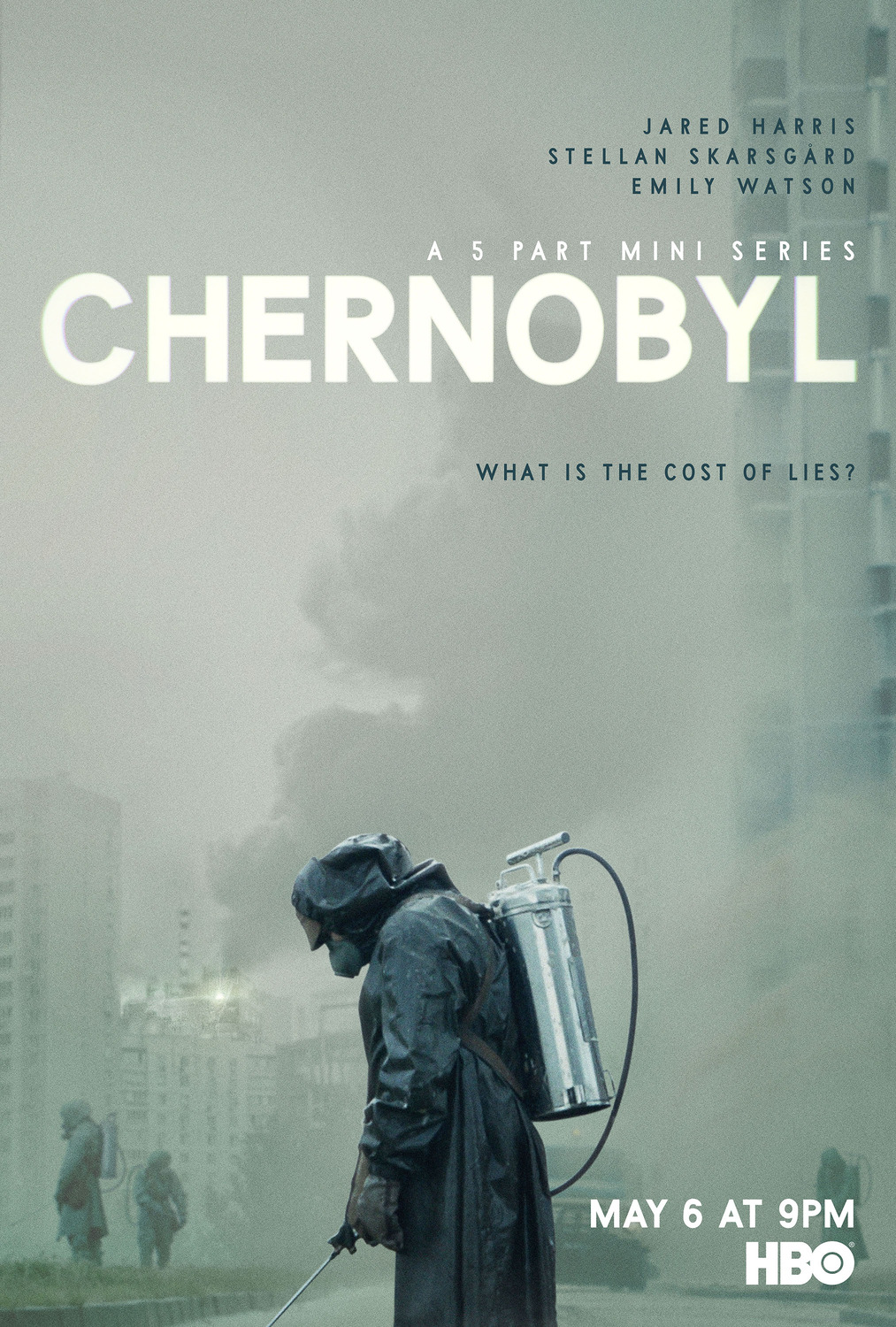
Chernobyl (2019)

Image is property of HBO

Chernobyl – TV Miniseries Review

Main Cast: Jared Harris, Stellan Skarsgård, Emily Watson, Jessie Buckley, Paul Ritter, Adam Nagaitis, Con O’Neill, Adrian Rawlins, Sam Troughton, Robert Emms, David Dencik, Alan Williams, Ralph Ineson, Barry Keoghan, Michael McElhatton

Showrunner: Craig Mazin

Synopsis: An account of the events leading up to the nuclear disaster at the Chernobyl Nuclear Power Plant, and the subsequent fallout of one of the deadliest man-made disasters in history…

Review: As human beings, our lives can so often be irreversibly impacted by natural disasters. Though we are powerless to prevent them from happening, preparations can be made to mitigate the damage and devastation that they leave in their wake. It’s a stark contrast to the numerous man-made disasters that we have seen throughout history, which have also had similarly deadly consequences. However, when you look at how the events transpired, it’s hard to overlook the fact that someone was responsible for allowing these atrocities to happen and how they could have very easily been prevented. One such disaster, arguably the worst man-made disaster in history, is that of the Chernobyl Nuclear Power Plant explosion. A tragedy of incomprehensible fallout, captured with horrifying realism in this tense and devastating HBO miniseries.

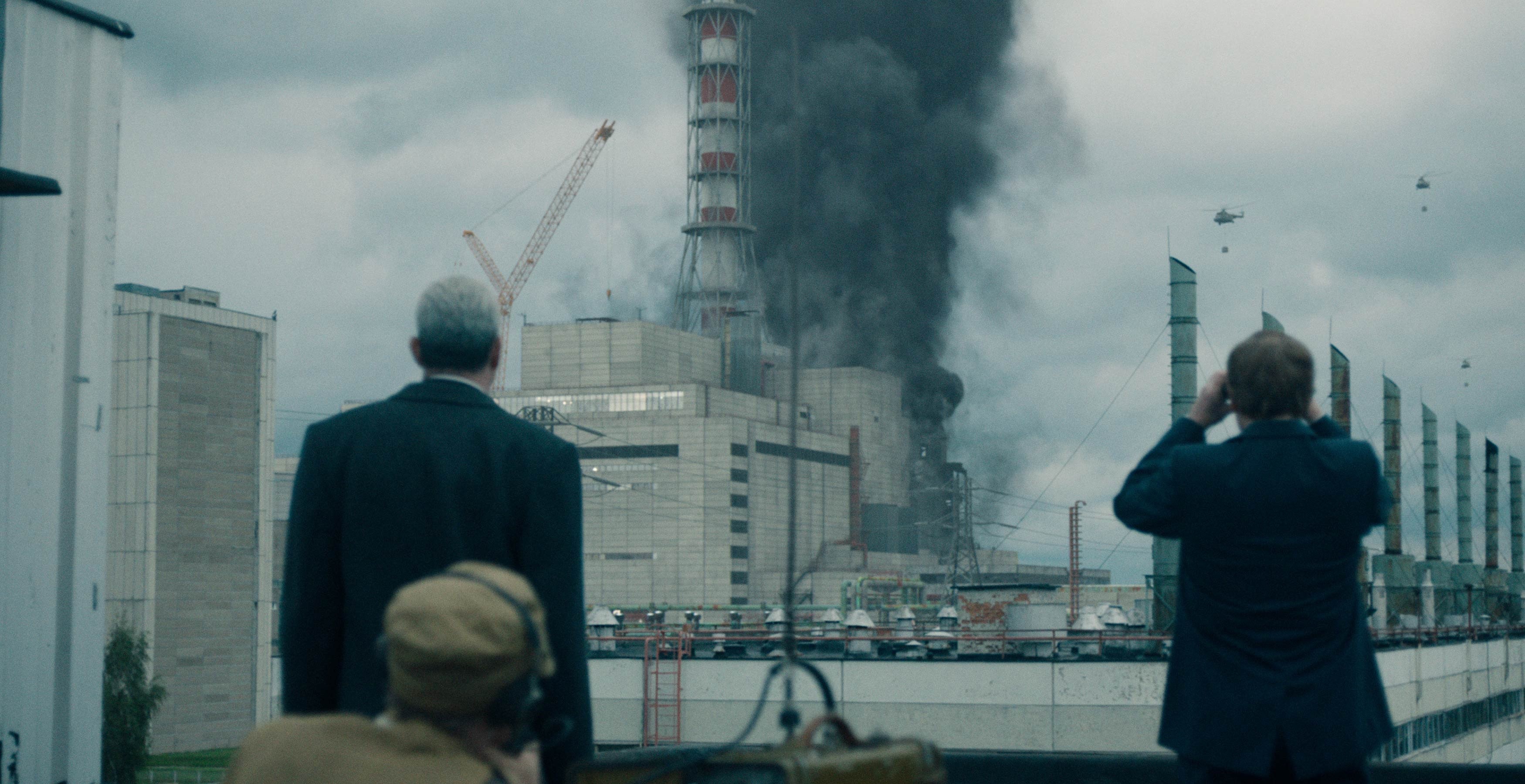
Over the course of five nerve-shredding episodes, showrunner/writer Craig Mazin and director Johan Renck explore the disaster and its horrific aftermath. Firstly, recounting the night of the deadly disaster and the catalogue of errors that led to the fatal explosion. Following on from that, looking at the attempts by the Soviet government to contain the fallout from the disaster. You watch with disbelief as they seek to prevent the already horrific situation from spiralling into something much worse, at times with shocking degrees of negligence and recklessness. Before ultimately trying to establish how such a nuclear catastrophe on this scale could have ever happened in the first place. At numerous points throughout the series, this feels more like a documentary. This is largely down to the expert production design, which recreates the power plant and the surrounding neighbourhoods, which feel remarkably authentic.

Irrespective of whether you’re coming to the series as someone who knows everything about the disaster, or if you know the barest minimum, Mazin’s scripts expertly combine informative scientific facts with intense and devastating drama. With each episode, it’s made painstakingly clear to us all as to the full extent of the horrific nightmare that was unfolding, enabling the audience to process just how an event like this could have ever happened. With the exception of a few artistic liberties, Mazin’s scripts faithfully recreate how events unfolded, and the excellent writing is brilliantly combined with Johan Renck’s masterful direction. Each episode expertly blends genres such as the intense drama and the traumatic horror of those who were the first to be affected by the radiation, to those who were recruited for some extremely perilous missions. Furthermore, the crackling sound of a dosimeter going haywire is so unnerving, it may well invade your nightmares.

With brilliant writing, combined with expert direction, and along with Hildur Guðnadóttir’s haunting score, every member of this cast delivers sublime performances. However, the three who shine the brightest are the three characters whose arcs are the pillars of this miniseries, the biggest of those belongs to Jared Harris, who is exceptional as Valery Legasov. Drafted in by the Soviet government to lead the efforts to mitigate the effects of the tragedy, he’s not afraid to speak up, and the people in charge just sweep everything under the rug. By his side, Stellan Skarsgard is equally tremendous as Boris Scherbina, a Minister whose relationship with Legasov is initially frosty to say the least. However, as the two men work closely together, to combat the scale of the disaster they’re dealing with, it strengthens their relationship immeasurably. Last and certainly by no means last is Emily Watson’s stirring work as Ulana Khomyuk. A composite character serving as the embodiment of the countless number of scientists who worked to uncover the full truth behind this unimaginable tragedy.

The show serves as a tribute to all those brave souls who risked their lives to prevent the catastrophe from becoming even more cataclysmic than it already was. However, the central theme that beats at the heart of this miniseries is the extremely damaging effect that lies can have when a country is in the grip of a catastrophic event like the Chernobyl disaster. In the wake of a deadly catastrophe that has wreaked unimaginable havoc, electing to cover things up with lies and misinformation may seem like a good idea at the time. However, as was the case with Chernobyl, these lies and misinformation came at a substantial cost, which is still being felt today. This is something that the governments of today could and should definitely learn from, especially at a time when a global health crisis of a very different nature is ravaging the world.

Sublime work from every aspect of the production ensures that this gripping and heartbreaking drama, like the disaster it depicts, will never be forgotten. An essential, definitive look at one of the worst man-made disasters in history. 

Posted in 2000-2009, Film Review

Pirates of the Caribbean: Dead Man’s Chest (2006)

Image is property of Walt Disney Pictures, Jerry Bruckheimer Films and Buena Vista Pictures

Pirates of the Caribbean: Dead Man’s Chest – Film Review

Cast:  Johnny Depp, Keira Knightley, Orlando Bloom, Stellan Skarsgård, Bill Nighy, Jack Davenport, Jonathan Pryce, Tom Hollander, Kevin McNally

Director: Gore Verbinski

Synopsis: Captain Jack Sparrow and the crew of the Black Pearl set sail in search of a chest that contains an item belonging to the ominous Davy Jones, but this item is also sought after by several other people, all of whom want this item for their own ends…

Review: Pirates, there’s something about these scallywags that cinema audiences certainly seem to like, and enjoy watching, as was evident by the phenomenal critical and commercial success that the first film in this franchise enjoyed. A sequel (or two, or three) was always going to happen. Sequels, however can be the equivalent of cursed treasure, in that if you get them wrong, it can place upon the preceding film a terrible curse that’s hard to shake off. Or it can be like finding a glorious stash of treasure that makes everyone rich and happy. In the case of Dead Man’s Chest, this is perhaps somewhere in between it’s not a curse, but it’s not a perfect stash of treasure either.

We begin when the wedding of Elizabeth Swann and Will Turner is rudely interrupted by Lord Cutler Beckett (Hollander) who’s after one man, yes Captain Jack Sparrow of course! After the latter was allowed to escape by the hands of Will, Beckett condems the bride and groom to be to the hangman’s noose. Jack meanwhile is desperately seeking to avoid the debt that he owes Davy Jones (Nighy) and so begins a spiral of events that stretch out this film’s run time to an incredible two and a half hours, that really really could have been trimmed down in one or two places.

Screenwriters Ted Elliott and Terry Rossio do ensure that there is some fun to be had of course, but there’s quite a lot of meandering as this ship steers its way through some very exposition filled waters that threaten to run the film aground. A common path for sequels to sail, is to make the tone that bit more darker, and this is the route that this film chooses to take, and in doing so much of the wackiness and the fun that the first film brought is replaced by a more serious ominous tone, though the film doesn’t lack some very entertaining sequences that returning captain Gore Verbinski helms to a similar standard as he did with the first film.

The ominous is perhaps best exemplified by Davy Jones, though we don’t find out much about him and why he looks the way he does. Nighy brings a very menacing presence, that is aided by some truly excellent CGI. Being in this creature’s presence could cause even the bravest of souls to quiver in fear.  Though the CGI for some of his crew aboard The Flying Dutchman is very obvious, it is for the most part very well done and the recipient of the Oscar for Visual Effects. Despite the meandering script, there are some rather splendid action sequences to enjoy, and the acting across the board remains at a solid standard.

Not someone you want to mess with…

With Depp again on splendid form as Captain Jack, and Orlando Bloom and Keira Knightley also in fine form reprising their roles as Will Turner and Elizabeth Swann. Newcomers Stellan Skarsgård and Tom Hollander give the most memorable performances of the newcomers as Will’s father Bootstrap Bill and the pesky Cutler Beckett.  It’s not the swashbuckling adventure its predecessor was, but there’s more than enough rum on this ship to ensure it has the right amount of wind in its sails.

A choppy plot, coupled with some clunky dialogue could have resulted in an unpleasant shipwreck, but an ample amount of fun action ensures it’s steered home to a satisfying conclusion.