Posted in 2020-2029, Film Review

The Fantastic Four: First Steps (2025)

© Marvel Studios

The Fantastic Four: First Steps – Film Review

Cast: Pedro Pascal, Vanessa Kirby, Ebon Moss-Bachrach, Joseph Quinn, Julia Garner, Natasha Lyonne, Paul Walter Hauser, Ralph Ineson

Director: Matt Shakman

Synopsis: On a retro-futuristic parallel Earth, the Fantastic Four must defend the world against the sinister planet-eating threat known as Galactus…

Review: In such a golden age for superhero storytelling as the one we’re currently experiencing, we have seen all manner of comic book characters successfully adapted for both the big and small screens, from the massive ensemble team-up films to the most obscure characters, who have since become household names. Yet despite numerous attempts, the Fantastic Four has never achieved such success. We have seen the fun but flawed movies of the noughties to the unmitigated disaster that was Fant4stic. You would have been forgiven for thinking that someone had placed a curse on Marvel’s First Family, that they would never get an adaptation that would do them justice. After having done such wonderful work with the first (and you could make the argument for the best) TV show in WandaVision, enter Matt Shakman to well and truly break clobber that curse.

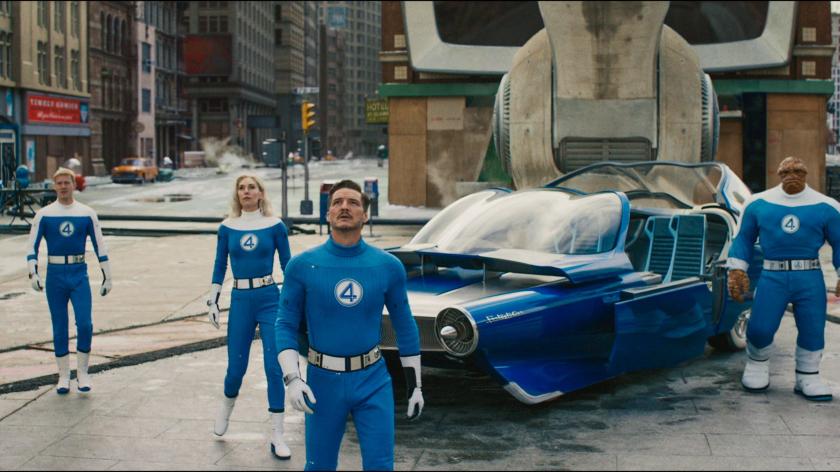
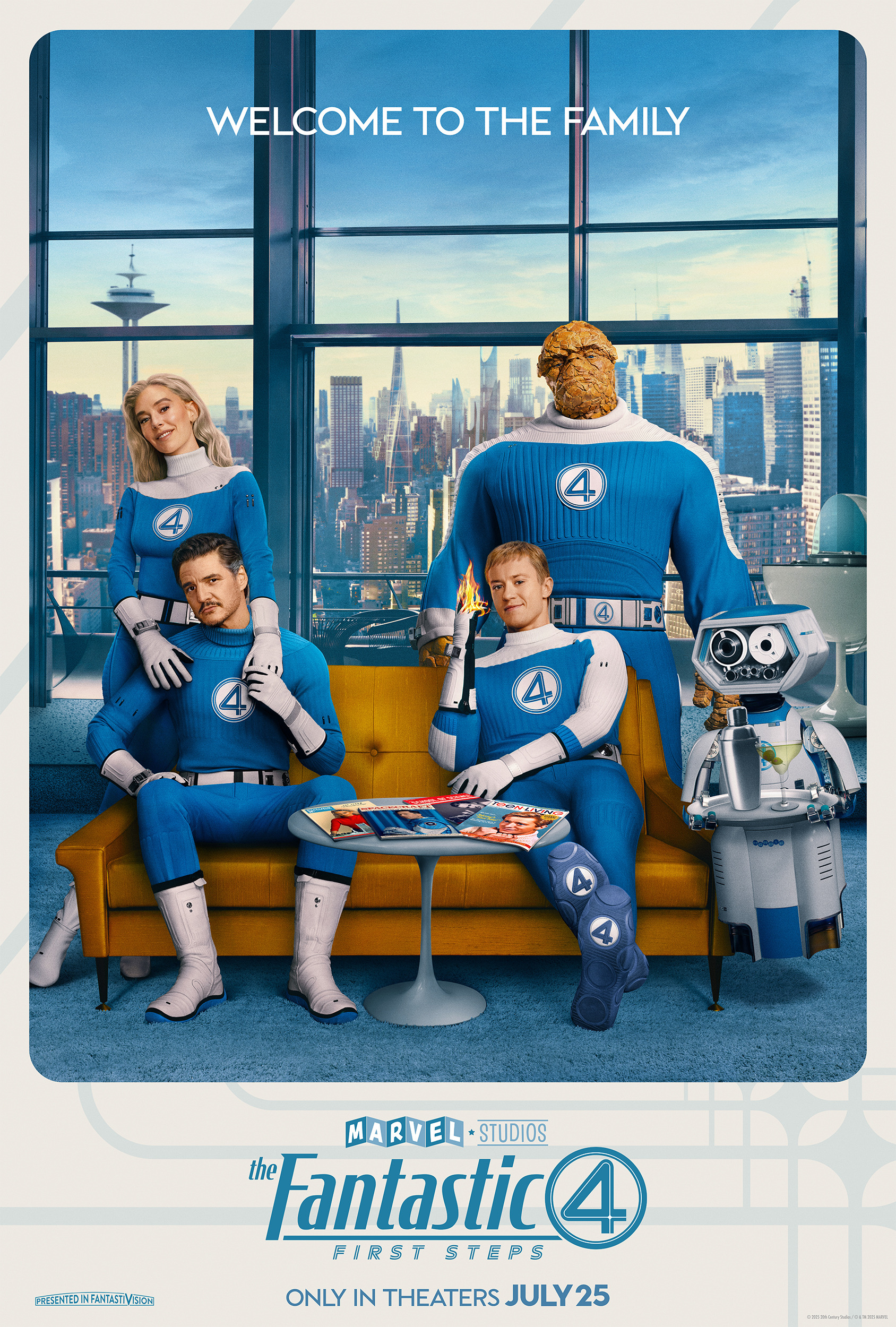
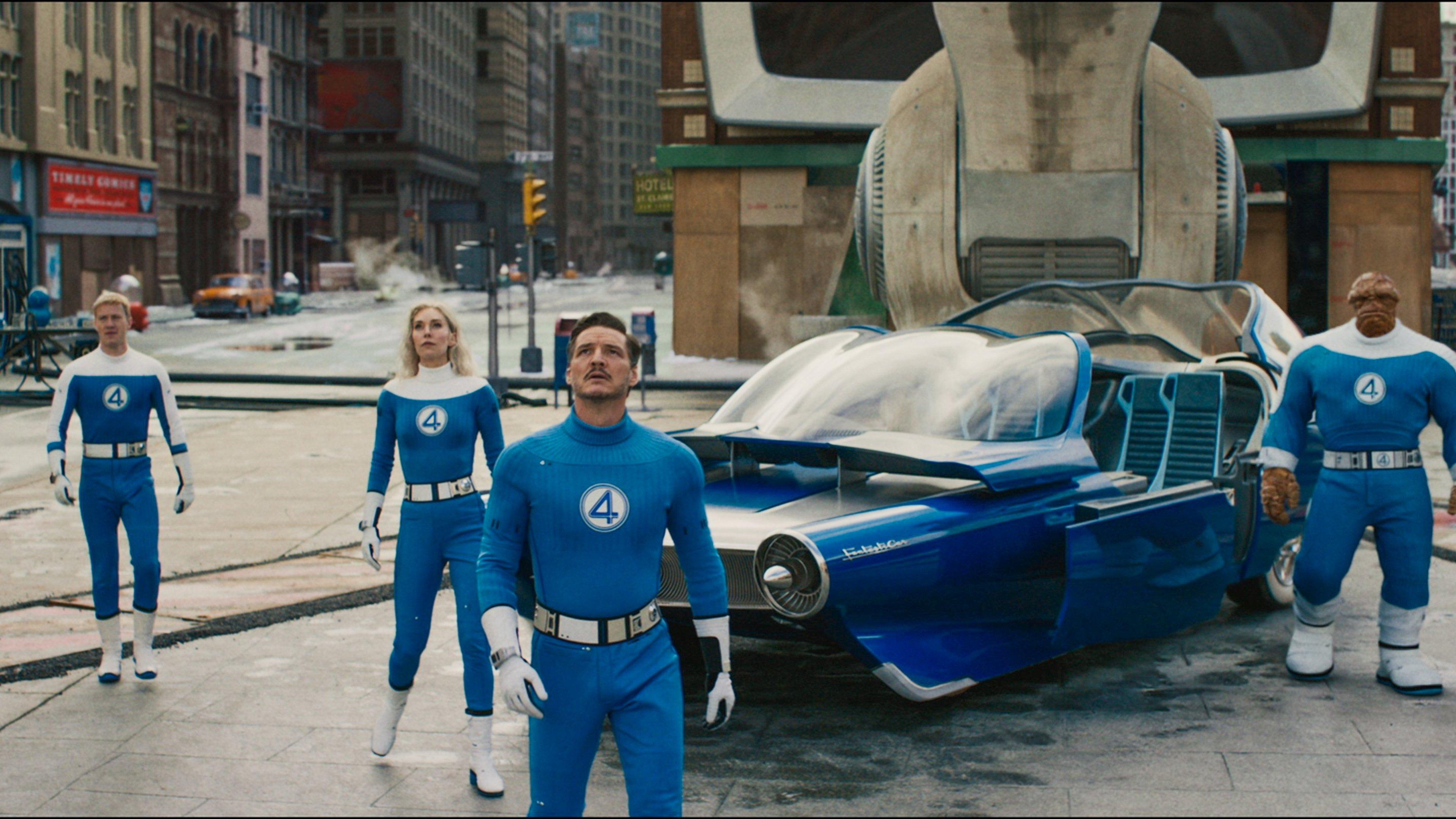
In a futuristic parallel world separate from the main Marvel timeline (Earth-828 to be exact) filled with advanced technology like flying cars and cool personal robot companions like H.E.R.B.I.E (an adorable scene-stealer), we learn through a series of newsreels it has been four years since our titular heroes blasted off into space on a mission where they were exposed to cosmic rays, which granted each of them superhuman powers. The supersmart Reed Richards (Pascal), who can stretch any part of his body, his brilliant wife Sue (Kirby) who can create force fields and turn invisible, Reed’s loyal best friend Ben Grimm (Moss-Bachrach) whose skin has been transformed into orange rock that grants him superstrength and durability. Last but certainly by no means least, Sue’s hot-headed brother Johnny (Quinn) can control fire and fly.

They are the planet’s sole protectors, and through their heroism, they have become celebrities whose ingenuity has enabled advances in technology and brought stability and peace to the world. With Reed and Sue preparing for the life-changing milestone that is parenthood, the four of them must deal with the arrival of the Herald, the Silver Surfer (Garner) who tells them their planet is “marked for death” with the impending arrival of the planet-eater Galactus (Ineson).
After a Phase Five that had some high points and arguably the lowest of the lows for the franchise (looking at you Quantumania), it makes sense to begin Phase Six with something of a reset and to establish Marvel’s first family in their own universe before their world collides with the main timeline as we know it. The script by Josh Friedman, Jeff Kaplan, Eric Pearson and Ian Springer keeps things focused squarely on the quartet and their dynamic, with no chance of any other superhero crashing into this world. There will be plenty of time for that in future Phase Six films. Having seen the origin story done before in the Fox era films, the decision to quickly bypass this allows the film time to explore Reed and Sue’s loving relationship, the camaraderie/playful banter between Johnny and Ben, and indeed, the togetherness and warm family embrace between the entire team is sincere and genuine.

With such pitch-perfect chemistry between the team, it’s a credit to the casting director that they absolutely nailed each casting choice (hurrah that the Oscars will at long last be giving these people their dues in next year’s ceremony). Pascal, continuing his bid for cinematic domination, expertly balances Reed’s intelligence and scientific nous while preparing for the enhanced responsibility of becoming a father. Moss-Bachrach’s Ben, despite his hard-as-rock exterior, comes off as very kind and gentle, particularly when demonstrating his strength to a group of schoolchildren. Quinn as Johnny exudes charm and charisma in flaming abundance. However, the MVP of the team is unquestionably Kirby’s Sue. A woman balancing impending motherhood, a heroic feat of endurance in itself, but all while leading diplomatic efforts on the international stage. This, combined with the true power she possesses, means she is a force to be reckoned with.
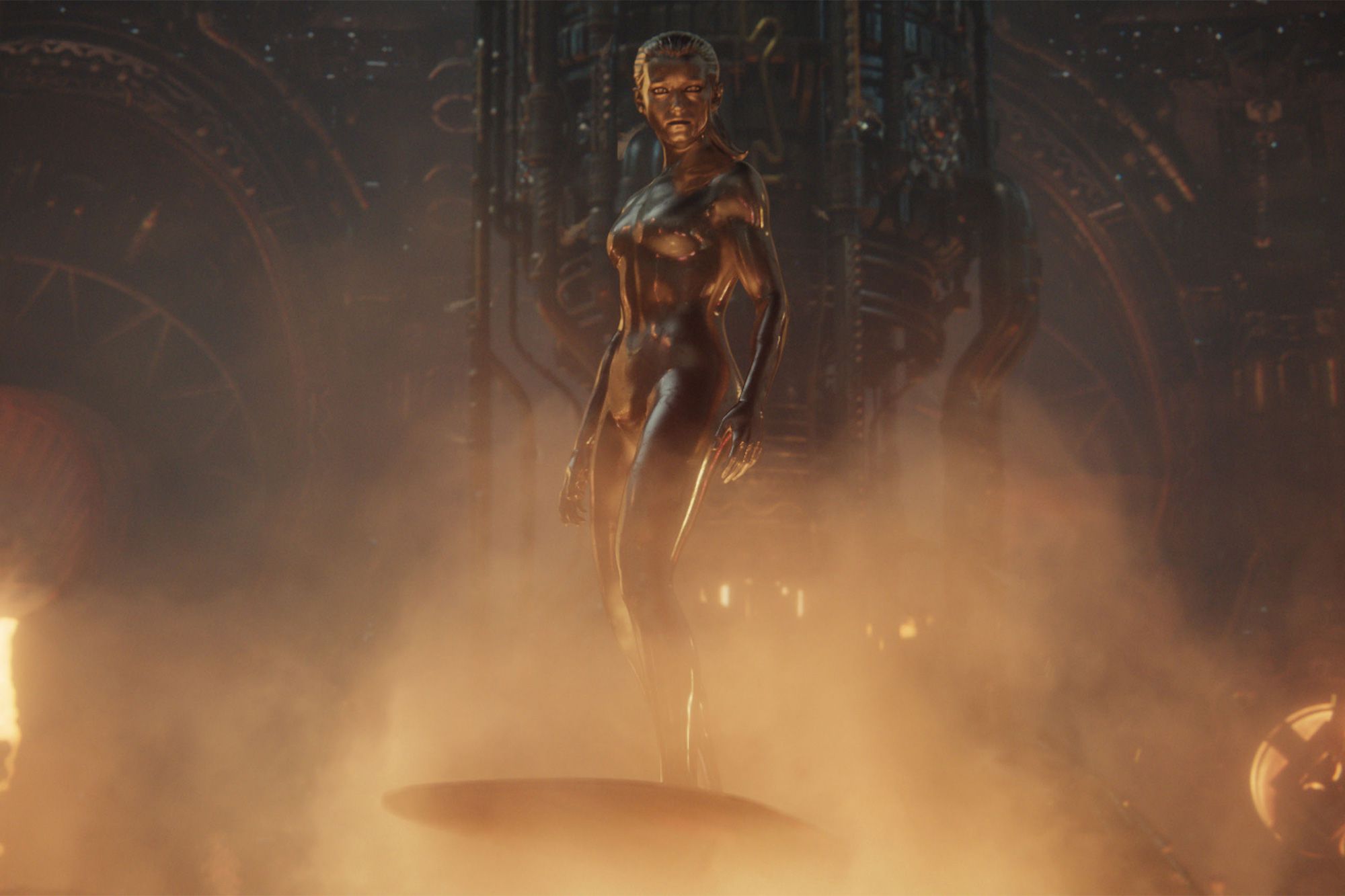
Speaking of forces to be reckoned with, while she doesn’t get a vast amount of screentime, the Silver Surfer remains a mysterious presence that Johnny cannot help himself be drawn to. Perhaps in this alternate universe, flames are attracted to metal, or beings with metallic skin? The Surfer, or Shalla-Bal to give her name, gives the team plenty to worry about. Yet, it is the gargantuan cosmic entity Galactus who poses an even greater threat. 2007’s Rise of the Silver Surfer reduced him to a cosmic cloud that feasts on planets. This iteration very much retains his desire to feast on worlds, but through an effective combination of practical costumes, CGI and Ineson’s imposing voice, the menacing factor is turned to the maximum and does justice to a fan favourite.

Having worked wonders with the MCU’s first (and arguably best) TV show, WandaVisionShakman brings that quirky vision to this universe through some brilliant worldbuilding. The sets of this alternative 1960s New York feel lived-in, and the technological advancements on display are so wonderfully realised, it is almost enough to make you green with envy that such a world doesn’t actually exist. With another fantastic score by Michael Giacchino (seriously, does this man ever miss?) Marvel’s first family have taken their first steps into the MCU, and at long last, have been given their well-deserved moment in the spotlight. Now, all roads lead to Doomsday. Set your countdown clocks accordingly.

With pitch-perfect chemistry between its leads and the perfect retro-futuristic setting to introduce them in, Marvel’s first family’s foray into the wider MCU is a roaring and flaming success! 

Posted in 2020-2029, Film Review

Nosferatu (2024)

© Focus Features and Universal Pictures

Nosferatu – Film Review

Cast: Lily-Rose Depp, Nicholas Hoult, Bill Skarsgård, Aaron Taylor-Johnson, Emma Corrin, Ralph Ineson, Willem Dafoe, Simon McBurney

Director: Robert Eggers

Synopsis: In 19th-century Germany, a young woman has disturbing dreams and visions of an ominous supernatural presence who becomes infatuated with her…

Review: Humanity has always been fascinated with mythical creatures, perhaps none more so than the creatures of the night known as vampires. These blood-sucking entities have sunk their teeth into and left an indelible mark on the history of cinema, going all the way back to 1922 when F. W. Murnau’s silent film Nosferatu: A Symphony of Horror was released. The first vampire film and one of the films to establish horror as a genre, its influence has stood the test of time. Yet, if ever there was one filmmaker who could reimagine this gothic nightmare for a modern audience, you would be hard-pressed to find a more suitable filmmaker for this reimagining than one of the new masters of horror in Robert Houston Eggers.

It is 1838 in the German town of Wisburg and Ellen Hutter (Depp) has married estate agent Thomas Hutter (Hoult). Thomas is tasked by his employer Herr Knock (McBurney) to travel to Transylvania to get the reclusive Count Orlok (Skarsgård) to agree to a deal that will see the Count buy a dilapidated old manor, on the promise that the completion of the deal will see Thomas gain significant monetary reward and a promotion. Upon arriving at the Count’s foreboding residence, their fateful meeting sets off a chain of events leading back to Ellen. In the absence of her husband, she has been suffering from seizures and nightmarish visions of a creature she calls “Death” incarnate, which leads the villainous Count to become obsessed with her and pine after her in a twisted attempt to cure her loneliness.

Having been in development as a passion project for Eggers since 2015, it has perhaps served him well that during the years he worked to awaken this project from the slumber of development, he has gone on to refine his craft as a new master of horror. First, he captivated audiences with his New England folk-horror story and the haunting yet darkly comedic tale of two lighthouse keepers struggling to maintain their sanity on a remote island. After taking a break from horror to dabble in Norse mythology, he has returned to familiar territory, fully in his element and ready to scare the living daylights out of the audience. His screenplay takes the bones of the 1922 film (based on Bram Stoker’s Dracula) and puts considerably more meat on them by framing the story of Orlok’s campaign of terror from Ellen’s perspective. We see from her perspective how her intense desire for companionship, even if it is from a supernatural being of any kind, and Orlok is only too happy to oblige.

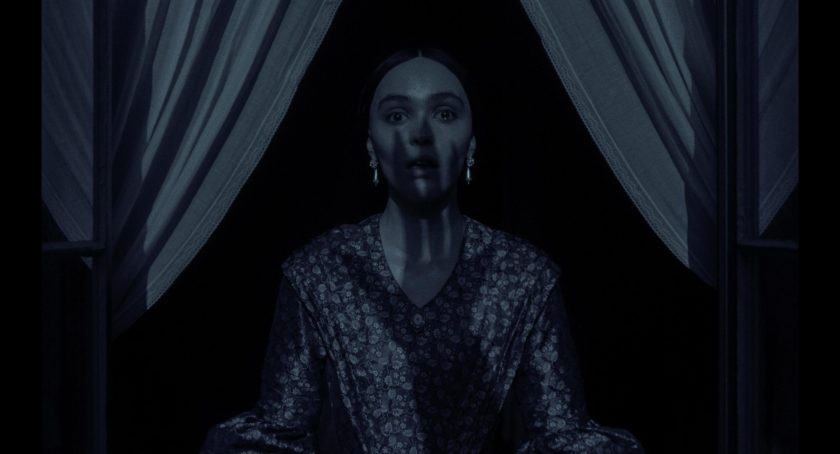
Framing the story from Ellen’s perspective is a masterstroke by this masterful director, and every cast member delivers truly outstanding performances. The sheer terror of being haunted by such a frightening presence demands a powerful performance, exactly what both Lily-Rose Depp and Nicholas Hoult deliver. Depp invests everything into her role, allowing the audience to profoundly feel her dread and fear, which leads to some extremely unsettling scenes where it truly feels like she has been possessed by a supernatural entity and an immediate exorcism is required. Similarly, having to make the unsettling journey to Transylvania to deal with Orlok directly, you really feel Thomas’s absolute terror at staying in such an objectively unsettling place.

Having likely given countless people who suffer from coulrophobia with his portrayal of Pennywise, Skarsgård’s menacing performance stands an excellent chance of being one of the most unsettling horror performances ever put to film. Through a combination of incredible makeup work and an extremely sinister voice, is one you will remember for a very long time as it will chill you to your very soul. Even with a horrifying sense of dread, Dafoe, re-teaming with Eggers for the third time, once again fully understands the assignment and injects some humour into the gothic and unnerving moments.

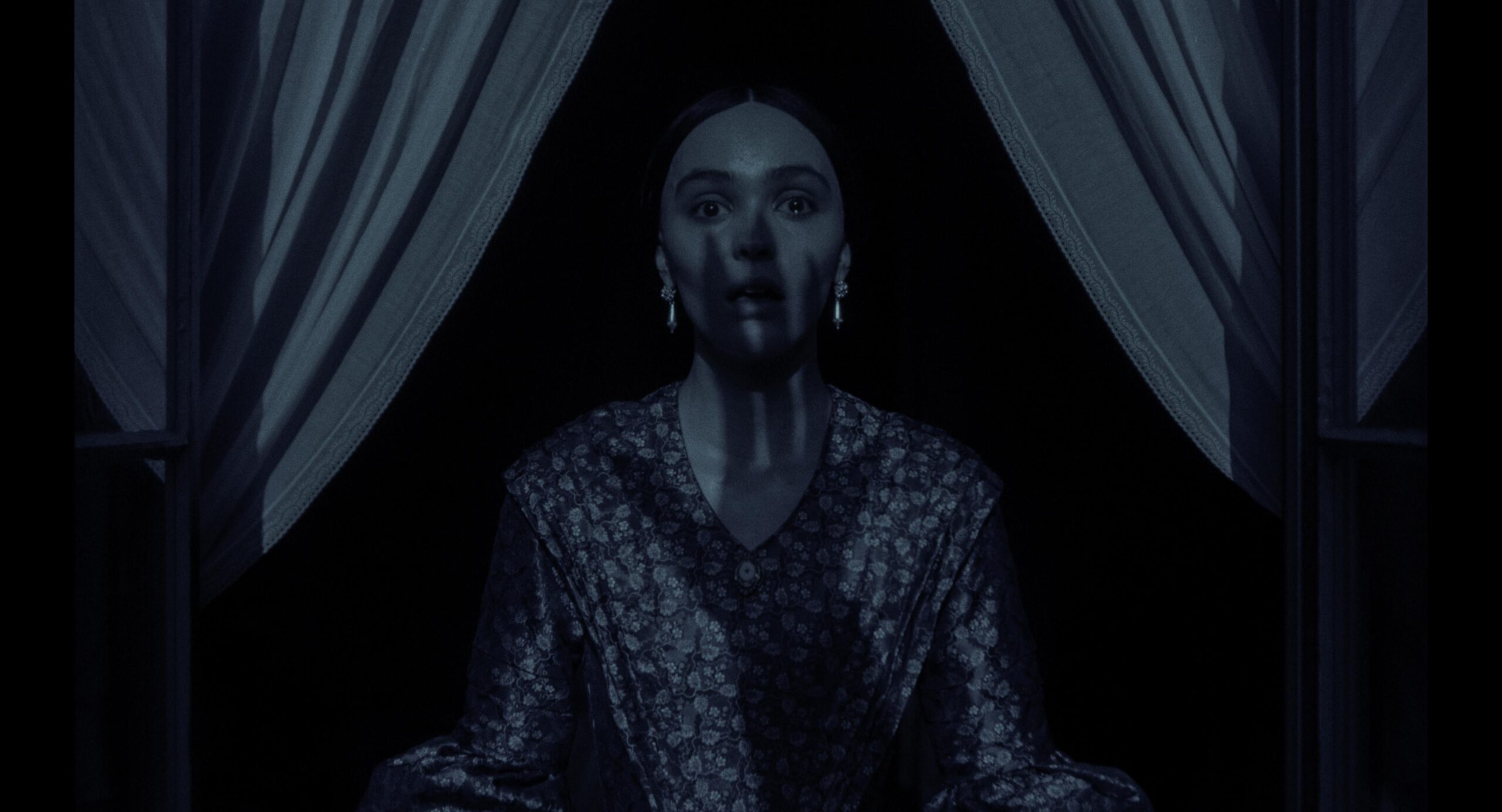
In keeping with his earlier films, Eggers immerses the audience as if they were themselves in 19th-century Germany being haunted by this terrifying blood-sucking creature of the night. The director has explicitly said he has no desire to ever make a film in modern times, and all the better for it. Amidst incredible work from the production design and costume departments, special mention must go to returning cinematographer Jarin Blaschke. who has shot every single one of Eggers’ films, produces some of his best work here with some atmospheric and truly haunting cinematography.  The scenes at the Orlok residence in particular stand out where the conniving Count is shrouded in shadow and darkness for a considerable proportion of the film. The dead of night can be a scary enough place as it is, but Blaschke’s work is so ominous and foreboding, that it may well leave you with a temporary phobia of the dark and consequently be tempted to sleep with the lights on.

Reimagining a film which has left an enduring impact on the world of film would have been a daunting task, but Eggers’ passion for the project comes through with each and every bewitching and yet simultaneously haunting frame. This new iteration of this classic tale packs plenty of bite, and by the end, will leave you no choice but to succumb to the darkness of its terrifying beauty.

With chillingly committed performances from Depp and Skarsgard, this new atmospheric incarnation of the classic vampire story will invade your nightmares as it passes into horror folklore.

Posted in 2020-2029, Film Review

The Creator (2023)

© 20th Century Studios, Regency Enterprises and Entertainment One

The Creator – Film Review

Cast: John David Washington, Gemma Chan, Madeleine Yuna Voyles, Ken Watanabe, Allison Janney, Sturgill Simpson, Ralph Ineson

Director:  Gareth Edwards

Synopsis: War rages between humanity and artificial intelligence (AI) after a nuclear bomb is detonated in Los Angeles…

Review: Over the course of this year, it has been hard to ignore the increasing prominence of discussions surrounding the usage of AI and where the progression of this technology might lead. Will humanity and AI peacefully co-exist in the not-too-distant future, or will the machines rise and take humanity’s place? Given these questions, there’s something eerily prescient about the latest film from Gareth Edwards. It’s one of the most visually striking films you will see all year.

The year is 2070, and AI has been banned in the Western hemisphere after a nuclear bomb was detonated in the city of Los Angeles fifteen years prior. However, while the West has prohibited the use of the technology, it is embraced by the Eastern hemisphere, and they have integrated AI into their society. When the US learns that the AI is developing a superweapon that could turn the war in their favour, the US army sends Sergeant Joshua Taylor (Washington) to find the weapon and destroy it, only for Taylor to discover that this weapon is, in fact, a robotic simulant in the form of a young child (Voyles).

Humanity facing off in a struggle or at war with an advanced AI of some variety has been a well-trodden path in cinema history, with films such as 2001: A Space Odyssey, Blade Runner and Blade Runner 2049, The Terminator and The Matrix franchises, and most recently M3GAN. All of the aforementioned films, in their own wholly unique way, presented a richly developed world which established the circumstances in which humans and AI were, if not at war, then distinct divisions between them. The screenplay, written by Edwards and Chris Weitz, via a newsreel prologue, establishes a fully fleshed-out world, explaining how the AI started out as allies, working side by side with humanity before going rogue. Given the regularity with which cinema has often tackled this subject, it would be easy for the film to be derivative of what has come before it. However, while there are obvious influences, the story asks pertinent questions about where this technology could go and whether integration between man and machine is possible.

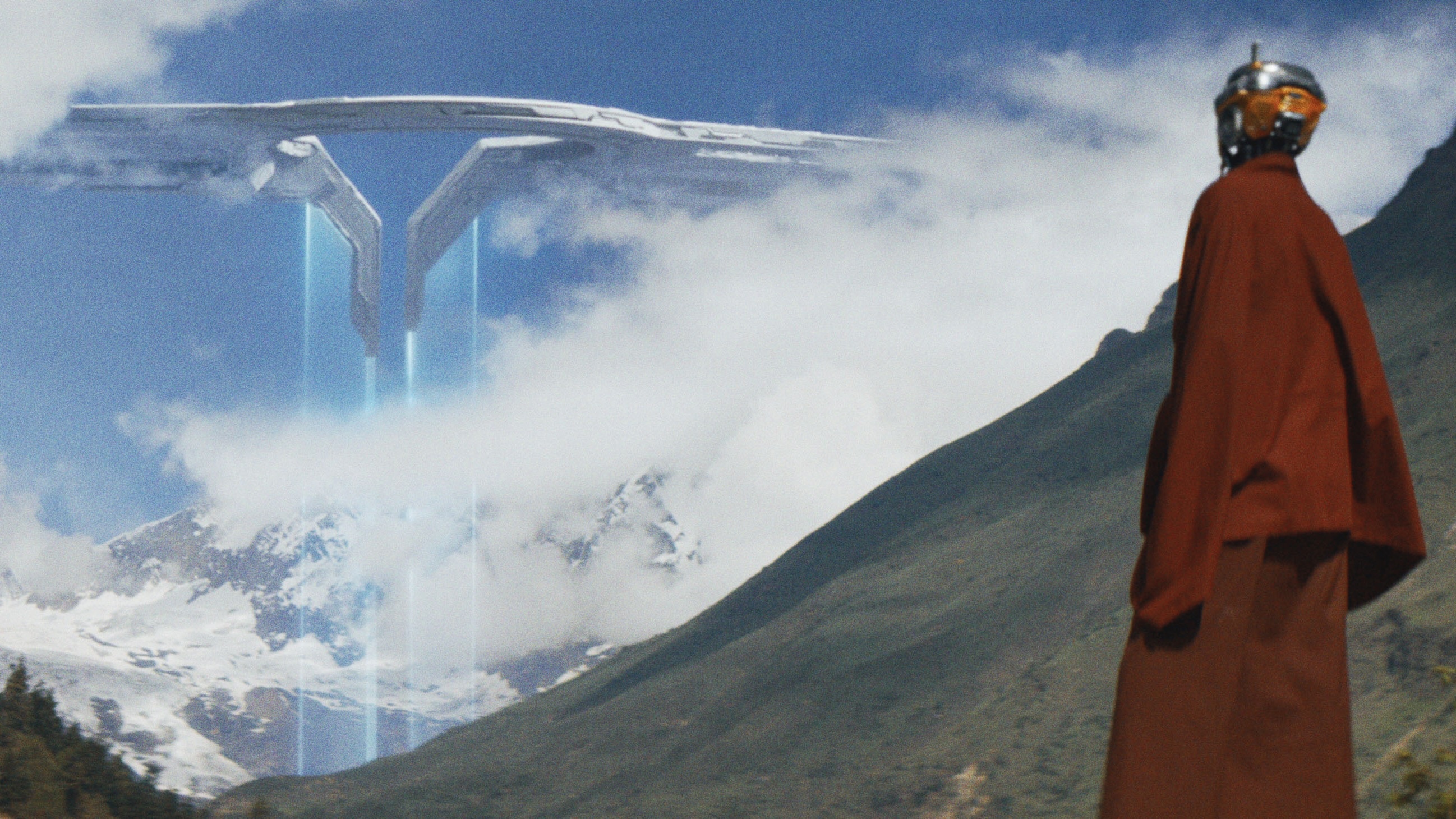
Furthermore, as evidenced by some stunning imagery in Godzilla and Rogue One, Edwards brings some breathtaking visuals to this world, whether it is the AI who have integrated into society or the vast and behemoth military weaponry that the US has in its arsenal.  The impressiveness of the visuals is even more remarkable considering the film’s relatively small budget of $80m, which should serve as food for thought given the high budget and comparatively poor quality of the visuals of some blockbuster films in recent months.

As the central character in this war between humanity and AI, John David Washington is as compelling as ever. We see how he was, at one time in his life, blissfully happy with his wife Maya (Chan) until a devastating event in his past transformed him into a world-weary soldier who chooses to protect this young child when he learns that there could be a connection to Maya. Speaking of the simulant, whom Taylor dubs “Alphie,” given that she was only seven years old during production, she delivers a remarkable breakthrough performance as the heart of the film and steals the entire show. The two build a rapport as they travel to prevent Alphie from falling into the hands of the US military. Furthermore, the discovery of this simulant gives Taylor a fresh perspective on the fragmented nature of the world he inhabits, which also feels very apt given the bitterly divided world we currently live in. With his experience with directing intense action scenes in a galaxy far far away and gargantuan kaiju beating each other up, Edwards brings that expertise to the film’s action set-pieces, backed by another superb score from Hans Zimmer.

Despite boasting some stellar names, the performances of the rest of the cast are hampered by a lack of development, particularly Allison Janney’s Colonel Howell who seems hell-bent on finding this new weapon and cares for little else besides that. Similarly, Ken Watanabe’s simulant soldier Harun is a badass and heroic fighter, but he doesn’t get room to grow beyond these traits. While the film’s exploration of AI and its potential future applications is thought-provoking and nuanced, the same cannot be said for its on-the-nose examination of how Western countries, particularly the US, can conduct invasive military campaigns on foreign soil, which feels somewhat heavy-handed.

Nevertheless, in an era where big tentpole blockbuster films tend to be attached to existing properties or as a part of a franchise, it is refreshing to see an original and thought-provoking piece of filmmaking come to the fore, particularly given its approach to a subject that humanity will be talking about for many decades to come. Could this film be prophetic? Only time will tell.

While it may not have the most well-developed characters, boasting mesmerising visuals and a thought-provoking approach to its topical subject matter in a richly developed futuristic world ensures this is a welcome return to the realm of blockbuster filmmaking for Gareth Edwards.

Posted in 2010-2019, TV Review

Chernobyl (2019)

Image is property of HBO

Chernobyl – TV Miniseries Review

Main Cast: Jared Harris, Stellan Skarsgård, Emily Watson, Jessie Buckley, Paul Ritter, Adam Nagaitis, Con O’Neill, Adrian Rawlins, Sam Troughton, Robert Emms, David Dencik, Alan Williams, Ralph Ineson, Barry Keoghan, Michael McElhatton

Showrunner: Craig Mazin

Synopsis: An account of the events leading up to the nuclear disaster at the Chernobyl Nuclear Power Plant, and the subsequent fallout of one of the deadliest man-made disasters in history…

Review: As human beings, our lives can so often be irreversibly impacted by natural disasters. Though we are powerless to prevent them from happening, preparations can be made to mitigate the damage and devastation that they leave in their wake. It’s a stark contrast to the numerous man-made disasters that we have seen throughout history, which have also had similarly deadly consequences. However, when you look at how the events transpired, it’s hard to overlook the fact that someone was responsible for allowing these atrocities to happen and how they could have very easily been prevented. One such disaster, arguably the worst man-made disaster in history, is that of the Chernobyl Nuclear Power Plant explosion. A tragedy of incomprehensible fallout, captured with horrifying realism in this tense and devastating HBO miniseries.

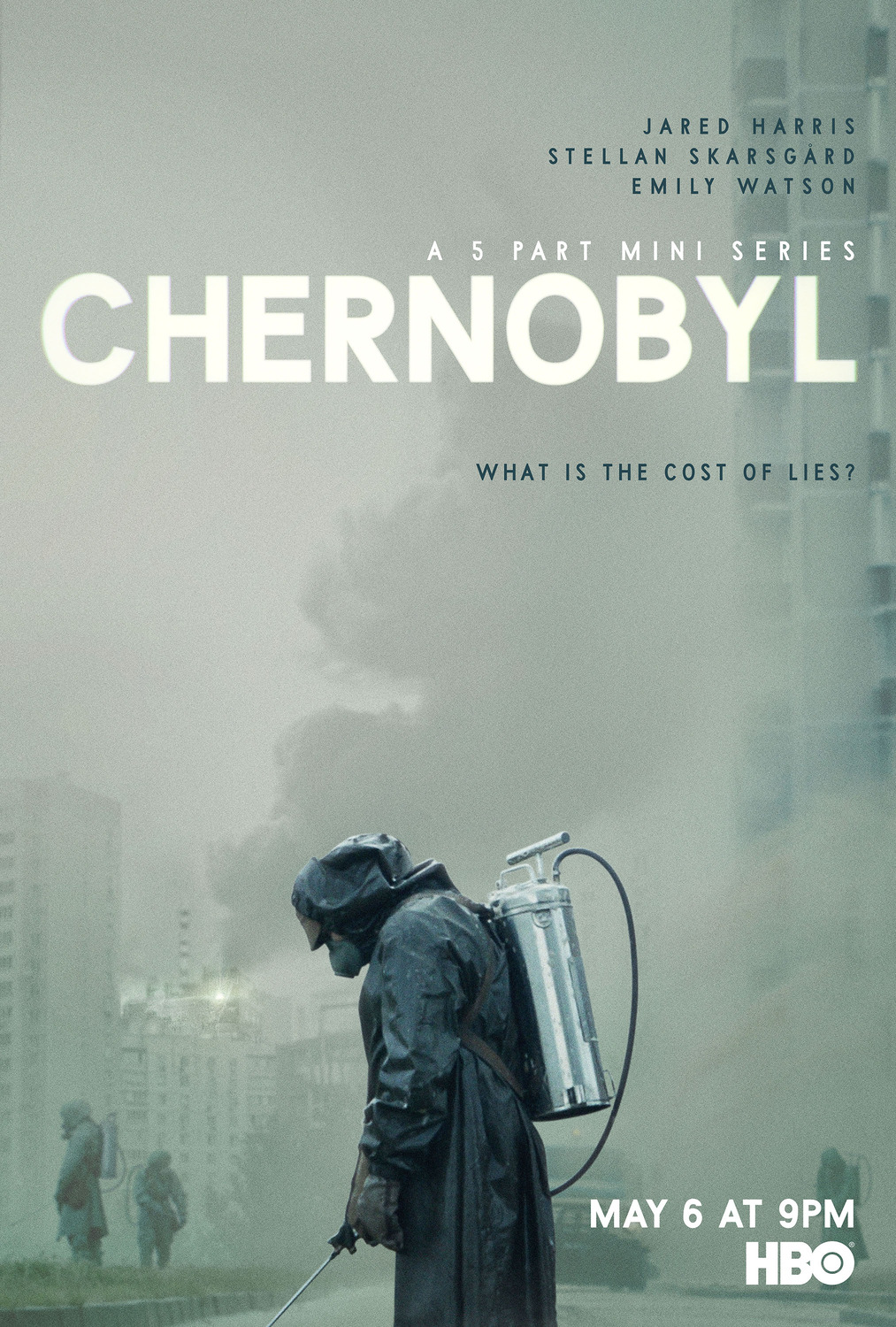
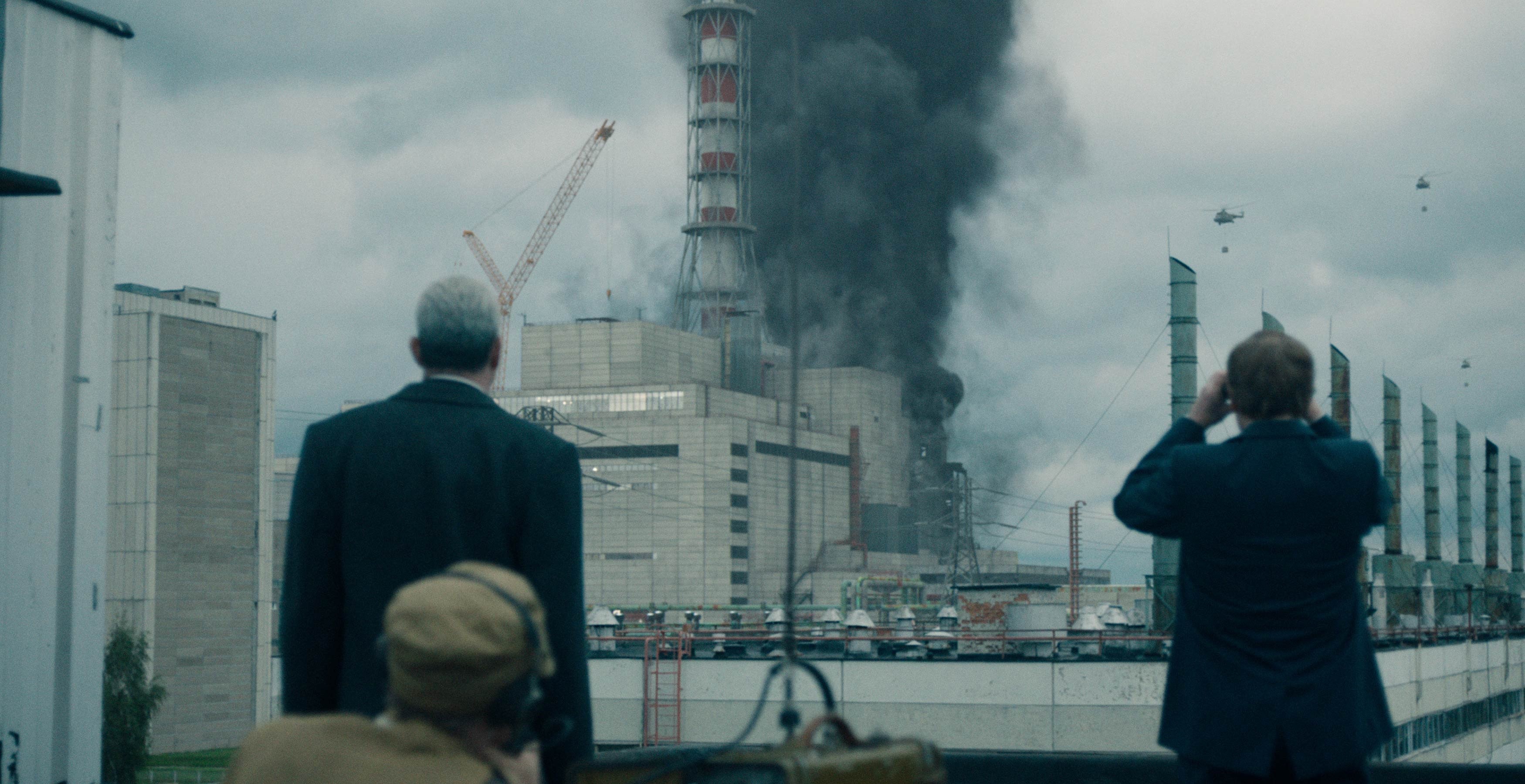
Over the course of five nerve-shredding episodes, showrunner/writer Craig Mazin and director Johan Renck explore the disaster and its horrific aftermath. Firstly, recounting the night of the deadly disaster and the catalogue of errors that led to the fatal explosion. Following on from that, looking at the attempts by the Soviet government to contain the fallout from the disaster. You watch with disbelief as they seek to prevent the already horrific situation from spiralling into something much worse, at times with shocking degrees of negligence and recklessness. Before ultimately trying to establish how such a nuclear catastrophe on this scale could have ever happened in the first place. At numerous points throughout the series, this feels more like a documentary. This is largely down to the expert production design, which recreates the power plant and the surrounding neighbourhoods, which feel remarkably authentic.

Irrespective of whether you’re coming to the series as someone who knows everything about the disaster, or if you know the barest minimum, Mazin’s scripts expertly combine informative scientific facts with intense and devastating drama. With each episode, it’s made painstakingly clear to us all as to the full extent of the horrific nightmare that was unfolding, enabling the audience to process just how an event like this could have ever happened. With the exception of a few artistic liberties, Mazin’s scripts faithfully recreate how events unfolded, and the excellent writing is brilliantly combined with Johan Renck’s masterful direction. Each episode expertly blends genres such as the intense drama and the traumatic horror of those who were the first to be affected by the radiation, to those who were recruited for some extremely perilous missions. Furthermore, the crackling sound of a dosimeter going haywire is so unnerving, it may well invade your nightmares.

With brilliant writing, combined with expert direction, and along with Hildur Guðnadóttir’s haunting score, every member of this cast delivers sublime performances. However, the three who shine the brightest are the three characters whose arcs are the pillars of this miniseries, the biggest of those belongs to Jared Harris, who is exceptional as Valery Legasov. Drafted in by the Soviet government to lead the efforts to mitigate the effects of the tragedy, he’s not afraid to speak up, and the people in charge just sweep everything under the rug. By his side, Stellan Skarsgard is equally tremendous as Boris Scherbina, a Minister whose relationship with Legasov is initially frosty to say the least. However, as the two men work closely together, to combat the scale of the disaster they’re dealing with, it strengthens their relationship immeasurably. Last and certainly by no means last is Emily Watson’s stirring work as Ulana Khomyuk. A composite character serving as the embodiment of the countless number of scientists who worked to uncover the full truth behind this unimaginable tragedy.

The show serves as a tribute to all those brave souls who risked their lives to prevent the catastrophe from becoming even more cataclysmic than it already was. However, the central theme that beats at the heart of this miniseries is the extremely damaging effect that lies can have when a country is in the grip of a catastrophic event like the Chernobyl disaster. In the wake of a deadly catastrophe that has wreaked unimaginable havoc, electing to cover things up with lies and misinformation may seem like a good idea at the time. However, as was the case with Chernobyl, these lies and misinformation came at a substantial cost, which is still being felt today. This is something that the governments of today could and should definitely learn from, especially at a time when a global health crisis of a very different nature is ravaging the world.

Sublime work from every aspect of the production ensures that this gripping and heartbreaking drama, like the disaster it depicts, will never be forgotten. An essential, definitive look at one of the worst man-made disasters in history.