Posted in 2020-2029, Film Review

Dune: Part Two (2024)

© Legendary Pictures and Warner Bros. Pictures

Dune: Part Two – Film Review

Cast: Timothée Chalamet, Zendaya, Rebecca Ferguson, Josh Brolin, Austin Butler, Florence Pugh, Dave Bautista, Christopher Walken, Léa Seydoux, Souheila Yacoub, Stellan Skarsgård, Charlotte Rampling, Javier Bardem

Director: Denis Villeneuve

Synopsis: After joining forces with the Fremen in the deserts of Arrakis, Paul Atriedes vows revenge on those who conspired against his family and murdered his father…

Review: “This is only the beginning”, as those words spoken by Fremen warrior Chani (Zendaya), with Hans Zimmer’s incredible score, rang in our ears by the conclusion of the first half of this adaptation of Frank Herbert’s revolutionary 1965 novel, it was a tantalising tease of what was to come. However, it might have all been for nought, as a second film was not guaranteed due to the decision to give it a simultaneous cinematic release and a day-and-date release on streaming. With a $400m haul at the box office (a mightily impressive feat given the pandemic) and viewed by 1.9 million households in the US on its opening weekend on streaming. The audiences spoke, as did the Academy with six Oscars, and the Spice Gods greenlit a sequel. After a few delayed release dates, the time has come to return to Arrakis, and  Denis Villeneuve has again defied the odds to deliver another magnificent demonstration of desert power.

Set immediately after the events of Part One, Paul Atreides (Chalamet) and his mother Lady Jessica (Ferguson) have fled to find shelter with the Fremen after his father Duke Leto and the majority of his House were murdered in a coup orchestrated by the villainous Baron Vladimir Harkonnen (Skarsgård) aided by the Sardaukar troops provided by the Emperor Shaddam Corrino (Walken). Though Paul is determined to get revenge, he initially opts to put this to one side and seeks to learn the ways of the Fremen to gain their trust as they see him and his mother as outsiders. Meanwhile, given her status as Bene Gesserit, the Fremen give Jessica an extremely important role within their community. While Paul learns the ways of the Fremen, the work of the Bene Gesserit has convinced some Fremen that Paul is the Lisan Al Gaib or “Voice from the Outer World”. This puts Paul in a moral quandary as to whether he is the prophesied messiah for the Fremen as he simultaneously continues to have horrifying visions for what the future might lead to.

Adapting the first novel in Frank Herbert’s legendary series was always considered to be an unfilmable task, just ask David Lynch. It just goes to show that betting against Denis Villeneuve is never a good idea because he thoroughly proved all the naysayers wrong. With seriously impressive world-building to give any epic franchise of the like a run for its money, Part One immersed the audience in this universe as if you were walking on the sand dunes of Arrakis themselves. However, this was a mere prelude for what Villeneuve and returning screenwriter Jon Spaihts have in store.

Part One walked so Part Two could, like a native Fremen, ride a sandworm in tremendous style. Across 165 spice-fuelled minutes, Villeneuve and Spaiths take all the world-building and the foundations laid by the first film and turbocharge them to deliver an equally epic, but considerably darker, emotionally charged and more action-packed second chapter. Alongside Paul learning the ways, and language of the Fremen, Chani and Paul begin to develop a romance and furthermore, all-out war between the Fremen and House Harkonnen as the former works to disrupt the latter’s spice production. On another side of the Universe, the Emperor’s daughter Princess Irulan (Pugh), who is also a disciple of the Bene Gesserit, begins to grapple with the consequences of the Harkonnen’s attack on the Atreides and the part her father played in engineering their downfall.

Despite the extensive and star-studded cast, such epic franchises can live or die based on the central character at the centre of this journey. Once again, Chalamet demonstrates why he is one of the finest actors of his generation as he gives what could well be a career-defining performance. Part One was very much about Paul striving to learn from leaders around him, such as his father and others he looked up to. Now, he is very much thrust into the spotlight of becoming not just a leader of the Fremen, but something much more. Chalamet magnificently balances Paul’s desire to lead the Fremen to victory against the Harkonnens, but also shows hesitancy to embrace the path that has been put at his feet by the Bene Gesserit. Fremen leader Stilgar (Bardem) is only too eager to believe this notion of a messiah, much to Chani’s chagrin. Zendaya is thankfully given much more to do this time around, beyond the extended cameo she had in Part One. The chemistry between her and Paul, like the dunes of Ararakis,  is scorching hot, though there is a lingering doubt in her mind as to whether Paul could be this messiah-like figure and if he is willing to embrace that destiny.

Like Gurney Halleck playing the baliset, there is not a false note in any of the performances. Though out of all the new cast members, the standout by far is the ruthless and psychotic Feyd-Rautha played by Austin Butler, another actor whose rise to stardom is also on an unstoppable trajectory. The perfection of the cast’s performances is matched by the incredible work of Villeneuve and his crew. Whether it’s the roar of the sandworms or the thrum of a thumper, the work of the sound design team makes you feel these sounds with maximum force, especially in IMAX. Likewise, Greig Fraiser’s cinematography be it the bright oranges of Arrakis deserts or the harsh black-and-white palette of the Harkonnen homeworld of Giedi Prime never fails to dazzle. The VFX work once again reinforces what happens when artists are given time to perfect their craft, and of course, Hans Zimmer once again delivers another impeccable and evocative score.

It would be easy to get lost down the wormhole of lore the film throws at the audience and while it does teeter on the brink of buckling under all of the weight of said lore, one cannot deny the spectacle and visual majesty of what Villeneuve has brought to the screen. Ever since he broke into the Hollywood mainstream – with a run stretching from 2013’s Prisoners to now –  each passing film has shown Villeneuve to be a master at combining emotional human struggles, with the sort of spectacle which is absolutely worth the price of a ticket and a reminder of the sheer power that cinema can have. Villeneuve has made no secret of the impact the novel had on him in his youth and one that also changed science fiction forever. In what is an already superb filmography, this magnificent two-part adaptation will (like its source material) stand the test of time, as one of the most epic sci-franchises ever and perhaps the pièce de résistance of Villeneuve’s mightly impressive filmography so far. Power over spice is power over all, indeed.
Building on the epic foundations laid by its predecessor, this magnificent sequel is another visually majestic reminder of the unstoppable force of desert power and the force of nature behind the camera that is Denis Villeneuve.

a

Posted in 2020-2029, Film Review

Avatar: The Way of Water (2022)

© 20th Century Studios, TSG Entertainment and Lightstorm Entertainment

Avatar: The Way of Water – Film Review

Cast: Sam Worthington, Zoe Saldana, Sigourney Weaver, Stephen Lang, Kate Winslet, Cliff Curtis, CCH Pounder, Jamie Flatters, Britain Dalton, Trinity Jo-Li Bliss and Jack Champion

Director:  James Cameron

Synopsis: After several years of peace, Jake Sully must do all he can when his adopted planet of Pandora comes under attack from a familiar foe…

Review: From an 80-page script drafted in 1994, to spending years crafting a constructed language and working with designers to design the world which came to be the planet of Pandora, James Cameron’s Avatar was a project long in the making. When it was finally released to the world in 2009, it became an instant cultural phenomenon, smashing box office records here, there and everywhere on its way to becoming the highest-grossing film of all time, a record it temporarily lost, but has since reclaimed after a brief tussle with the MCU. Such an accomplishment meant a sequel was inevitable, but as was the case with its predecessor, the sequel’s journey to the big screen has been beset with delays. Now, after a 13-year wait, it is finally time for audiences to return to Pandora, but was it worth the wait?

At least a decade has passed since the first film’s events, Jake (Worthington), having been permanently transferred into his Na’vi form, has started a family with Neytiri (Saldana), living peacefully, raising their four children: Neteyam, Kiri, Lo’ak and Tukitrey. However, their peace is interrupted as the Sky People have returned, still desperate to utilise Pandora’s resources to save Earth. However, the mission has some added personal stakes for the humans as they are also out for revenge against Jake after he led the Na’vi to victory against them. Left with no choice, Jake and Neytiri are forced to relocate to take their family to a new region of Pandora, where they meet another Na’vi clan who, unlike the Omticaya, make their homes and livelihoods in the waters of Pandora.

When Avatar first came out, the one thing no one could deny was its utterly breathtaking visual effects, combined with the pioneering motion capture technology. Combined together, these incredible feats of filmmaking brought the beauty of Pandora, its majesty, the Na’vi and the incredible array of characters which call this world home to life in a manner so vivid and fully realised, it could (almost) convince you that Pandora is a planet which exists somewhere in the vast array of the universe.  Yet, having played his card of wowing audiences with astounding immersive visuals once, surely Cameron and his team of visual effects artists could not outdo themselves to create even more impressive visual effects this time around?

Srane (Na’vi for yes), srane they can! By taking this sequel to a whole new section of Pandora, it gives them what is essentially a whole new world to play in and the cast and crew dive (pun definitely intended) straight into the opportunity. The world of performance capture has come a long way since Avatar was released, but Cameron once again goes one better by pioneering incredible technology with visual effects company Weta, enabling the cast and crew to utilise motion capture technology while actually filming scenes underwater. These scenes illustrate the incredible power of this technology and are so stunning and mesmerising to look at, illustrating that there aren’t many better companies than Weta when it comes to crafting stunning visual effects. No words in the English (or Na’vi) language can do justice to how immaculate these visuals look on screen, and they deserve to be seen on the biggest screen you can find in order to appreciate them in all of their stunning glory. They might as well start engraving the names of the artists on the respective visual effects awards trophies now.

While the film’s visuals certainly leap off the screen, they cannot do all the heavy lifting and there’s still a need for the cast to deliver the performances required to drive the narrative forward.  The screenplay by Cameron, Rick Jaffa and Amanda Silver, by expanding our horizons of what we know of Pandora, proved to be a smart decision, not just for the technology but for the story too. It puts the characters in a difficult position where they must learn to adapt to how this water-based Na’vi clan live their lives, which is especially hard for Jake and Neytiri’s children, as their lives in the forest are all they have ever known. It is through their eyes that we see this acclimatisation to the new clan and their ways unfold. Each of these young actors’ performances (Jamie Flatters, Britain Dalton and Trinity Jo-Li Bliss) shines through motion capture technology.

However, the biggest revelation here is the portrayal of Kiri by frequent Cameron collaborator Sigourney Weaver as Kiri. It might have seemed an odd choice to have the legendary actor play a 14-year-old Na’vi child, but through the magic of seemingly Eywa herself, it works wonders. Also returning from the first film (in a slightly different role) is Stephen Lang’s villainous Quaritch, now taking the form of the Na’vi to utilise their speed and strength as a weapon against them as he leads the charge for the humans in seeking revenge against Jake.

While the change in location serves the story up to a point, with the film coming in with a run time of 192 minutes, it struggles to justify such a lengthy run time with an imperfect second act. Furthermore, by putting the focus to such an extent on the young Na’vi children, certain important characters are relegated to bit-part roles. There is undoubtedly a familiarity in terms of the narrative, but when it is time for the Na’vi and the humans to clash once more, it remains utterly compelling and reinforces Cameron’s credentials as a master of crafting action. It might have taken a bit longer to return to Pandora than he would have liked. Still, when you have a director like Cameron in his element, pioneering ground-breaking performance capture and visual effects,  all in the name of our entertainment, you just have to take your hat off to him and say, irayo (thank you).

While it can feel a bit repetitive in terms of its story, the long-awaited return to Pandora goes to extraordinary depths with stunningly immersive visuals which surpass its predecessor, reinforcing Cameron’s reputation as a master blockbuster filmmaker.


Posted in 2020-2029, Film Review

The Northman (2022)

© Universal Pictures, Regency Enterprises and Perfect World Pictures

The Northman  – Film Review

Cast: Alexander Skarsgård, Nicole Kidman, Claes Bang, Anya Taylor-Joy, Ethan Hawke, Björk, Willem Dafoe

Director: Robert Eggers

Synopsis: A Viking Prince swears brutal revenge after witnessing his father’s death at the hands of his traitorous uncle…

Review: Over the last few years, there have been several up-and-coming directors who have made a significant impact with their careers, establishing their reputations as sought after talent, with every film they make becoming event-worthy. One such director would be Robert Eggers. His first two films, The Witch and The Lighthouse, with a combined budget of $15million, became indie darlings that were both released to critical acclaim. With that success to his name, it has given Eggers the platform to go all out, backed by a studio’s considerably larger budget (between $70 and 90 million), and make his biggest and most visually striking film to date.

Prince Amleth is a happy young Viking boy living with his father King Aurvandill (Ethan Hawke) and his mother, Queen Gudrún (Nicole Kidman). Aurvandill is aware that the time will come for Amleth to one day assume the responsibilities of King in his stead. However, before Aurvandill can properly prepare him for his role as King, Auravandill is betrayed and murdered by his brother Fjölnir (Claes Bang). Faced with the prospect of certain death at his uncle’s hands, Amleth is forced to flee but vows brutal revenge against his Uncle for his crimes. Several decades later, the now-adult Amleth (Skarsgård) has transformed into a fierce and brutal Viking warrior. Having lost sight of his original mission for vengeance, a chance meeting with a seeress (a brilliant cameo by Icelandic singer Björk), reminds him of the promise he made to himself all those years ago.

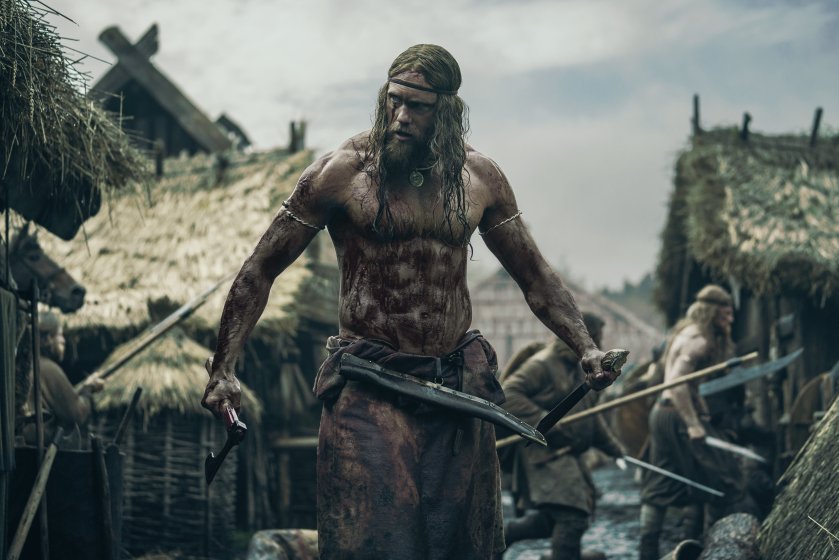
Welcome to the Viking gun show…

Based on the legend of Amleth, which served as the inspiration for the character of Hamlet in the famous play by Shakespeare, Eggers and the Icelandic poet and novelist Sjón, have crafted a screenplay that is so steeped in the richness of Norse mythology, that there probably could be a whole short film devoted to the extensive research that undoubtedly went into the making of the film. While it is first and foremost a tale of one man’s mission for revenge, Eggers takes a lot of time in the first act to establish the culture and the mythology that was central to the civilisation at the time, while simultaneously incorporating the visually striking aesthetics he’s renowned for.  By taking his time to explore the complexities of Norse mythology, Eggers is able to immerse his audiences with scenes of wild rituals, songs and spells and sacrifices. While it is true that at its heart, the plot is very much one man’s quest for bloody revenge against the man who committed a terrible atrocity against him many years ago. However, that does the plot a disservice, as there’s so much more meat on the bones to this story.

Such a physical and brutal film requires a committed leading performance, and in Alexander Skarsgård’s leading turn as Amleth, you have that and then some. His physical transformation for this role is extremely impressive, practically at times having transformed himself into a terrifying feral creature that’s more animal than man. He’s an absolute behemoth of a warrior that you would categorically not want to find yourself in battle with. While his physical prowess cannot be denied, there’s unfortunately not a lot of room for character development, beyond his desire for revenge. The character of Fjölnir could have been a very cliched villain who commits an act of betrayal against his family out of jealousy towards his brother. But as a terrifying and ruthless antagonist, Claes Bang imbues him with nuances and motivations that flesh him out.

Re-teaming with Eggers, after The Witch, Anya Taylor-Joy’s Olga is perhaps the character who is given the most development as the sorceress Olga. A witch who’s resourceful and with a cunning intellect, she works closely with Amleth to help him achieve his goal. A further reunion comes in the form of Willem Dafoe, who is clearly having a riot in his small but significant role of Helmir the Fool. Given she’s reduced to a cameo appearance in the first two acts, you’d have been forgiven for forgetting Kidman was even in the film at all. However, this all dramatically changes as she really stamps her authority onto the scene during the climactic third act.

As this is a tale about vengeance, some violence was inevitable, but this time around, Eggers holds nothing back. The violence is uncompromisingly brutal that will test even the strongest of stomachs. The thrum of the booming drums that make up a considerable chunk of the score is the perfect complement to the sweeping visual majesty of the rip-roaring spectacle. Even with one or two pacing issues in and around the middle, it’s not enough to drag down the sheer epicness of what Eggers brings to this tale. Into the halls of Valhalla, we go!

Bloody, ferocious and wildly entertaining, with an exceptional cast and an extraordinarily committed leading performance from Skarsgård, an ascension into the halls of the greatest revenge films of all time awaits.

Posted in 2020-2029, Film Review

Dune (2021)

© Warner Bros and Legendary Pictures

Dune  – Film Review

Cast: Timothée Chalamet, Rebecca Ferguson, Oscar Isaac, Josh Brolin, Stellan Skarsgård, Dave Bautista, David Dastmalchian, Stephen McKinley Henderson, Zendaya, Chang Chen, Sharon Duncan-Brewster, Charlotte Rampling, Jason Momoa, Javier Bardem

Director: Denis Villeneuve

Synopsis: On the harsh desert world of Arrakis, the Atreides family are entrusted with the stewardship of the planet that is home to the most valuable resource in the world….

Review: When it comes to science fiction and fantasy storytelling, Star Wars and Lord of the Rings are two of the pinnacles of the genre, and have inspired generations of filmmakers and audiences. Yet, there is another body of work that is hugely influential to the genre. A story that featured a vast array of planets and civilisations, hailed by many as the greatest science fiction novel of all time. Now, in the hands of one of the finest directors working today, a new adaptation of Dune is here, and ready to win over a brand-new generation of fans.

In the far future, the most valuable resource is the spice Melange, harvested on the planet of Arrakis. For years, the planet and its people, the Fremen, have been under the brutal rule of the Harkonnens, who have ruled with an iron fist of fear. Now, it has been decreed that the planet, and the monumental task of mining the spice, will fall to the House Atreides, led by Duke Leto (Isaac). By his side, will be his son Paul (Chalamet) and Paul’s mother, the Lady Jessica (Ferguson), who belongs to a mystical order of powerful women known as the Bene Gesserit. There’s a lot of pressure on Paul’s shoulders, as the Bene Gesserit believe Paul could one day turn out to be the Chosen One.

Of course, this isn’t the first time that Frank Herbert’s novel has been adapted for the big screen. However, for reasons that are far too numerous to list here, David Lynch promptly disowned his 1984 adaptation upon release. Villeneuve has cited Dune as one of his favourite novels growing up, and from the very first minute, it is clear why he was the perfect director to helm this new adaptation. A glance at Villeneuve’s body of work has demonstrated his outstanding skill to bring jaw-dropping visuals to any story he directs, often in part due to astounding cinematography. While there’s no Roger Deakins behind the camera here, Greig Fraser is an extremely capable replacement. The gorgeous visuals are expertly combined with the sheer scale of this universe, and it is nothing short of epic.

Due to the extremely dense nature of the source material, it is a necessity for Villeneuve and writers Eric Roth and Jon Spaihts, to take their time. There is a staggering amount of existing lore and mythology to establish, as well all the various planets and Houses that exist within this story. It would be easy for any newcomers to get lost in the enormity of the world-building. Hence, the screenplay bides its time, and gives the audience ample opportunity to take everything in. The use of the practical, real life sets for the film’s production design, such as the immense Jordanian desert amplifies the impressive nature of the construction of this universe. As Villeneuve memorably said in an interview last year, “They didn’t shoot Jaws in a swimming pool!” The use of practical sets adds so much richness to the film and ultimately it makes it unlike anything that we’ve seen in this type of big-budget blockbuster filmmaking in a very long time.

At the centre of all this is Chalamet’s Paul. He’s an actor who has carved himself a career in a plethora of Indie films over the years. The central role in a gargantuan behemoth that is Dune, is quite the step up. However, he makes that transition into a leading man seamlessly. Ferguson as the Lady Jessica is a fierce and strong-willed woman. However, there is a vulnerability that she brings to the role as she is fiercely protective of her son and the gifts that he possesses. This adds considerable depth and nuance to the relationship between Paul and Jessica. Oscar Isaac brings a lordly aura to that of Duke Leto. Yet, despite his very many duties as the leader of a great House, he still exhibits warmth, especially where Paul is concerned.

Meanwhile, the characters of Jason Momoa’s Duncan Idaho and Josh Brolin’s Gurney Halleck, core components of the inner circle of House Atreides, are the notable standouts. Opposing the Atreides, is the ruthless House Harkonnen. Right from the moment they are introduced, they are instantaneously the foreboding and ominous threat that any film with such a richly developed universe, incomparable in its scope and majesty, requires. Furthermore, Stellan Skarsgård as the villainous Baron, is an on-screen presence that you will not be forgetting in a hurry.

Reuniting with Villeneuve after collaborating on Blade Runner 2049, there aren’t enough superlatives to describe just how special this score by Hans Zimmer really is. The true power of a good film score is how a single note can transport you into that world, and this score by Zimmer will take you back to Arrakis in an instant. While the cast are all phenomenal in their roles, given the obvious influences of Arab culture into the source material, it is disappointing that there is a distinct lack of MENA cast members present. However, as this film only represents one half of Herbert’s novel, a second part would give Villeneuve the chance to rectify that missed opportunity.

To give audiences one half of this incredible story, only to not tell the second half would be extremely disappointing. Sweeping epics like this seldom come around very often. Hence, the spice must flow sufficiently enough to ensure that second part will come to fruition, and not be something that will be swirling in our dreams from the deep forever more.

It was said to be unfilmable. Yet with a superb cast, incredible world-building and a sweeping and enthralling narrative, Denis Villeneuve has accomplished something truly special, and we’re only halfway through the story.

a

Posted in 2000-2009, Film Review

Gladiator (2000)

gladiator-movie-poster
© Universal Pictures, Scott Free Productions and Red Wagon Entertainment

Gladiator – Film Review

Cast: Russell Crowe, Joaquin Phoenix, Connie Nielsen, Oliver Reed, Djimon Hounsou, Richard Harris, Derek Jacobi, Spencer Treat Clark, Ralf Möller

Director: Ridley Scott

Synopsis: Popular Roman GeneralMaximus Decimus Meridius is betrayed by the elderly Emperor’s corrupt son, who seizes power for himself. Having lost everything, Maximus becomes a gladiator, determined to get revenge…

Review: Whenever you learnt about history, be it at school or university, odds are good that you would have learnt about the Romans and their considerable Empire. Their presence in history is certainly vast and they have left their mark on the world today in no uncertain terms. As such, many filmmakers have taken the task of representing the Roman Empire in film. 1959’s Ben-Hur or 1960’s Spartacus certainly come to mind, but no movie has arguably come quite as close to capturing Ancient Rome in all its glory as well as Ridley Scott

It is 180 AD and Maximus (Russell Crowe) is leading the Roman Army in a battle against the “barbarians” of Germania. All goes swimmingly and the general has the affection of the elderly emperor Marcus Aurelius. Unfortunately, he does not share this love for his legitimate son Commodus, which does not end well for all parties. In committing his treason, the usurper must dispense with Maximus and his family. This plan goes somewhat awry but not before Maximus can save his family from a brutal fate. Furious with grief and anger over the murder of his Emperor and family, the fallen General sets out on a path of vengeance, against the corrupt Commodus, determined to bring justice to all those who wronged him.

Gladiator

Scott is a director known for his work in science fiction, but he skillfully captures the grandeur of Ancient Rome. Every detail is meticulously portrayed, from the costumes to the production design and sets, all appearing exceptional. With numerous extras, one can only imagine the immense effort that went into achieving such detail. Although CGI is utilized for the Colosseum scenes, it does not detract from the overall impact of the film. The movie won the Oscar for Best Costume Design, along with several other awards, including Best Picture, and received nominations for art and set decoration.

Such attention to detail would have been nothing without a compelling story, which we most certainly have courtesy of the screenplay by David Franzoni, John Logan and William Nicholson. The screenplay fuses perfectly the intense battle scenes with the behind-the-scenes political manoeuvring. From the very first battle onwards, the story is gripping, from a very climactic opening battle to some scenes with some very personal, emotional moments between these characters. Russell Crowe completely shone as the lead Maximus, he’s a loyal man, to his emperor and to his family, and a brilliant soldier. Strength and Honour are two words that absolutely define him. So when he becomes a gladiator, that compassion is gone, replaced by a ferocious hatred against those who committed horrific acts against those closest to him, but his honour remains absolute. Joaquin Phoenix is also on great form as the slimy, cold Commodus who has an alarming desire to sleep with his sister Lucilla (Connie Nielsen). The late Richard Harris as Marcus Aurelius and Oliver Reed as Proximo also both deliver excellent performances in what is an outstanding cast.

There are more than a few superb action scenes packed into the movie’s run time. Scott helms these scenes excellently, and you have battles of all sorts, including a battle with chariots and in one instance, tigers. The action is edited superbly well and the scenes are completely gripping to watch from the scenes in a Roman Province right to the superbly recreated Gladitorial battles which took place in the Colosseum. Russell Crowe certainly showed his action chops in these scenes, and he delivered a career-defining performance in this role, that won him an Oscar. In addition, with an immortal line of dialogue when faced against the treacherous Commodus will go down as one of the best lines of dialogue in any movie, ever, Maximus can certainly lay claim to being one of the best movie characters of the 2000s.

A brilliant historical spectacle fused with fictitious elements, superb action, and a career-defining performance from Crowe, Gladiator can certainly claim to be one of Scott’s best movies.

Rating: A+