Posted in 2020-2029, Film Review

Furiosa: A Mad Max Saga (2024)

© Warner Bros. Pictures, Kennedy Miller Mitchell and Village Roadshow Pictures

Furiosa: A Mad Max Saga – Film Review 

Cast: Anya Taylor-Joy, Chris Hemsworth, Tom Burke, Alyla Browne, Lachy Hulme

Director: George Miller

Synopsis: Years before the events of Fury Road, a young Furiosa is taken from her home and family by the warlord Dementus…

Review: It was nothing short of a spectacular triumph when the Mad Max franchise finally came revving back onto our screens after a 30-year absence (including a significant period being stuck in the deepest depths of development hell). Even with all the frustration that would have surely brewed following its severely troubled production, Mad Max: Fury Road blew our collective socks off when it was finally unleashed. Aside from the mind-blowingly impressive, practical effects-driven action sequences and flamethrowing guitars, it also introduced us to a character who would outshine Max himself. Namely, Imperator Furiosa, played immaculately by Charlize Theron. With the character having such an impact, it is not remotely surprising that in those long years spent trying to get Fury Road up and running, the visionary behind this franchise George Miller came up with a story centred on this one-armed badass warrior. As the trailer so succinctly summarised: this is her odyssey.

Approximately 15 to 20 years before she encounters the Road Warrior, a young Furiosa (Browne) lives with her family in the Green Place of Many Mothers. In this bountiful utopia, all the inhabitants are skilled warriors and resources are plentiful. However, after Furiosa is kidnapped by the minions of the Warlord Dementus and his dangerous gang of bikers, she is taken prisoner by Dementus. With Furiosa in tow, he travels to the Citadel to challenge the tyrannical rule of Immortan Joe, leading to Furiosa spending many years in servitude to both men. Yet through all these years, she retains that ferocious spirit and is determined to fulfil her promise to her mother to find her way back home.

For all the praise richly and justifiably heaped upon Fury Road as a masterclass in crafting heavy metal, balls-to-the-wall action spectacle. It cannot be argued that it was a little bit light on plot and could be summarised as one big, long car chase set over the course of a few days. Therefore, Miller and returning screenwriter Nico Lathouris have crafted a different beast, but one that serves as the perfect companion piece. Split into episodic chapters charting Furiosa’s journey and how she learns to adapt in the harshest of environments where lawlessness is rampant. She must also learn to survive while in the servitude of these despots looking to either gain or maintain their grip on power in the remnants of a society where lawlessness is rampant, with only a few places left that have not fallen into ruin.

Such was the charisma and sheer force of nature in the performance that Charlize Theron gave in initially bringing this character to the screen, Anya Taylor-Joy had some enormous shoes to fill stepping into this role and doing her justice. Yet it’s a challenge she rises to phenomenally, though admittedly not for the first third of the film as it falls to young Alyla Browne to portray the Imperator in her childhood. As she grows up in this brutal environment, Browne imbues the character with steely hardiness and resilience into her adult years.

As an adult, Furiosa does not have a substantial amount of dialogue. Still, sometimes actions speak louder than words, and Taylor-Joy fits the part of Furiosa like a prosthetic arm. Though in the same vein as how Furiosa outshone Mad Max in his own film, Chris Hemsworth as Dementus threatens to drive away with the film, atop his insanely cool motorcycle chariot. Sporting scraggly hair and beard and decaying teeth, a far cry away from the princely and regal aura of the God of Thunder, imagine a cross between the Joker and a pirate, and you have the craziness that is Dementus. Hemsworth is delightfully batshit bonkers in this role and he owns every minute of screen time he has. Meanwhile, taking over the role from the late Hugh Keays-Byrne, Lachy Hulme is equally menacing as Immortan Joe.

With a lot more emphasis on character, Miller takes his foot off the pedal when it comes to the action sequences and it is not full-throttle from practically the opening credits. Such was the intensity of those adrenaline-fuelled action scenes of Fury Road that have set the standard for filmmakers when it comes to action scenes, surely Miller couldn’t surpass himself again? Like his fellow master filmmaker Martin Scorsese, Miller is proving age is just a number because he is not allowing himself to slow down. One scene in particular, involving the iconic War Rig, is truly mind-blowing, worth the price of a ticket alone, and demands to be witnessed on the biggest screen possible.

For all the action mastery that Miller has in his arsenal, by splitting the story into episodic chapters, the pacing stalls from time to time resulting in the two-and-a-half-hour run time dragging in a couple of places.  However, it remains crystal clear Miller is in his element developing and enriching this mad sandbox of a world he first brought to life back in 1979. 45 years later, he’s absolutely still going strong. Should he continue to sit in the driving seat of this franchise, audiences will likely be more than eager to start those engines and come along for the ride.

Considerably more character-driven but with plenty of mind-blowing action and a scene-stealing turn from Chris Hemsworth. Under the vision of the mad magnificent genius of George Miller, audiences shall bear witness to 2024 being the year of desert power! 

Posted in 2020-2029, Film Review

The Super Mario Bros. Movie (2023)

© Illumination, Universal and Nintendo

The Super Mario Bros. Movie – Film Review

Cast: Chris Pratt, Anya Taylor-Joy, Charlie Day, Jack Black, Keegan-Michael Key, Seth Rogen, Fred Armisen

Directors: Aaron Horvath and Michael Jelenic

Synopsis: After being transported to the Mushroom Kingdom, Mario must join forces with Princess Peach to stop Bowser from conquering the world…

Review: With his signature red cap, overalls and signature moustache, it is not an exaggeration to say that ever since he made his first appearance in a Donkey Kong arcade video game in 1981, the character of Mario has become one of, if not the, most famous video game character of all time. Given his enormous influence in video games, it is perhaps somewhat surprising that the legendary Italian plumber has crossed over to the cinematic realm only once. Then again, given how poorly received both critically and commercially the 1993 film was, it is little wonder Nintendo exhibited uncertainty before giving another cinematic adventure with Mario the green pipe, sorry, green light. Now, 30 years after that unmitigated disaster, Nintendo has teamed up with Illumination to bring us a new cinematic incarnation which certainly captures the essence of the games, but sadly falls short of landing the gold star it would have hoped for.

Mario (Pratt) and Luigi (Day) are brothers who have started a plumbing business in New York City. While out on a job, the duo stumble across a pipe which transports Mario to the Mushroom Kingdom and Luigi to a realm controlled by the evil Bowser (Black). Determined to rescue his brother, Mario must team up with Princess Peach (Taylor-Joy) to save him and stop Bowser’s plans from taking over the Mushroom Kingdom.  Such a plot feels ripped straight from a Mario game, and the film endeavours to feel as authentic to the games as possible, which will undoubtedly please long-time fans of the franchise. Yet, while striving for authenticity is to be commended, it also comes at a cost. Matthew Fogel’s screenplay opts for a simplistic approach of throwing as many recognisable elements from iconic Mario games of the past into the film, such as the racing, or Luigi’s Mansion, with seemingly little thought of a plot or a fully developed story. The use of these Easter Eggs will please long-time fans, but the world of Mario is so vast and rich, the opportunity was there to come up with a story which is not severely lacking and could not even be fixed with the help of a magic mushroom.

The subject of the voice casting was, to put it mildly, the topic of much discussion, with Chris Pratt’s casting as the voice of Mario being the decision which was by far and away the most debated. Pratt is an actor who has proven he has the potential to be a voice actor in comedies (The Lego Movie) and in more heartfelt emotional roles (Onward). The decision to have Mario and Luigi as brothers who hail from Brooklyn is a smart one and it makes for an easy adjustment for fans who might have been worried about Pratt attempting the familiar exaggerated Italian accent, though there is a fun little nod to that at the beginning of the film. The voice work across the board is functional towards the film’s paper-thin plot. Furthermore, since there’s barely a scintilla of character development in the majority of the characters, with the exceptions of Princess Peach and Bowser, it results in no emotional stakes in the ensuing adventure at all.  Peach’s character is often reduced to the role of a damsel-in-distress in the games, yet she is thankfully proactive and asserts her leadership over the Mushroom Kingdom, while Jack Black’s portrayal of the King of the Koopas injects some much-needed personality and humour into the film, but it all counts for very little.

The animation is impressive in its detail as it perfectly captures the look and feel of a typical Mario game. However, the bar for animated films continues to be raised by studios across the board in recent years, and consequently, in spite of its phenomenal success at the box office with its Despicable Me franchise, Illumination’s efforts still pale in comparison to the efforts of its rival studios. Given the immense popularity of these characters, which have stood the test of time over multiple decades, there was so much potential for a proper big-screen adaptation which would successfully introduce him to a new generation and satisfy the audience members who grew up with the video games. It certainly accomplishes the former, but really misses the mark with the latter. Mamma Mia, what a missed opportunity!

Impressively animated, but a paper-thin story and severely undeveloped characters ensure this latest adaptation of the Nintendo franchise is devoid of any emotional stakes which made the games so iconic.

Posted in 2020-2029, Film Review

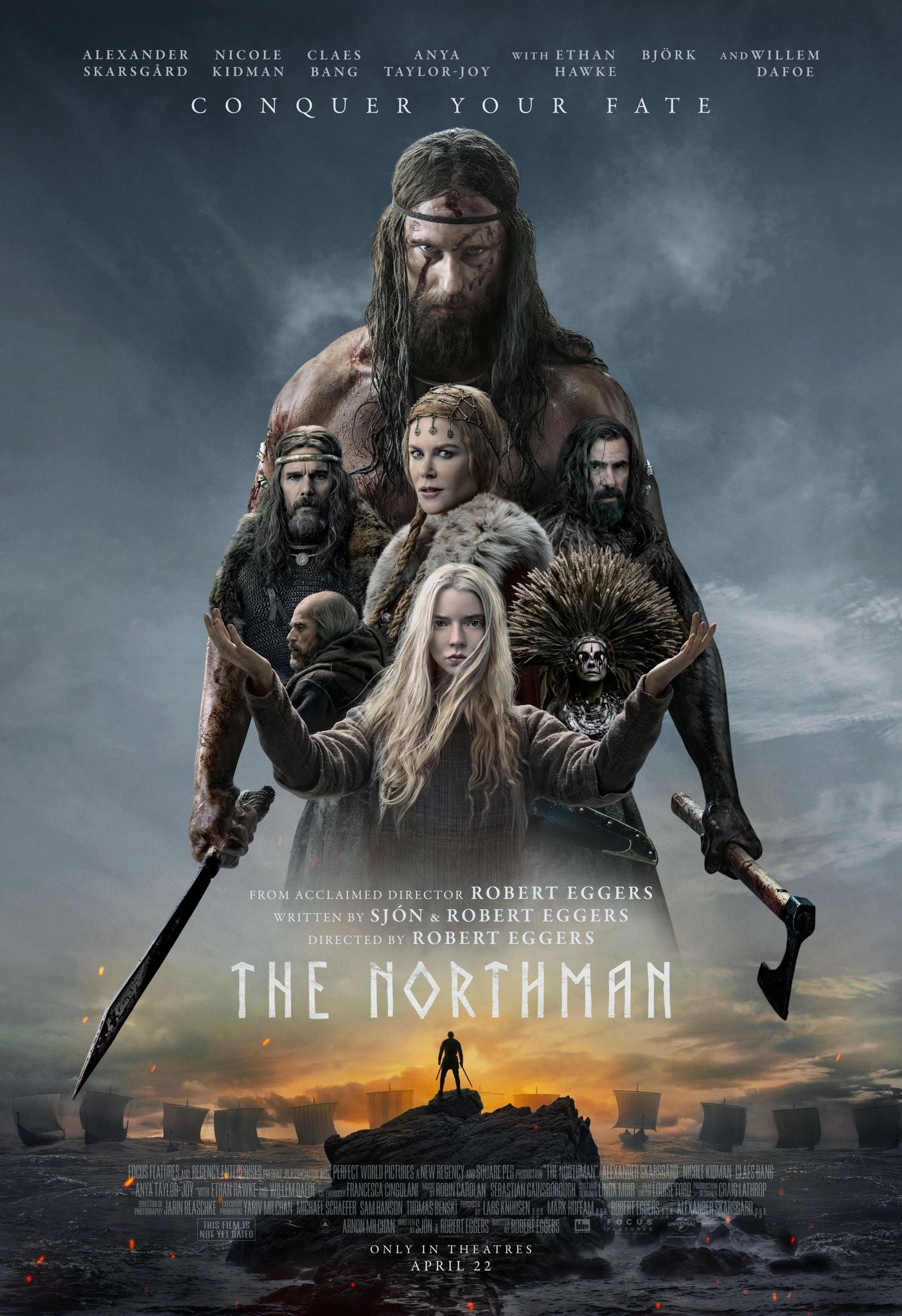
The Northman (2022)

© Universal Pictures, Regency Enterprises and Perfect World Pictures

The Northman  – Film Review

Cast: Alexander Skarsgård, Nicole Kidman, Claes Bang, Anya Taylor-Joy, Ethan Hawke, Björk, Willem Dafoe

Director: Robert Eggers

Synopsis: A Viking Prince swears brutal revenge after witnessing his father’s death at the hands of his traitorous uncle…

Review: Over the last few years, there have been several up-and-coming directors who have made a significant impact with their careers, establishing their reputations as sought after talent, with every film they make becoming event-worthy. One such director would be Robert Eggers. His first two films, The Witch and The Lighthouse, with a combined budget of $15million, became indie darlings that were both released to critical acclaim. With that success to his name, it has given Eggers the platform to go all out, backed by a studio’s considerably larger budget (between $70 and 90 million), and make his biggest and most visually striking film to date.

Prince Amleth is a happy young Viking boy living with his father King Aurvandill (Ethan Hawke) and his mother, Queen Gudrún (Nicole Kidman). Aurvandill is aware that the time will come for Amleth to one day assume the responsibilities of King in his stead. However, before Aurvandill can properly prepare him for his role as King, Auravandill is betrayed and murdered by his brother Fjölnir (Claes Bang). Faced with the prospect of certain death at his uncle’s hands, Amleth is forced to flee but vows brutal revenge against his Uncle for his crimes. Several decades later, the now-adult Amleth (Skarsgård) has transformed into a fierce and brutal Viking warrior. Having lost sight of his original mission for vengeance, a chance meeting with a seeress (a brilliant cameo by Icelandic singer Björk), reminds him of the promise he made to himself all those years ago.

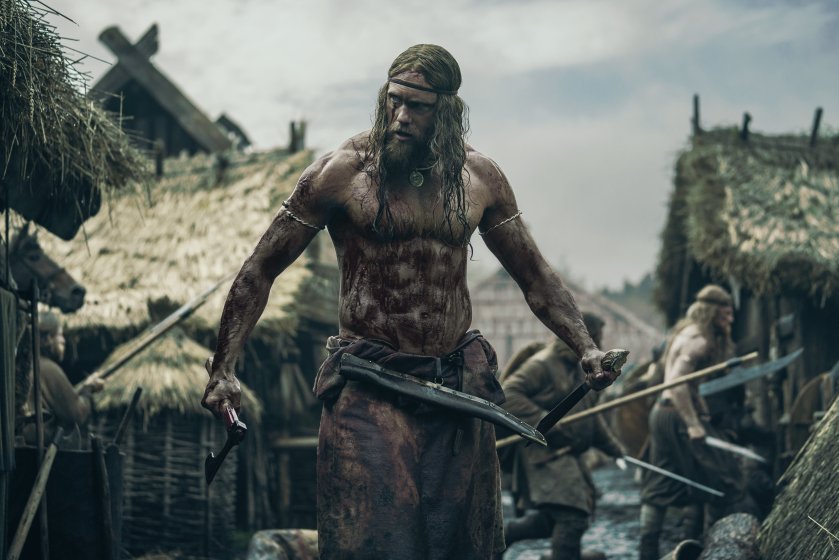
Welcome to the Viking gun show…

Based on the legend of Amleth, which served as the inspiration for the character of Hamlet in the famous play by Shakespeare, Eggers and the Icelandic poet and novelist Sjón, have crafted a screenplay that is so steeped in the richness of Norse mythology, that there probably could be a whole short film devoted to the extensive research that undoubtedly went into the making of the film. While it is first and foremost a tale of one man’s mission for revenge, Eggers takes a lot of time in the first act to establish the culture and the mythology that was central to the civilisation at the time, while simultaneously incorporating the visually striking aesthetics he’s renowned for.  By taking his time to explore the complexities of Norse mythology, Eggers is able to immerse his audiences with scenes of wild rituals, songs and spells and sacrifices. While it is true that at its heart, the plot is very much one man’s quest for bloody revenge against the man who committed a terrible atrocity against him many years ago. However, that does the plot a disservice, as there’s so much more meat on the bones to this story.

Such a physical and brutal film requires a committed leading performance, and in Alexander Skarsgård’s leading turn as Amleth, you have that and then some. His physical transformation for this role is extremely impressive, practically at times having transformed himself into a terrifying feral creature that’s more animal than man. He’s an absolute behemoth of a warrior that you would categorically not want to find yourself in battle with. While his physical prowess cannot be denied, there’s unfortunately not a lot of room for character development, beyond his desire for revenge. The character of Fjölnir could have been a very cliched villain who commits an act of betrayal against his family out of jealousy towards his brother. But as a terrifying and ruthless antagonist, Claes Bang imbues him with nuances and motivations that flesh him out.

Re-teaming with Eggers, after The Witch, Anya Taylor-Joy’s Olga is perhaps the character who is given the most development as the sorceress Olga. A witch who’s resourceful and with a cunning intellect, she works closely with Amleth to help him achieve his goal. A further reunion comes in the form of Willem Dafoe, who is clearly having a riot in his small but significant role of Helmir the Fool. Given she’s reduced to a cameo appearance in the first two acts, you’d have been forgiven for forgetting Kidman was even in the film at all. However, this all dramatically changes as she really stamps her authority onto the scene during the climactic third act.

As this is a tale about vengeance, some violence was inevitable, but this time around, Eggers holds nothing back. The violence is uncompromisingly brutal that will test even the strongest of stomachs. The thrum of the booming drums that make up a considerable chunk of the score is the perfect complement to the sweeping visual majesty of the rip-roaring spectacle. Even with one or two pacing issues in and around the middle, it’s not enough to drag down the sheer epicness of what Eggers brings to this tale. Into the halls of Valhalla, we go!

Bloody, ferocious and wildly entertaining, with an exceptional cast and an extraordinarily committed leading performance from Skarsgård, an ascension into the halls of the greatest revenge films of all time awaits.

Posted in 2020-2029, Film Review, London Film Festival 2021

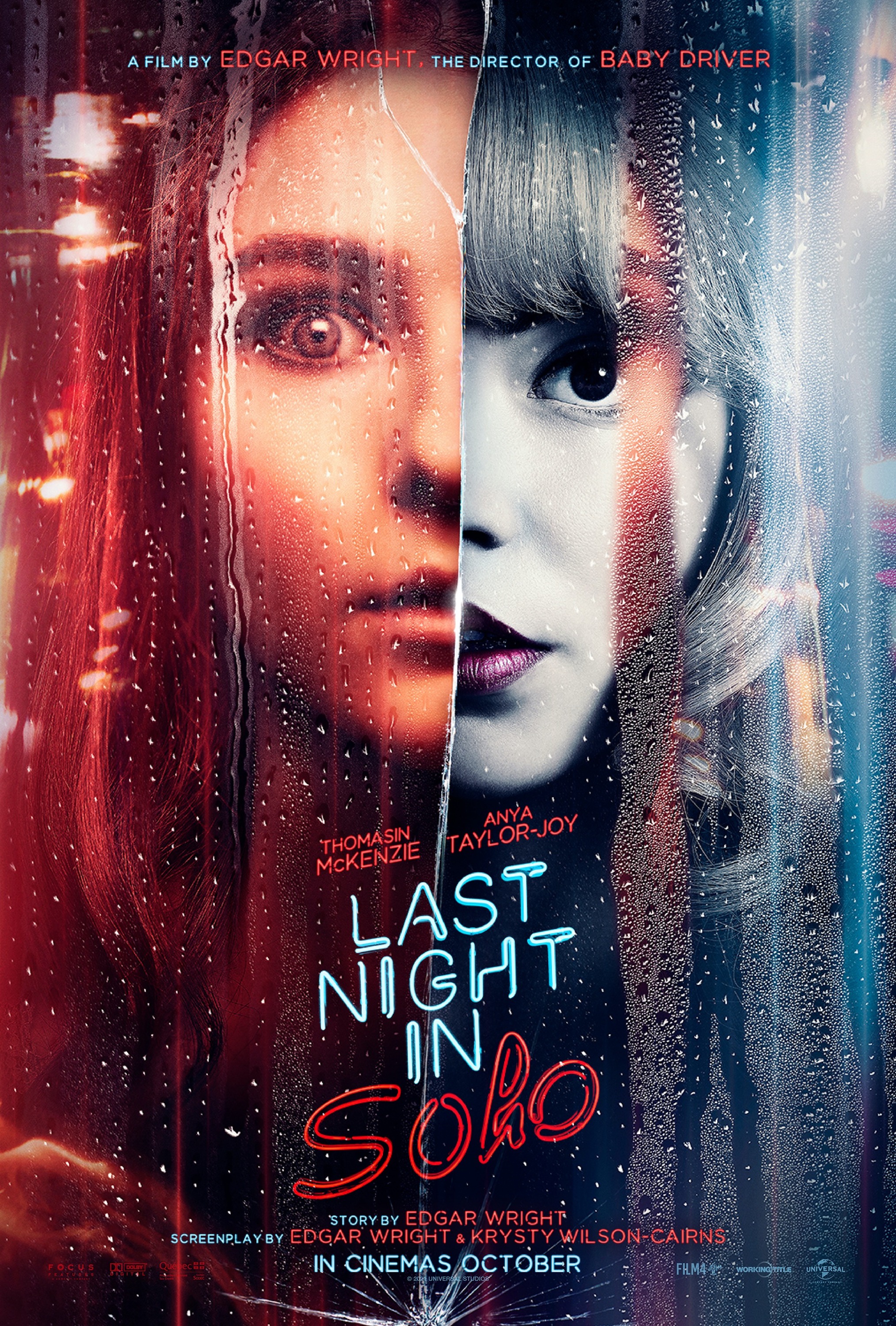
Last Night in Soho (2021)

© Universal Pictures, Film4 Productions, Perfect World Pictures and Working Title Films

Last Night in Soho  – Film Review

Cast: Thomasin McKenzie, Anya Taylor-Joy, Matt Smith, Terence Stamp, Michael Ajao, Dame Diana Rigg

Director: Edgar Wright

Synopsis: An aspiring fashion student moves to London with dreams of becoming a fashion designer. However, she soon finds herself somehow being connected to a different era of London’s Soho…

Review: It’s a dream that plenty of us have at some point in our lives. Leave the comforts of the homes that we were raised in, and experience the bright lights, the busy streets, and the atmosphere and vibes that life in the big city can offer. Yet, for all the tourist attractions and the appealing allure of the big city life, every city (especially one as vast as London) can be overwhelming for people at first. Additionally, each city has a dark side, and both the celebration and the sinister dark side of London form the basis of the new film from one of the most unique voices in British film-making: Edgar Wright.

Eloise (McKenzie) is a fashion student who is a big fan of the 1960s and the music of that era. She moves from her cosy South West roots to the big bright lights of London to attend the London College of Fashion. She has big ambitions to realise her dreams and become a household name amongst the world’s fashion designers. Shortly after arriving, Eloise discovers that when she is asleep, she can travel back to a point during the Swinging Sixties in London where she mysteriously finds herself intertwined with the life of Sandy (Taylor-Joy), who aspires to become a singer. Initially, everything appears to be fine and dandy in the brightly lit neon streets of 1960s London. However, not everything is what it seems, and there’s a darker side to this city that Eloise is about to discover.

Having established herself with her stunning but subdued performance in Jojo Rabbit, this is another demonstration of Thomasin McKenzie’s extraordinary talents. When you make the move from the pleasant countryside to the big city, it can be overwhelming, especially if you’re a student who’s experiencing the madness that is Fresher’s Week. McKenzie’s performance perfectly encapsulates that feeling in an extremely relatable manner as she initially struggles to adapt to this new life. As time goes on, she develops more confidence, as she sees part of herself in Sandy, which inspires her to be more outgoing in her social life and with her fashion designs. As the woman at the centre of Eloise’s fascination, Taylor-Joy’s performance as Sandy is suitably captivating. Additionally, this film marks the final on-screen performance of the late, great Diana Rigg’s illustrious career, and it’s a wonderful final performance.

In a note from the cast and crew of the film that was posted on Twitter, the urge to keep the mystery surrounding this film intact was heavily emphasised. Or, as they put it “What happens in Last Night in Soho, stays in Soho.” Hence, the mystery that has been crafted by Wright and co-writer Krysty Wilson-Cairns shall not be disclosed here. The film starts very strongly as we see Eloise blissfully experience her favourite time period through this vivid dream, but that blissful dream soon turns into a living nightmare when certain truths begin to emerge. As the mystery that’s at the centre of this film begins to unravel, the line between reality and fantasy begins to blur. This is down some extremely slick editing. Through this shift, the film descends into horror film territory, a genre that Wright is no stranger to, given that he expertly combined horror and comedy in Shaun of the Dead.

While there’s enough to make audiences jump out of their seat in terror, the scares can get a little wearisome and repetitive. Furthermore, the messages of the film feel a little muddled in parts, especially by the end of the third act. This is extremely frustrating because of the ambitious nature of the story. However, life in the big city can sometimes be overwhelming and too much for the senses. Wright’s love letter to this city, which clearly means so much to him, has much to be admired about it. There are a plethora of ideas thrown at the wall, but not all of them stick the landing. Hence, it does sometimes feel a bit unsure of what kind of film it wants to be and might have just bit off more than it can chew.

You cannot fault the ambition, but even with a committed performance from McKenzie, a slightly muddled screenplay prevents Last Night in Soho from becoming another classic in Wright’s filmography.