
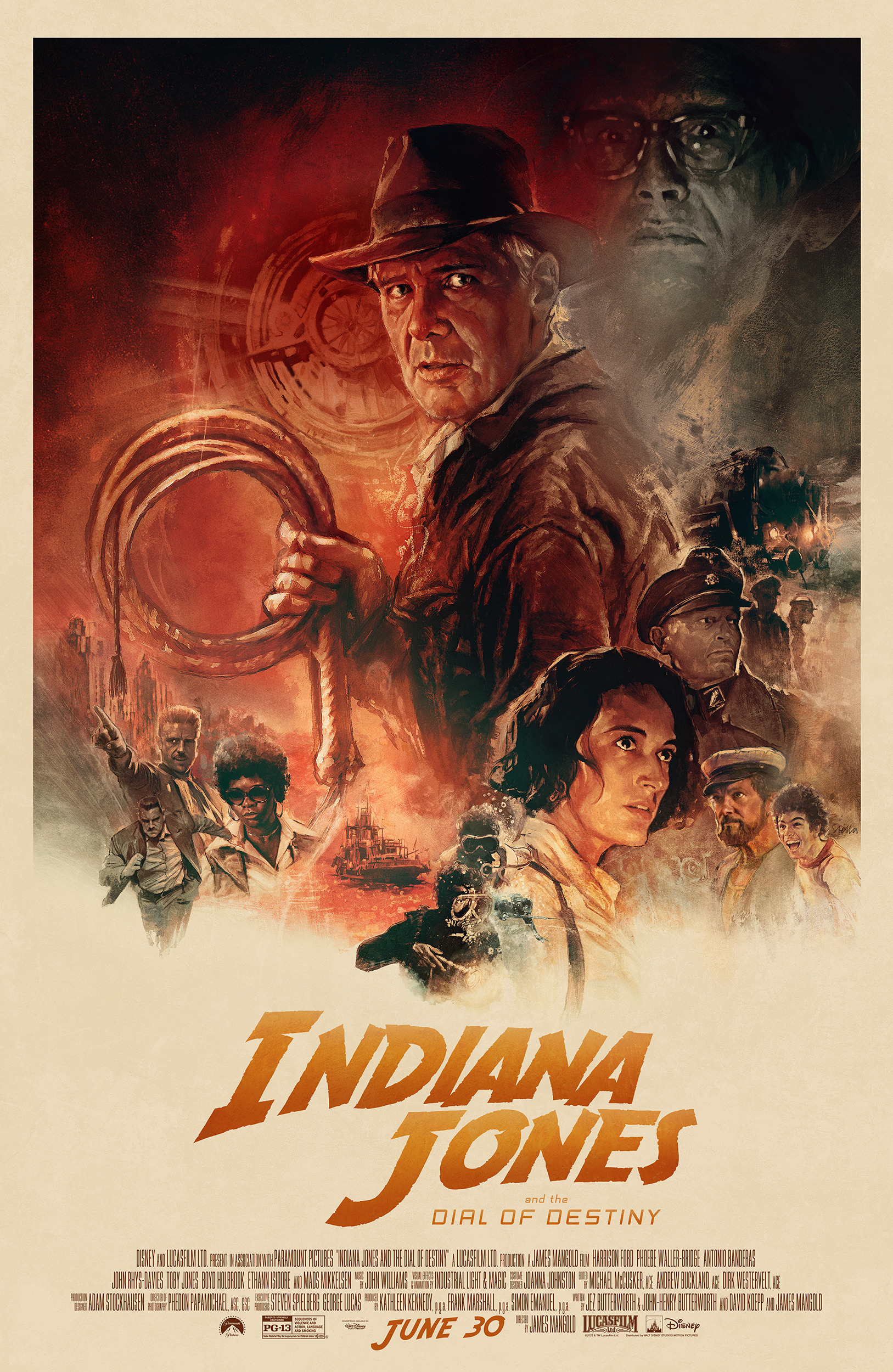
Indiana Jones and the Dial of Destiny – Film Review
Cast: Harrison Ford, Phoebe Waller-Bridge, Antonio Banderas, John Rhys-Davies, Toby Jones, Boyd Holbrook, Ethann Isidore, Mads Mikkelsen, Shaunette Renée Wilson
Director: James Mangold
Synopsis: Legendary archaeologist Indiana Jones finds himself in a race against time, and the Nazis, in a bid to recover a historical artefact…
Review: Whether it be the fedora, the whip, his sense of adventure, his charm, or the fact he loves to give a Nazi or two a punch to the face, the appeal of Dr Henry Walton “Indiana” Jones Jr is one which has endured throughout the decades ever since he made his debut in 1981’s Raiders of the Lost Ark. The subsequent three films which followed may have varied in quality, but what did not vary was the popularity of this character, which has endured to the point where he is widely regarded as one of the greatest characters in the history of cinema. Fifteen years after what was billed as his last adventure, Indy has dusted off the leather jacket and the whip, for another go at one final adventure.
The year is 1969 and Dr Jones is on the brink of retirement from his teaching job as a university lecturer. The Space Race between the USA and the Soviet Union is in full swing, with the former poised to be the first country to send people to the moon. While once his students were fascinated by the subject of archaeology, now they’re completely unenthusiastic and are far more interested in space, leaving Indy facing up to the prospect of a rather lonely future in retirement. This is until his goddaughter Helena Shaw (Waller-Bridge) shows up out of the blue seeking Indy’s help to locate an ancient historical artefact in the form of a dial, which is said to have belonged to Archimedes. Though, of course, the dial is also being pursued by former Nazi Jurgen Voller (Mikkelsen), who has since been recruited by NASA to assist the US with their efforts in the Space Race.

Before the globetrotting adventure to retrieve this artefact can begin however, the film turns back time to a thrilling 20-minute prologue set during the tail end of World War II minute prologue, where a younger Indy (via a digitally de-aged Ford) and his fellow archaeology enthusiast Basil Shaw (Jones) are in search of another artefact which they believe may be in the possession of the Nazis of. However, a chance encounter leads them to this dial which may or may not have some kind of magical powers of some kind to it. It wouldn’t be an Indy film without it! Fast forward 25 years, and Indy and Helena set off on a new adventure to retrieve this priceless treasure before it falls into the wrong hands.
Ford is an actor who has no shortage of legendary roles to his name, each of which he has reprised over the years to wonderful effect, and Indy is no exception. It is apparent Ford has a great affinity for this character, and despite his age, he puts in a committed performance proving there is no one else to don Indy’s fedora. Given the length of time Ford has played this role, the script by Jez Butterworth, John-Henry Butterworth, David Koepp and James Mangold leans into this longevity and the fact that an adventure of this nature would wear an adventurer of his age down. His general grumpiness, combined with Helena’s endless energy and enthusiasm, lends itself to some comedic moments, and Waller-Bridge is tremendous in the role. She is easily given the most development out of all the new characters, which is frustrating particularly where Mikkelsen’s villain is concerned. He’s an actor who has proved he can play a thoroughly unlikeable villain with nuance and subtlety to the point where you almost feel sorry for him. Unfortunately, the script doesn’t develop him much beyond he’s a former Nazi who is desperate to find this dial for his nefarious purposes and so Indy and Helena must stop him and his assortment of goons led by Boyd Holbrook’s Klaber at all costs.
It is strange that for an Indiana Jones film, there is no involvement of either franchise creator George Lucas or the director of the first four films Steven Spielberg, with both instead serving as executive producers. Taking on the reins from Spielberg is an unenviable task, but it is one which James Mangold rises to. He is a director who notably has experience with giving a beloved character the swansong they deserve and has an incredibly broad range of films across a multitude of genres in his career. The action scenes have a vibrant energy to them and are visually stunning to look at especially the opening prologue and some of the action scenes in the second act. While these are fun to watch, the film clocks in at nearly two and a half hours, it is the longest film in the franchise to date and you begin to feel that run time by the end due to some sluggish pacing. Furthermore, the film can feel a bit too reliant on the by-the-numbers nature of its plot and the nostalgia many will undoubtedly have for this franchise, aided by the score that the living legend John Williams provides. Matching the lofty standards set by two-thirds of the original trilogy (looking at you Temple of Doom), was always going to be a tall order. However, where Kingdom of the Crystal Skull fell short, Dial of Destiny turns back time to let this character roll back the years and enable him to take a final bow befitting of an iconic screen legend.
While it leans a bit too much its nostalgia and its tried and tested formula, the committed performances from Ford and Waller-Bridge ensure the legendary archaeologist’s final adventure is one which is absolutely worth going on.




 Through the Silver Screen