

Posted in 2020-2029, Film Review

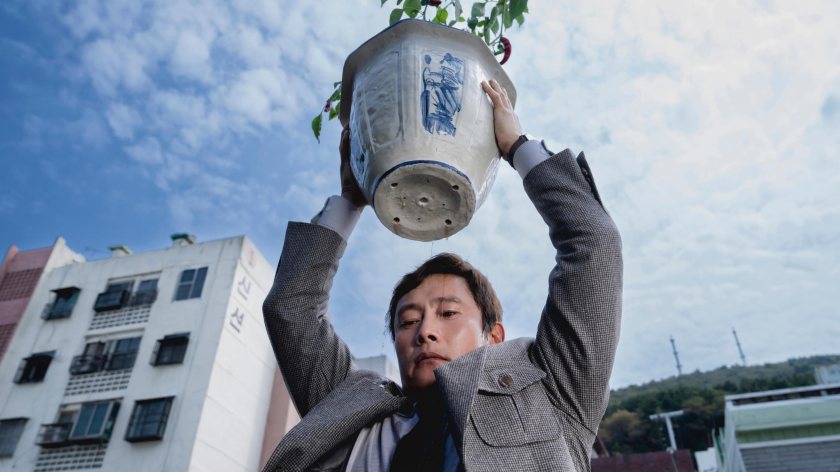
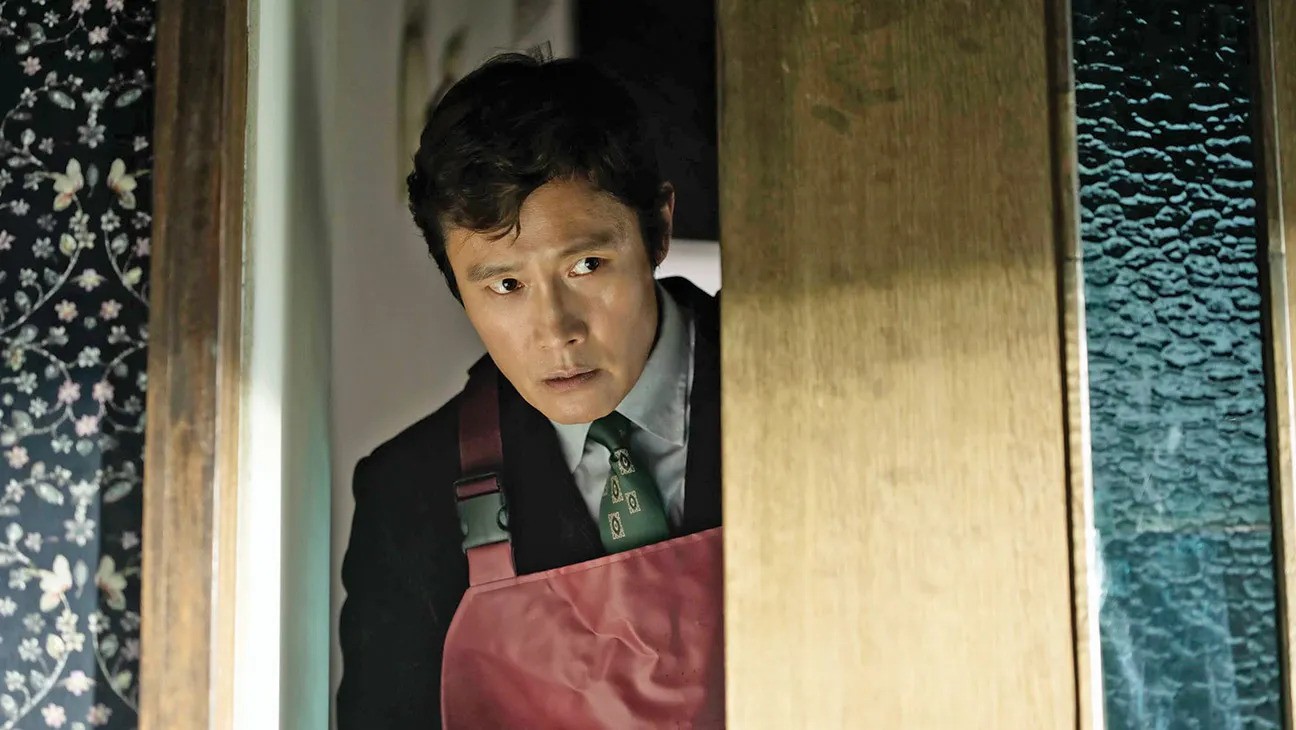
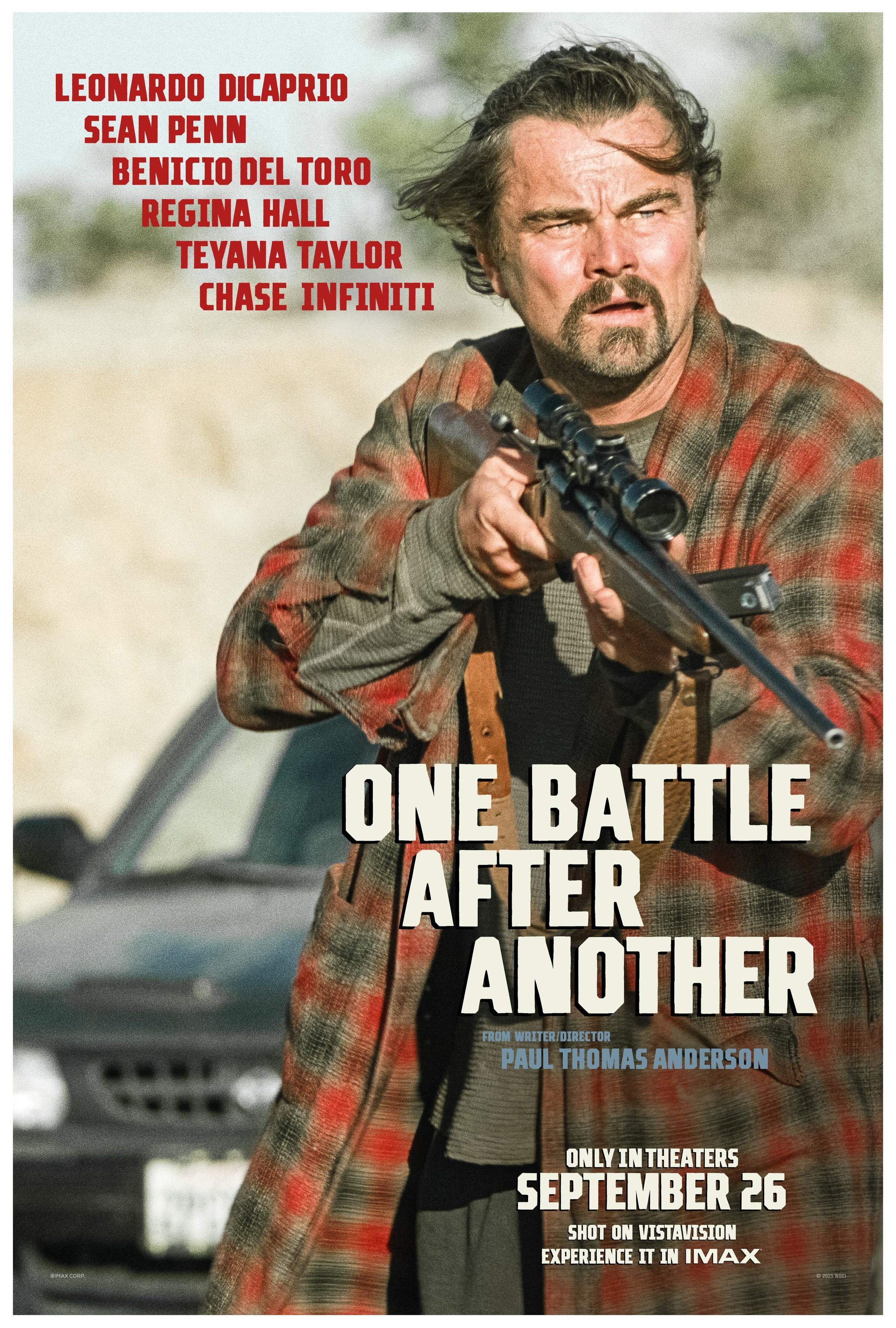
One Battle After Another (2025)

  © Warner Bros. Pictures and Ghoulardi Film Company

One Battle After Another – Film Review

Cast: Leonardo DiCaprio, Teyana Taylor, Chase Infiniti, Sean Penn, Regina Hall, Benicio Del Toro, Alana Haim

Director: Paul Thomas Anderson

Synopsis: A washed-up former revolutionary is forced to confront his past when both he and his daughter are hunted by a former foe…

Review: You’d have to be living under a rock to be unaware that the political climate in the United States in 2025 is as fraught and bitterly divided as it has been at any point over the past decade. In such politically charged times, it takes a brave filmmaker to hold nothing back and go for the jugular with a thorough, uncompromising look at the land of the free and what the country actually stands for. Enter Paul Thomas Anderson, with a film two decades in the making, where the revolution will very much be televised.

In one of, if not the, most frenzied first acts of the year, Pat (DiCaprio) and Perfidia (Taylor) are two members of the far-left revolutionary group the French 75. The group have gathered outside an immigrant detention centre to storm the facility and release the migrants detained, while also perpetrating attacks against other key targets against the country’s infrastructure. These attacks capture the attention of Colonel Steven J Lockjaw (Penn), who makes it his personal mission to hunt down and eliminate the group’s members at any cost. Pat and Perfidia soon fall in love and have a child, whom they name Charlene. After their daughter’s birth, Pat is determined to lay low and leave his revolutionary days behind, but Perfidia isn’t one to give up the fight so easily, which lands her on Lockjaw’s radar. After 16 years of lying low, now going under the aliases of Bob and Willa (Infiniti), the duo find themselves on the run again when they realise they are once more in Lockjaw’s crosshairs.

After an adrenaline-charged first act that throws you headfirst into the heat of the action, Anderson briefly gives the audience a moment to catch their breath, but don’t get too comfortable. One Battle After Another truly lives up to its title; while the characters may have claimed an initial victory, the war is far from over. Loosely adapted from Thomas Pynchon’s 1990 novel Vineland, Anderson’s screenplay is sharp and scathing in its criticism of modern-day America, and the parallels between the revolutionaries and the pushback against the US government’s callous and inhumane treatment of migrants are all too relevant in the absurdity of this timeline. Yet, this is a film with a lot more on its mind as it also scathingly rebukes the hatred and oppression that marginalised groups, especially immigrants, face and a society which allows this contempt to filter into society through truly poisonous ideologies such as white supremacy. Such hatred, while those at the top perpetrate rampant corruption. It is all too relevant to the absolute authoritarian hellscape that is the US in 2025, which ensures the film hits like a sledgehammer, with a powerful and furious urgency.

Having come very close to working with Anderson on 1997’s Boogie Nights, Leonardo DiCaprio can finally add Anderson’s name to the distinguished list of filmmakers he has worked with across his career. DiCaprio rarely disappoints, even when the film around him is an absolute dumpster fire (looking at you Don’t Look Up). Unlike that film’s pitiful attempts at humour, Anderson combines the tense political themes with a surprising amount of humour. Not least because in those 16 years, he has developed a penchant for anxiety-reducing drugs to ease his paranoia, which is understandable given his revolutionary past. Consequently, he spends a not insignificant part of the film stoned out of his mind, while wearing a knitwear bathrobe that could give Jeff “The Dude” Lebowski a serious run for his money. Taylor makes her presence felt with what little screentime she has, but it is to the film’s detriment that she only appears in those explosive first 30 minutes and disappears thereafter.

Going toe to toe with such a titan of the industry would be a daunting task for anyone, especially a newcomer, but Chase Infiniti goes toe to toe with her more experienced counterpart and more than holds her own with a fierce and spirited performance. Even in the midst of a society that is seemingly crumbling before her very eyes, there is fire in her belly, especially when it comes to the threat posed by Lockjaw and her determination to find and be reunited with her father. Penn gives a fiendishly frightening turn as a bigoted and loathsome human being (those individuals being well represented in the current US administration) who thrives on the cruelty and mistreatment of others and will stop at nothing with almost robotic-like efficiency until he finds his target.

Shot in stunning VistaVision, Michael Bauman’s cinematography is nothing short of breathtaking, pulling the audience into a vividly chaotic world on the brink of collapse, yet still managing to find beauty amidst the turmoil. Jonny Greenwood continues his collaboration with Anderson with a score that pulses with intensity, driving the film’s 162-minute runtime with an electrifying energy that ensures the pacing never lags, culminating in a pulsating, edge-of-your-seat action sequence in the third act. The fires of revolution have been lit, and it is up to all of us to ensure they never go out, especially in the face of fascism, bigotry and tyranny from power-hungry madmen. Viva La Revolución!

Combining comedy with high-intense and serious drama in a society on the brink doesn’t always fully mesh. However, with the power of its performances, especially newcomer Chase Infinity, and its furiously urgent messages ensures Paul Thomas Anderson has made the most important film of his career to date. 

Posted in 2020-2029, Film Review

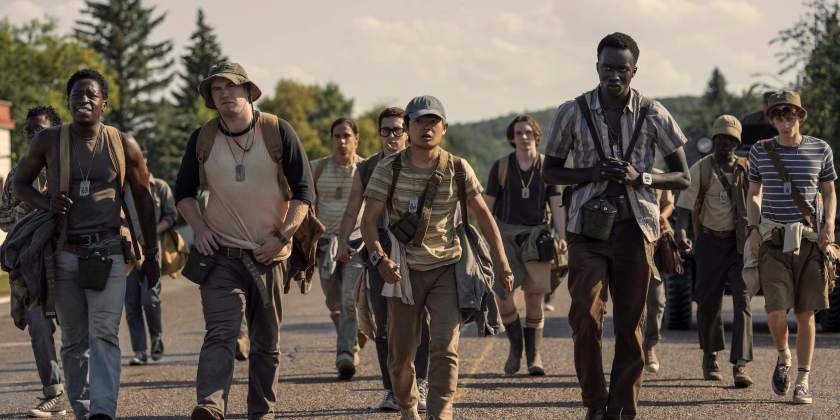
The Long Walk (2025)

© Lionsgate and Vertigo Entertainment

The Long Walk – Film Review

Cast: Cooper Hoffman, David Jonsson, Garrett Wareing, Tut Nyuot, Charlie Plummer, Ben Wang, Roman Griffin Davis, Joshua Odjick, Judy Greer, Mark Hamill

Director: Francis Lawrence

Synopsis: In a dystopian United States, 50 teenage boys must walk until only one is left standing…

Review: Throughout the long history of the United States, the notion of the country descending into a nightmarish hellscape ruled by an authoritarian regime should not feel relevant in modern times. Yet, given its current leader and the state of the world in general, it remains an all-too-familiar reality. A 1979 novel written by the one and only Stephen King (under the pseudonym Richard Bachman) feels more pertinent than ever, given the hellish state of the country today. In Francis Lawrence, a director who knows a thing or two about helming multiple films set in a dystopian US devastated by civil war, having directed all but one of the films in The Hunger Games franchise. A franchise which also featured brutal contests where participants fought for survival until only one remained, there couldn’t be a more apt director to translate a depressingly relevant visualisation of the US to the big screen.

Set in an alternate 20th century, in an attempt to inspire patriotism and imbue a work ethic among its citizens amid a severe economic downturn, the brutal totalitarian military regime in charge of the country set up an annual competition known as The Long Walk. 50 teenage boys, one from each state, are selected to compete. The rules are simple: they must walk for hundreds of miles across an open road at a pace of three miles per hour until there is only one competitor left standing. Any competitor who falls below that pace is given three warnings to get back up to speed. If they fail to do so after the third warning, they will have their “ticket punched” by the armed soldiers patrolling the route, with a bullet.

Four dozen impoverished souls walking for miles across nothing but flat terrain, occasionally breaking through the sparse pockets of civilisation, could quickly become tedious and monotonous. However, over 108 utterly absorbing and tense minutes, JT Mollner’s screenplay keeps the proceedings moving swiftly and remains intensely gripping by focusing on these young men, pushed into this dangerous and gruelling trek, as they cling to the hope of being the victor. In a contest where the winner will claim a substantial cash prize and the chance to have one wish granted, it seems unlikely that any bonds will form among the walkers. Yet, this is precisely what makes the film so compelling. Some choose to form alliances, while others resort to antagonistic tactics. As the miles pass and day turns into night, then into the next day, the sound of gunfire as numerous competitors are eliminated shocks those remaining into continuing to put one foot in front of the other. It never once loses momentum.

Such is the strong brotherhood that forms between a handful of these young men, it wouldn’t nearly be as impactful if it were not for excellent performances across the board. As the central protagonist, Cooper Hoffman’s Ray Garraty is motivated to partake in the walk due to deeply personal circumstances. The bond he forms, particularly with David Jonsson’s Peter McVries, is the relationship that drives the film forward. Jonsson, once again proving what a phenomenal talent he is, exudes charisma and determination even in the face of such gruelling and unforgiving circumstances that the other boys, including Ben Wang’s Hank, Charlie Plummer’s Gary and Garrett Wareing’s Billy, rally around him. The boys are also united by their burning hatred for the callous Major, an extremely effective villainous performance by Mark Hamill, channelling the ruthlessness and gruffness of Full Metal Jacket’s Sergeant Hartman.

Having been somewhat held back by the constraints of The Hunger Games franchise in portraying the violence of the games, Lawrence faces no such restrictions here. The manner in which those who fall behind and, for whatever reason, be it injury, a need to relieve themselves, or just plain exhaustion, do not get back up to speed is unflinching and brutally violent. It is uncompromising in the depiction of a regime which will not hesitate to use military violence and intimidation to keep people in line, an ominous parallel to the 21st-century America, where the so-called leader of the free world has demonstrated his desire to deploy military force against his own people.

While the film could have offered more context about the war that led to the fall of democracy and the rise of authoritarianism, it also could have done without such an abrupt and rushed ending. Nevertheless, the relevance of this story, first written by King nearly 50 years ago, strikes a powerful chord in today’s political climate. It serves as a vital reminder that, even in the face of brutal authoritarian rule, humanity must persist, continue, and fight on, even if you have walked for hundreds of miles, and the temptation to give up may be overwhelming.

Bolstered by a pair of gripping performances from Hoffman and Jonsson, The Long Walk is a tense and powerful tale of the human spirit and the necessary struggle to take a stand in the fight against oppression and authoritarianism. 


Posted in 2020-2029, Film Review

From the World of John Wick: Ballerina (2025)

© Lionsgate, Summit Entertainment, Thunder Road Films and 87Eleven Entertainment


From the World of John Wick: Ballerina – Film Review

Cast: Ana de Armas, Anjelica Huston, Gabriel Byrne, Lance Reddick, Norman Reedus, Ian McShane, Keanu Reeves

Director: Len Wiseman

Synopsis: After being trained in the traditions of the Ruska Roma organisation, an assassin sets out on a quest for revenge after her father was murdered…

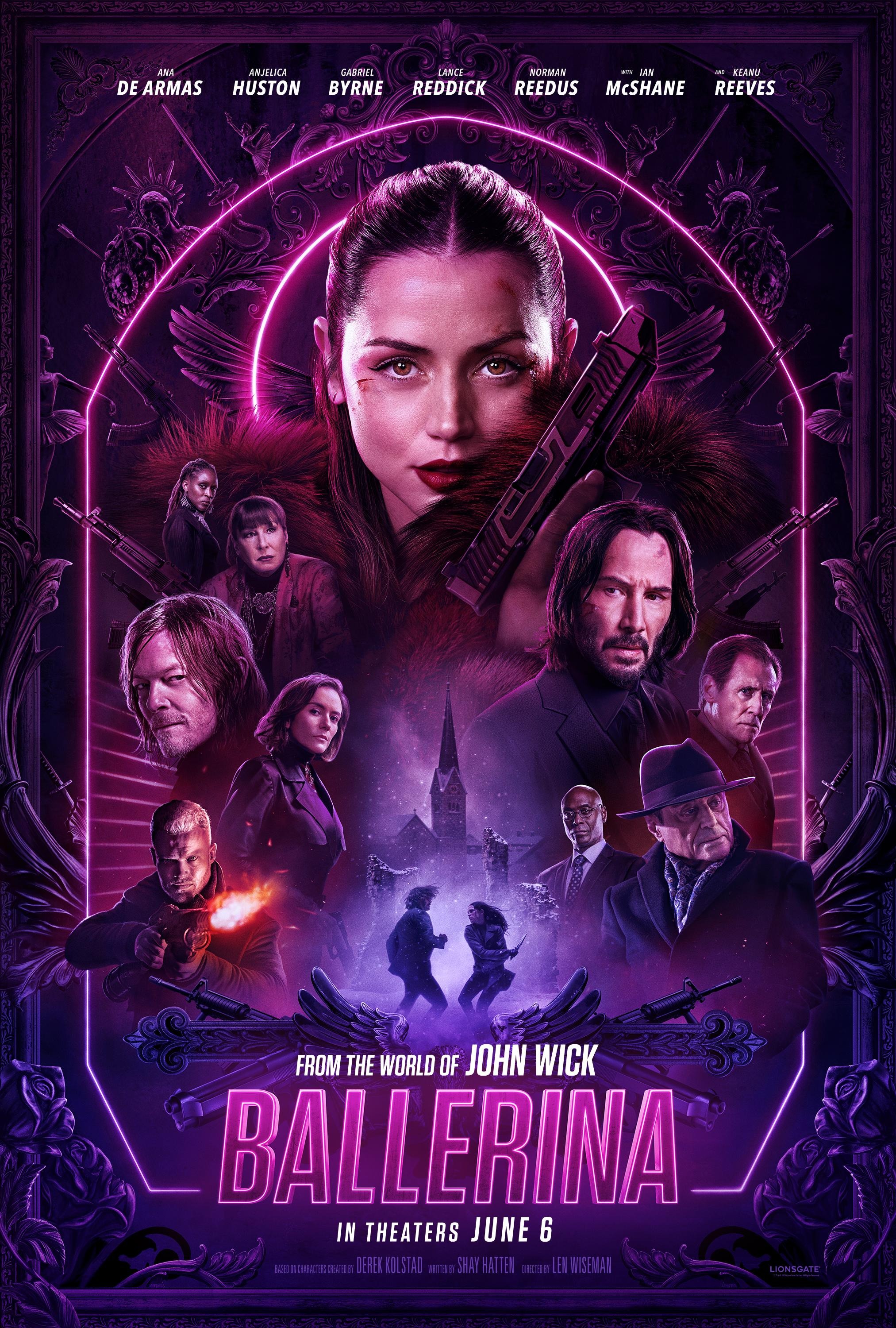
Review: It is incredible to think that a film about a man who embarks on a violent and personal mission to exact revenge on the goons who killed a puppy, a gift from his beloved late wife, could spawn such an enthralling and gritty action franchise. Taking a close look at the murky criminal underworld and a network of assassins with hotels all around the world for these assassins to rest in between jobs, all while allowing its titular hero to find endlessly creative ways to eliminate those who wronged him. Yet, after four films that have shot and stabbed their way to a billion dollars at the worldwide box office, and a spin-off TV show about the New York Continental. However, the time has come for the passing of the torch and for a new central figure to pirouette her way to take the limelight, that the Baba Yaga has carried so successfully.

Set between the events of John Wick: Chapter 3 Parabellum and Chapter 4, Eve Macarro (de Armas) is a ballerina turned assassin who has been training in the traditions of the Ruska Roma for over a decade after her father was murdered when she was a young girl. After a decade of gruelling training, Eve graduates from the programme and is sent out on missions by the Ruska Roma’s uncompromising and strict director (Huston). Yet, the whole time, the thought of getting back at those who were responsible for her father’s murder is never far from her mind. When she comes across a clue that could lead her to them, she defies the director’s orders and sets off on her quest for revenge, and no one is going to stand in her way from getting to the bottom of who killed her father.

Anyone who saw 2021’s No Time to Die will know that when de Armas’s CIA agent Paloma meets Bond to infiltrate a meeting of the nefarious SPECTRE and fend off their goons, it delivered one of the film’s most exhilarating sequences. Despite a scandalously brief amount of screentime, she certainly left her mark on the franchise, and probably several of those SPECTRE goons, when she kicked their arses. Opportunities arose for her to develop that impressive turn alongside 007, but they never quite materialised. Thankfully, this is the one that doesn’t waste her talent and, much like Mr Wick, allows her to showcase her incredible action skills and get inventive in how she takes down her enemies. Flamethrower? Check. Grenades? Check. Ice skate blade? Check. Hell hath no fury like a woman on a deeply personal mission of revenge, and de Armas commits to the physicality of the role and does the majority of her own stunts in tremendous style.

The Wick universe is synonymous with slickly directed and stylish action scenes, where bad guys are dispatched in a violent and brutal fashion. Even with some reported reshoots helmed by franchise veteran Chad Stahelski, Len Wiseman brings an experienced hand to them. Yet for a female-led spin-off, it is a massive missed opportunity to not have a woman assume the responsibility of director. Shay Hatten’s script is surface-level at best when it comes to providing Eve with a sufficient amount of depth beyond her mission. You want to root for her, given the personal nature of her quest for revenge. Despite slotting in seamlessly as a spin-off to the underworld established by the first four John Wick films, the script does her a disservice, as she is explicitly told to “fight like a girl” by Ruska Roma teacher Nogi (Duncan-Brewster).

In a world where numerous badass female assassins have gone toe-to-toe with their male counterparts, and especially given what we know de Armas is capable of as an action star, it’s counterproductive and works against establishing Eve as a force to be reckoned with in this universe. This is not something she explicitly needs to be told when preparing for her missions. Perhaps a female director would have enabled the action to stand proudly on its own two feet, but instead, it cannot escape the shadow of Keanu Reeves’ legendary hitman. Speaking of Mr Wick, his appearance here could have been nothing more than a gratuitous cameo for the sake of nothing more than fan service, but he does serve a purpose in Eve’s revenge mission against the Chancellor (Byrne). An antagonist for Eve to confront for the pain he’s caused her, but he could have been so much more and is ultimately given paper-thin depth and development and pales in comparison to the villains of the John Wick films.

Checking back in to this brutal world of legendary hitman and bloody revenge is always a welcome one, especially as it represents our final chance to bid farewell to the late Lance Reddick as the concierge Charon. However, despite de Armas’s best efforts to twirl, shoot, and stab her way through as many bad guys as she can, as entertaining as these moments are, they don’t quite reach the heights of the films that have come before it. Still, there is definitely room for further expansion, and hopefully Eve Macarro will get her chance in the future to establish herself as a force to be reckoned with in the same breath as the Baba Yaga.

 Ballerina is at its most exhilarating when Ana de Armas is tearing through bad guys through any means at her disposal, but ultimately, the spin-off doesn’t quite hit the heights set by the previous entries in the franchise. 


Posted in 2020-2029, Film Review

Conclave (2024)

© Black Bear UK, Focus Features, FilmNation Entertainment and Indian Paintbrush

Conclave – Film Review

Cast: Ralph Fiennes, Stanley Tucci, John Lithgow, Sergio Castellitto, Isabella Rossellini, Lucian Msamati, Carlos Diehz

Director: Edward Berger

Synopsis: After the death of the Pope, a cardinal is tasked with organising the vote to elect a new leader of the Catholic Church…

Review: In a year when many people worldwide have gone to the polls to cast their ballot in elections, Edward Berger’s follow-up to his Oscar-winning All Quiet on the Western Front, couldn’t be timelier. Like the outcomes of these general elections, the election of a leader for an institution like the Catholic Church – an important pillar of faith for millions – is highly consequential. While the process is conducted away from the eyes of the watching world, Berger swaps the trenches of World War I for the halls of the Vatican and peers through the black or white smoke, at one of the most secretive and oldest elections in human history.

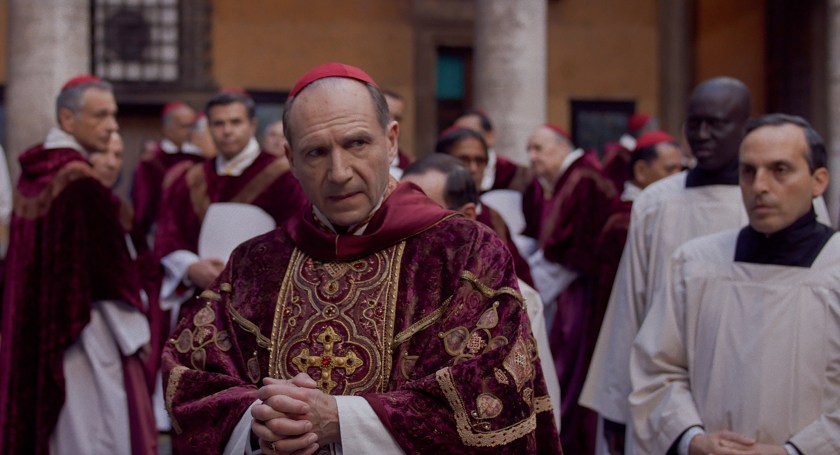
The film opens with Cardinal Lawrence (Fiennes) pacing through the streets of Rome late at night, arriving at the Pope’s private chambers in the Vatican. There, he receives the solemn news that the Holy Father has passed away from a heart attack. As the Dean of the College of Cardinals, Lawrence is tasked with organising the papal conclave, the election process to select the new pope. As the election begins, four leading contenders emerge: the liberal Cardinal Bellini (Tucci), the socially conservative Cardinal Adeyemi (Msamati), the moderate Cardinal Tremblay (Lithgow), and the hardline traditionalist Cardinal Tedesco (Castellitto), who threatens to reverse decades of reform. As the election unfolds to determine the most powerful figure in the Catholic Church, startling revelations emerge, threatening to overshadow the process and could cause catastrophic damage to the Church’s reputation, if they became public knowledge.

In the same vein as the elections the public participates in, with politicians desperately looking to either attain power or hang onto it by any means necessary by appealing to their respective electorates, Conclave is a fascinating exploration of humanity’s innate and almost selfish desire for ambition and to obtain power whenever they can. These are traits you wouldn’t expect of religious men in the service of a higher being and the institution to which they have devoted their lives. Peter Straughan’s script, adapted from the book of the same name by Robert Harris, lays this for all to see as these four men desperately look to play their hands and outmanoeuvre their competitors. It is all the more difficult for Lawrence, who shares the same political mindset as Bellini but must position himself as neutral given his position as the one who is overseeing the election. Yet, he knows of the damage that would be dealt to the Church and the Papacy if someone like Tedesco ascended to the papal throne. All the while, as the election takes shape, the revelations that come to light cause Lawrence to doubt his faith in the institution to which he has devoted his entire life.

The hallways of the Vatican, featuring men in fancy garments writing some words on a bit of a paper to choose their next leader, might seem the most unlikely ground for a pulsating, edge-of-your-seat thriller. Yet, for a gripping 120 minutes, as agendas begin to shuffle, the scheming commences as support for the various candidates fluctuates as some uncomfortable truths are revealed. It never fails to be utterly captivating, in no small part due to the phenomenal performances across the board. As the cardinal at the centre of this, Fiennes has consistently had a consistently captivating screen presence across his 40-year career, and he is utterly masterful once again. He must balance the difficult task of remaining objective in the running of the conclave, while desperately trying to prevent the election of a pontiff that would in his mind, cause considerable damage to an institution that has already had plenty of issues to contend with that have damaged its standing with the public. While Bellini ideologically aligns with Lawrence, he emphatically rejects any desire to become Pope. However, he may find himself reluctantly drawn into it to prevent Tedesco, or the devious Tremblay from winning the election, the latter of whom may also have some secrets he desperately tries to keep hidden.

While these cardinals scheme, bicker and devise plots throughout the process, the nuns in the Vatican remain mostly anonymous and silent observers. This is until Sister Agnes (Rossellini) is called upon when a decades-old secret comes to Lawrence’s attention. Fleeting though her screentime may be, with every word or gesture, she makes the most of her screentime in no uncertain terms. Reteaming with Berger after their combined Oscar success, Volker Bertelman’s string-heavy score is enough to get your heart racing with its intensity as if there wasn’t fraught enough with the events of the election playing out before our very eyes. The brisk editing by Nick Emerson ensures the film’s pacing never lags while Stéphane Fontaine’s cinematography is with several scenes boasting such visual splendour, that they wouldn’t look out of place in the Sistine Chapel. 2024 has been a significant year for vying for power at the highest positions of government, perhaps more than some would have liked it to be, given the outcomes of certain elections. Yet, it serves as a stark reminder, that absolute power corrupts absolutely, and no man, religious or not, can hide from that inescapable truth.

Through the divine work of an impeccably acted ensemble, featuring some of the best performances of Fiennes’ illustrious career, who would have thought a film about the election of a leader of the Catholic Church could be so thrilling?

Posted in 2020-2029, Film Review

Twisters (2024)

© Warner Bros, Universal and Amblin Entertainment

Twisters   – Film Review

Cast: Daisy Edgar-Jones, Glen Powell, Anthony Ramos, Brandon Perea, Maura Tierney, Sasha Lane, Daryl McCormack, David Corenswet, Harry Hadden-Paton

Director:  Lee Isaac Chung

Synopsis: Years after a personal tragedy, a meteorologist is drawn back into the world of storm-chasing by an old friend…

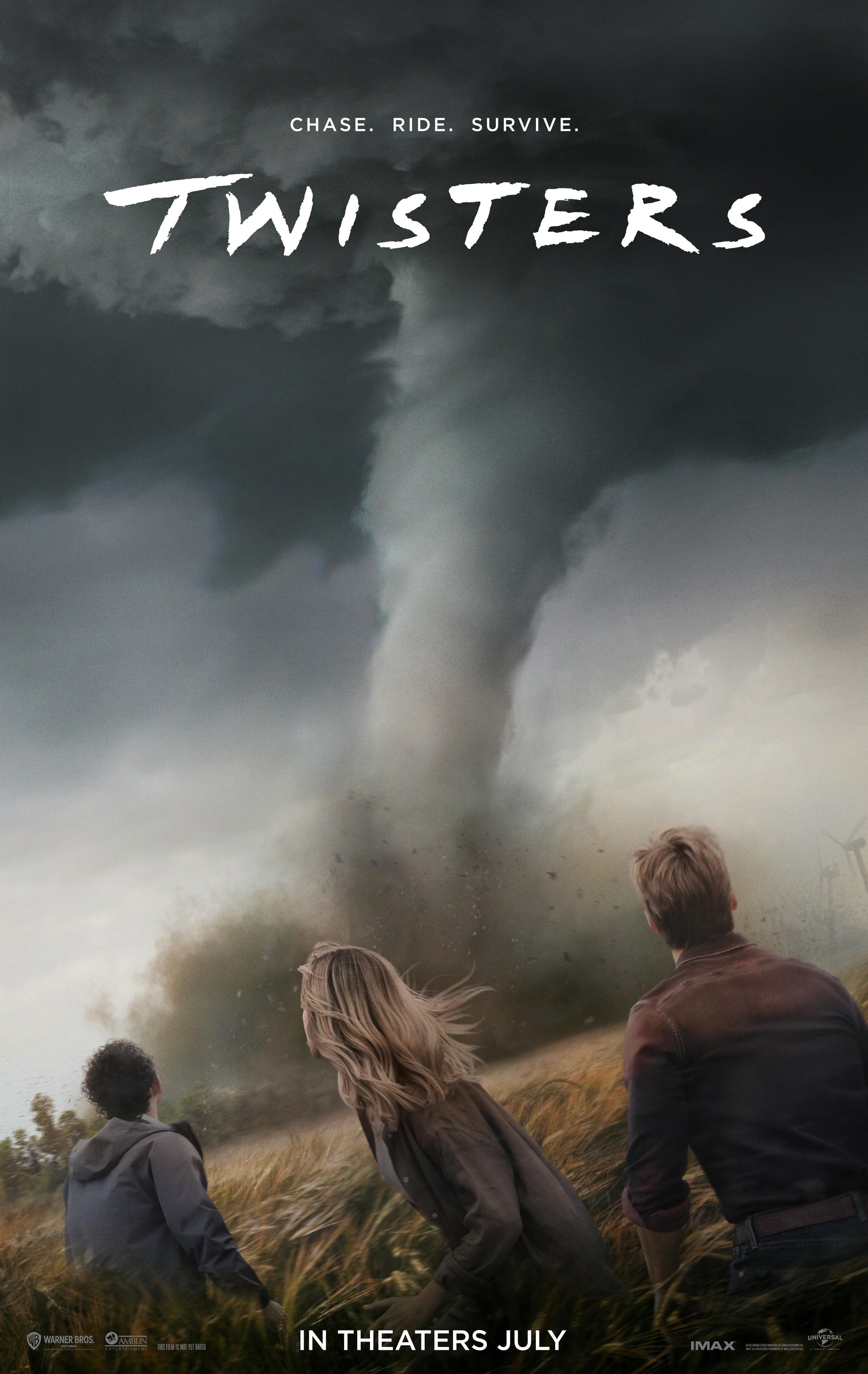
Review: Mother Nature can be a very beautiful thing, but she also be extremely frightening and deadly if she wants to be. There is no shortage of natural disasters to unleash on anything and anyone who finds themselves in the path of these deadly occurrences.  Yet despite the threat these events pose, there is something that is inescapably compelling, and in some cases, inspiring about watching them unfold on the big screen. 1996’s Twister, despite being plagued by a troubled production of adverse weather conditions, is to this day, one of the best examples of a disaster movie, and led to a rise in the number of students who looked to study meteorology. The forecast at the time would surely have predicted a high probability of a sequel. It has taken nearly 30 years to arrive, but it is here, to blow your socks off.

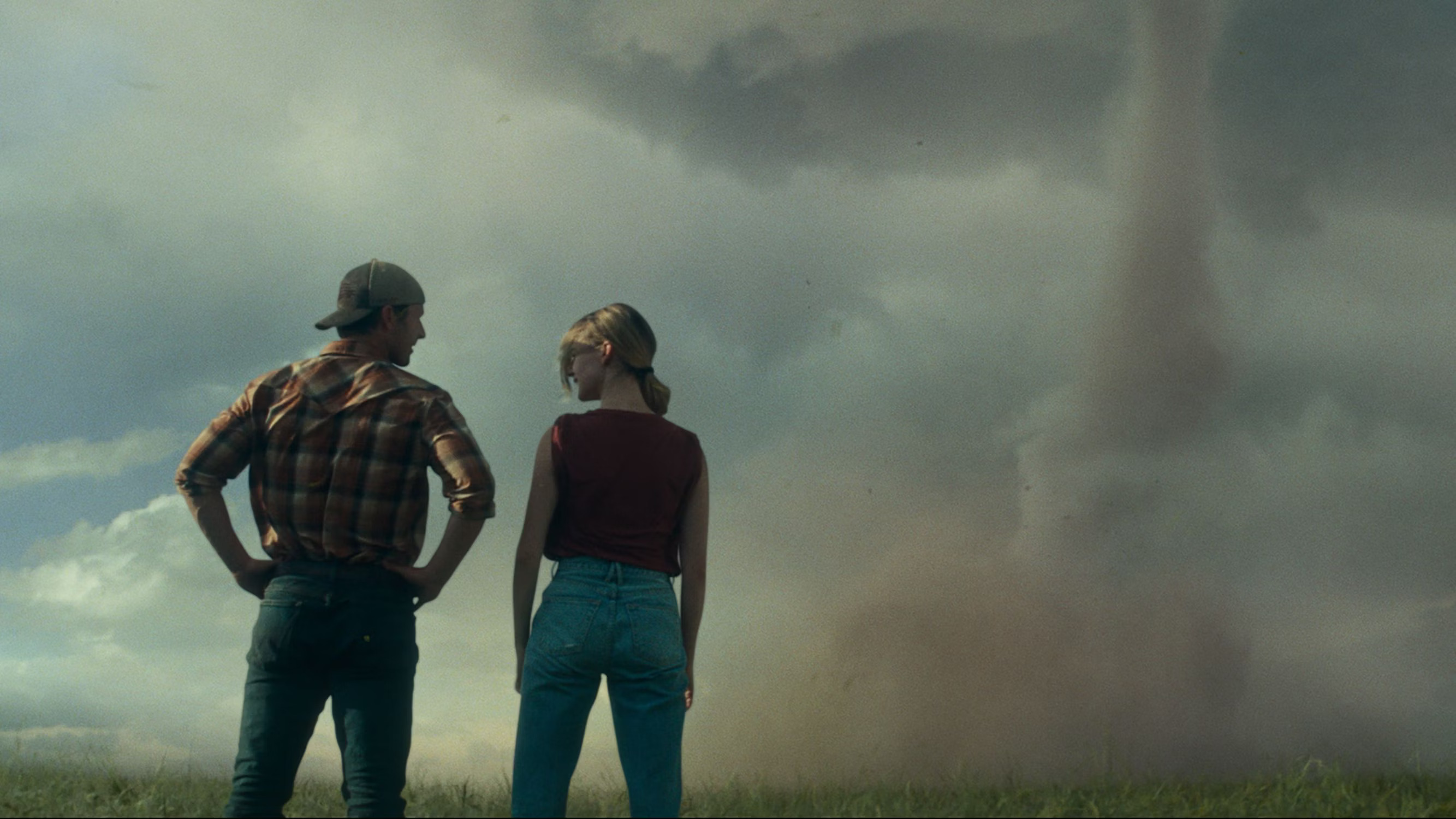
Kate Carter (Edgar-Jones) is a meteorologist living in New York City. Five years earlier, while chasing a tornado with a team to carry out research on how to reduce the storm’s intensity in Oklahoma, tragedy strikes which leaves most of her friends and fellow storm chasers dead, with the only survivor being Javi (Ramos). Such a traumatic experience has taken its toll on Kate, she initially rebuffs an offer from Javi to get back into the world of storm-chasing. However, upon seeing the damaging impact the storms are having and the potential to save countless lives, Kate joins up with Javi and a new team in Oklahoma. When they arrive, they encounter Tyler “Tornado Wrangler” Owens (Powell) a fellow meteorologist, who also happens to vlog his storm-chasing adventures with his eclectic team.

It will not come as news to anyone that tornados can be immensely dangerous, with the most extreme storms capable of reaching wind speeds of more than 300 miles per hour and can stay on the ground for more than 100 kilometres. These perils are devastatingly realised in an extremely tense opening scene in which director Lee Isaac Chung really makes the audience feel the intensity of these storms and how one wrong move can be catastrophic.  The script by Mark L. Smith, which serves as a stand-alone sequel to Jan De Bont’s classic, shares no mutual characters and no connective gusts of wind. However, in a world with the threat of extreme weather events becoming more and more common, the screenplay makes the wise choice to not tinker with what made the 1996 film so successful. It merely brings it into the 21st century, with all the technological advancements that have happened, to enable those who would be brave/crazy enough to venture into the heart of a storm all in the name of scientific research, or for just the sheer thrill of it because: “if you feel it, chase it!”.

As the meteorologist in the eye of these storms, Daisy Edgar-Jones is terrific as Kate. Her talent for storm-chasing is immediately evident and she brings an abundance of enthusiasm for it. You get the sense that after stepping away from it for several years, she is eager to make up for the lost time. In what has been a remarkable rise for him over the last few years, Powell is also on terrific form as Tyler. He very much exudes that charisma and bravado that was on display in Top Gun: Maverick, who is at first solely in the business of storm-chasing for internet fame and daredevil. Though initially on rival storm-chasing teams, the duo begin to work together when the very real threat of these storms stands to cause catastrophic damage across the region. Such is their palpable chemistry, that it blows the rest of the supporting cast to the sidelines, aside from Anthony Ramos’s Javi who finds himself torn between the friendship he has for Kate, and the investor of his company, who may or may not be involved with some rather shady business practices.

After directing the heart-warming and soulful Minari, Twisters is perhaps not the next film many would have forecast Chung to be as his follow-up feature. Combined with the immaculate direction of the storm-chasing sequences, as he showed with his tender debut feature about one immigrant family’s pursuit of the American Dream, Chung brings real humanity to the film as the relief efforts to help the people rebuild their lives, homes, and businesses are given the necessary attention. It’s all well and good chasing a tornado to get the blood pumping, but the film never loses sight of the devasting impact these storms have on the people whose livelihoods are in their path. Unless you are the daredevil sort, storm-chasing is an adventure you probably won’t want to be seeking out any time soon, but it will provide you with a blustery good time at the cinema and who knows, maybe inspire a whole new generation’s interest in meteorology? Lightning could most certainly strike twice.

Following in the path of one of the best disaster films might have been a daunting task, but with the charisma of its cast and thrilling and intense storm-chase sequences, Twisters is a thrilling blast of spectacle and struggle against the perils of Mother Nature. 

Posted in 2020-2029, Film Review

Civil War (2024)

© A24

Civil War – Film Review

Cast: Kirsten Dunst, Cailee Spaeny, Wagner Moura, Stephen McKinley Henderson, Nick Offerman, Sonoya Mizuno, Jesse Plemons

Director: Alex Garland

Synopsis: A team of photojournalists document events on the ground as the United States is in the midst of a brutal civil war…

Review: “A date which will live in infamy”, the words of US President Franklin D. Roosevelt after the US naval base of Pearl Harbour came under attack on December 1941. However, they could just as easily have been words uttered in the wake of January 6th, 2021, when the world recoiled in horror as supporters of the disgraced former President Donald Trump, attacked the US Capitol in a violent insurrection after being told straight-up falsehoods about the Presidential election held just a few months prior. As the world watched, the ugliness and the depravity of those scenes were scarred into our memories as a moment where it felt like the US was at a tipping point and could very easily descend into the second Civil War in its history. This moment, an unprecedented one in history seems to have inspired this grounded and harrowing tale of war in a bitterly divided nation from Alex Garland.

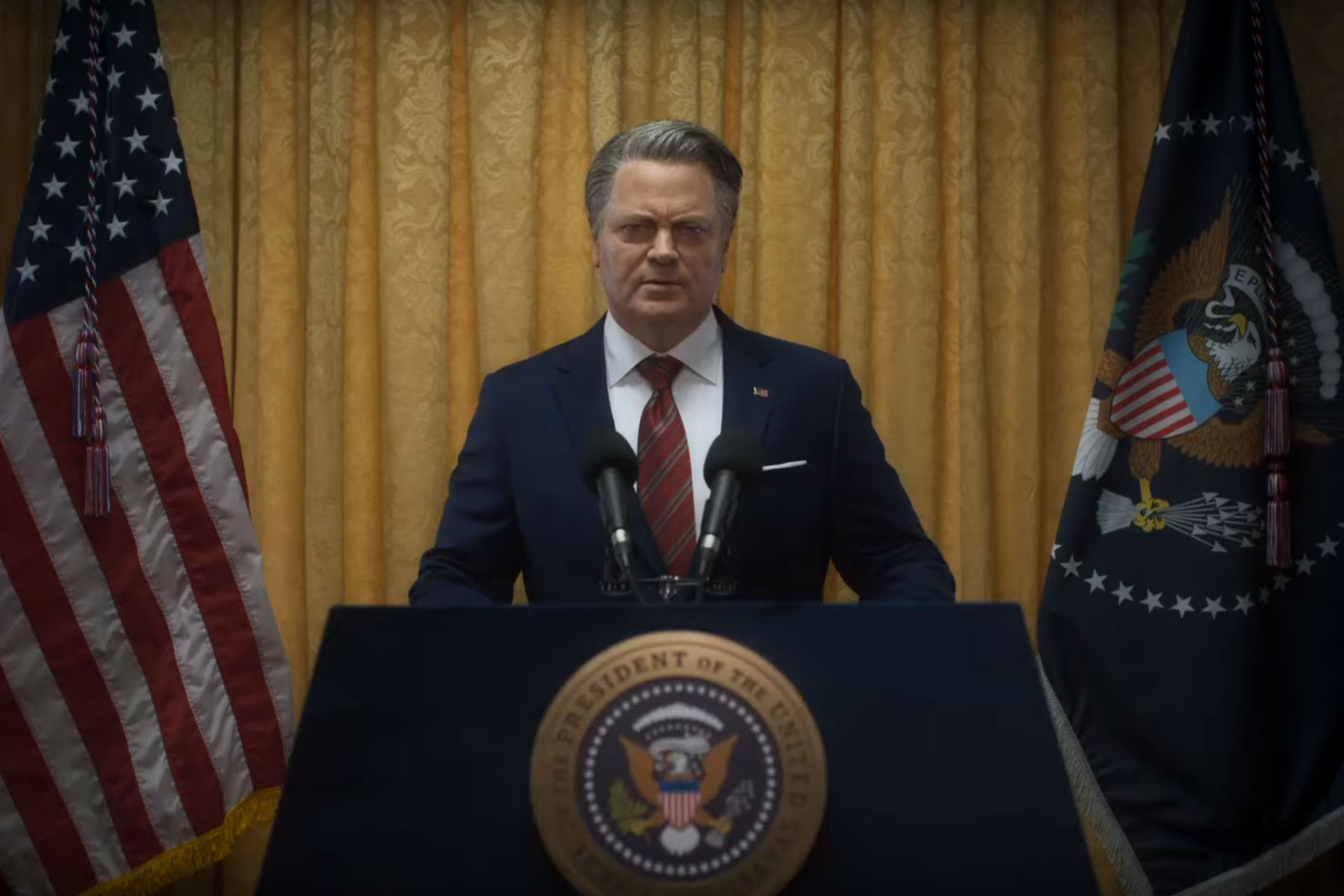
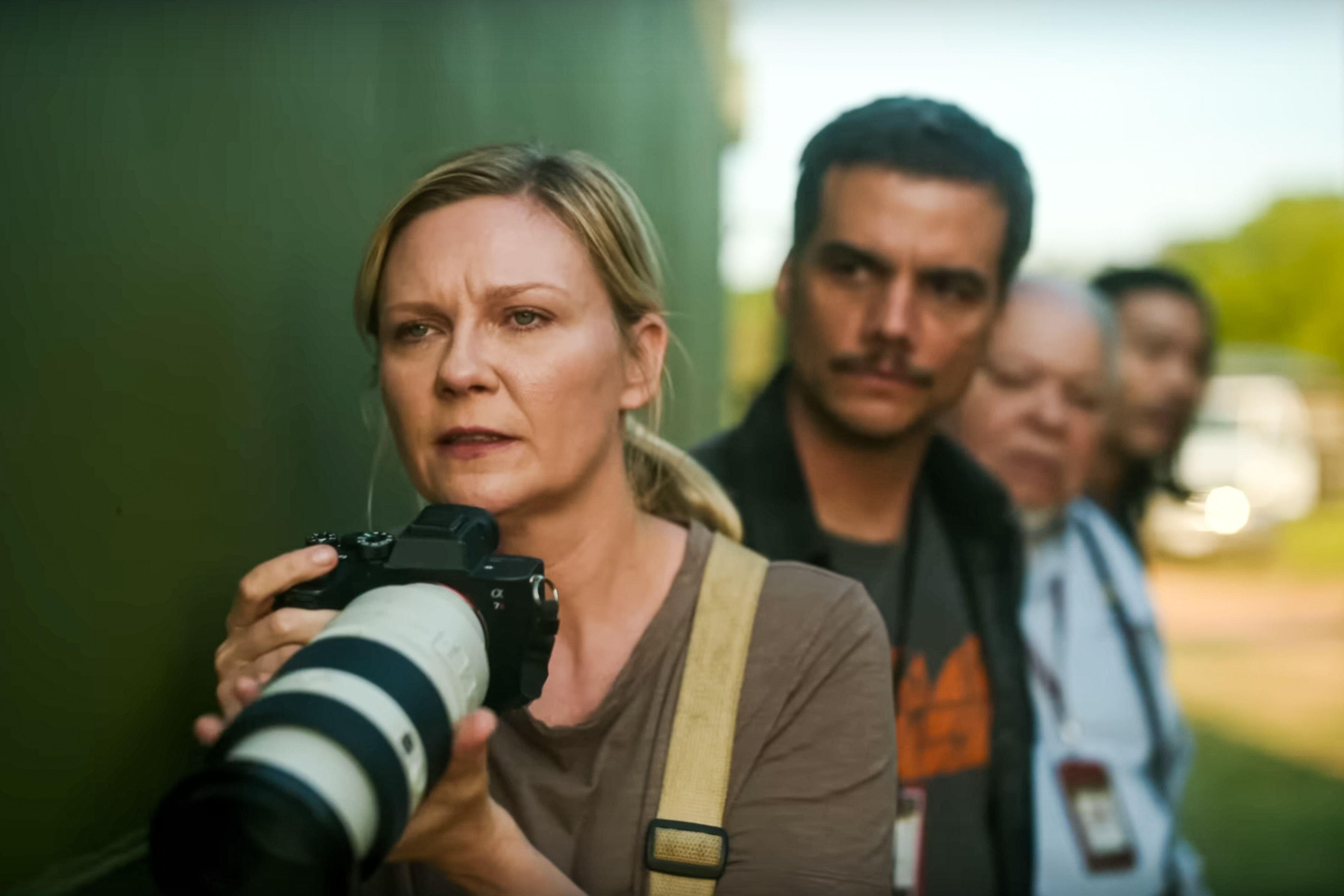
Set in the near future, the country is in the midst of a civil war with multiple factions locked in a brutal fight against the other. On one side stands the Loyalist states which have stood by the President (Offerman), who it’s vaguely suggested has become something of a dictator as he is serving his third term in office. On the other side of the battlefield, stand numerous other factions which have seceded from the union, including the New People’s Army consisting of states in the north-west of the country, the Florida Alliance and crucially the Western Alliance consisting of the states of California and Texas. As the Western Alliance prepares for an offensive against Washington DC, war photojournalist Lee (Dunst), journalist Joel (Moura), and veteran journalist Sammy (McKinley-Henderson) prepare to make the perilous journey to the capital to document the events on the ground and in the hope of interviewing the president. They are joined by aspiring photojournalist Jessie (Spaeny), who idolises Lee’s work.

One would have to have been living under a rock to not know that in recent times, particularly since 2016, the United States has become a very divided nation, fraught with bitter political tension. Therefore, Garland’s script chooses to not pick a side in this conflict and instead frames the hostilities from the perspective of the journalists. Brave men and women who risk their lives to document the hostility objectively in the face of any conflict. The decision to frame the film from the perspective of the journalists is a pointed one, particularly given the fact their jobs have become considerably more challenging in recent years, stemming from certain former world leaders using their platform to viciously attack the media for simply doing their jobs and bringing the facts to light, even as such spurious terms like  “fake news” have become rampant. It is a sharp and necessary reminder of the essential jobs of the media, particularly in fraught times where conflict is raging, certain politicians who are only too eager to launch attacks on them as the foundations of society have crumbled, and civilisation as we know it has completely fallen into ruin.

Garland also uses this as a means to examine how the humanity of such journalists would be impacted when they have been in such close proximity to brutality and death for extended periods, particularly Dunst’s Lee. Within minutes of meeting her, you get the impression this is someone who has been through and witnessed more barbaric acts of violence and horror than any person should have over their lifetime. Dunst’s performance exudes a sense of world-weariness and exhaustion, yet despite this, she knows she must plough on, particularly given Jessie’s adoration for her and her work. Lee recognises Jessie’s potential, which prompts her to take Jessie under her wing, in a similar vein to how Sammy took Lee under his wing when Lee first started out. All the while Jessie, while keen to learn under her idol, is left severely shaken by some of the horrifying sights she sees while the group makes the journey to Washington DC.

To say this is a perilous journey would be a severe understatement, as Garland does not hold back with depictions of what a modern-day Civil War in the States could look like. Striking images of former metropolises once teeming with life, reduced to barren wastelands with buildings smouldering in smoke. Shopping centres are left totally abandoned. Hostilities break out in broad daylight, with bodies strewn across the streets, and in some instances, soldiers proudly displaying their victories as a warning to the opposing forces. It is, at times, disturbing to watch and Garland’s direction is gritty and captures the brutality and ugliness of what would likely happen if a Civil War broke out on the streets of the US in the modern era. One scene is so fraught with tension and anxiety, that you could cut it with a knife, and will send audiences’ heart rates soaring.

In a time when the news cycle is dominated by seeing numerous regions the world over and utterly grim and heartbreaking stories emerging on a daily basis, Garland’s film is topical, to say the least about the horrors and devastation of war. However, while it drops hints here and there as to the causes, with Offerman’s President spouting very Trumpian rhetoric and the flashbacks to the Capitol insurrection, the key context for the events that led to the breakout of the war is left to the audience’s interpretation. You could certainly make the case the film had plenty more to say about the state of US politics. However, in an election year, with political tension showing no sign of letting up amid an ever-chaotic and violence-stricken world, the overarching message that war is hell is received loud and clear.

While it could have had more to say about the state of politics in our world today, Civil War remains a tense and gritty look at a society torn apart by conflict and the pivotal role of the media. 

Posted in 2020-2029, Film Review, London Film Festival 2023

The Killer (2023)

© Netflix

The Killer – Film Review

Cast: Michael Fassbender, Charles Parnell, Kerry O’Malley, Sala Baker, Sophie Charlotte, Tilda Swinton, Arliss Howard, Emiliano Pernía, Gabriel Polanco

Director: David Fincher

Synopsis: An assassin on a mission to eliminate a target finds himself up against his employers after the mission goes awry…

Review: “Empathy is weakness, weakness is vulnerability” narrates the nameless assassin at the centre of the latest film from the master of suspense David Fincher. It is probably a requisite in that particular line of work that one would need to not allow their feelings or emotions to interfere in the name of getting the job done. Cinema has seen no shortage of films centred on the worlds of espionage and paid assassins. In the hands of a director whose methods are as targeted and as precise as its titular hitman, he brings an entirely unique perspective to this genre, unlike anything we have seen before.

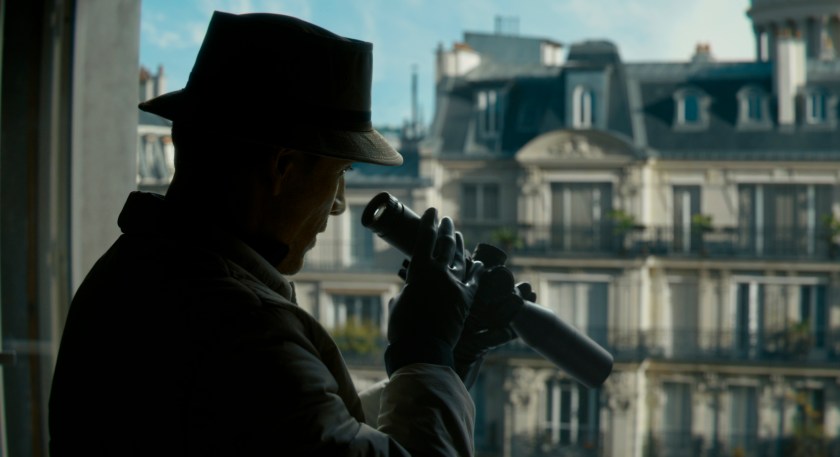
The eponymous assassin (Fassbender) is contracted by his employers to eliminate a target by any means necessary, even if it means waiting for days on end for the opportune moment to present itself. While he lies in wait, he will prepare meticulously to ensure he is ready, but he will also find time to engage in regular day-to-day activities, such as ordering fast food and doing yoga. The precise and methodological approach he takes towards his job is procedural, and he will merely bide his time waiting for the moment to strike. When the moment does arrive, a rare mishap leaves him wondering who might now be after him and if he is about to be the one in the crosshairs of his employers.

Adapted from the French graphic novel series of the same name written by Alexis Nolent, the script by Andrew Kevin Walker (reuniting with Fincher after the duo worked on Se7en) wastes no time getting down to business. It whizzes through the opening credits almost quickly as a speeding bullet, though it slows back down again as through an extensive period of narration by The Assassin as he gets ready to carry out the assassination he has been paid one presumes an exorbitant amount of money for. From there, once the planned hit has been botched, the film is divided into chapters as he goes across the globe to confront his employers and seek retribution against those who may have targeted him, or those close to him in response to the botched job. He does all this while having a penchant for destroying mobile phones and listening to The Smiths. Who knew that listening to Morrissey is the perfect ambience an assassin requires to commit brutal acts of violence?

Before taking a three-year break away from the big screen, Fassbender was in something of a rut having starred in a series of films which did not have the best of receptions either critically or commercially. Therefore, it is immensely satisfying to see him return to form in a big way as he is electrifying here. Given he’s in just about every frame of the film, he commands the screen with a presence with an intensity and an aura of someone you absolutely do not want to mess with. He’s a man of few words but has an icy death stare that would make anyone’s blood run as cold as the deepest depths of the South Pole during a long and dark winter night. For understandable reasons, Fincher keeps his camera trained on Fassbender to the extent that pretty much every other member of the cast is given very little or sparse screen time. However, each one, especially Tilda Swinton makes their screentime count.

There’s a foreboding nature running through every frame of the film thanks to the atmospheric cinematography from Erik Messerschmidt, and an intense score from Trent Reznor and Atticus Ross. It is all overseen by a director who like his main character, is methodical and meticulous in how he shoots his films. His command of the craft is never in doubt, particularly when it comes to what is one of the most brutal fight scenes in a film this year or in a good long while for that matter where every punch and blow is strongly felt. While the story itself is light on substance and could have delved more beyond the surface level of the assassin’s psyche and what makes him tick, it is hard to count that against it when everything is so slickly and stylishly presented. This should come as no surprise given that like his titular assassin, Fincher shoots to thrill, and thrill he most certainly does.

Gripping from the word go and never letting up due to a phenomenal leading performance from Michael Fassbender, the master of the thriller once again delivers a pulsating and intense ride which does not miss.

Posted in 2020-2029, Film Review

Fall (2022)

© Lionsgate and Signature Entertainment

Fall – Film Review

Cast: Grace Caroline Currey, Virginia Gardner, Mason Gooding, Jeffrey Dean Morgan

Director: Scott Mann

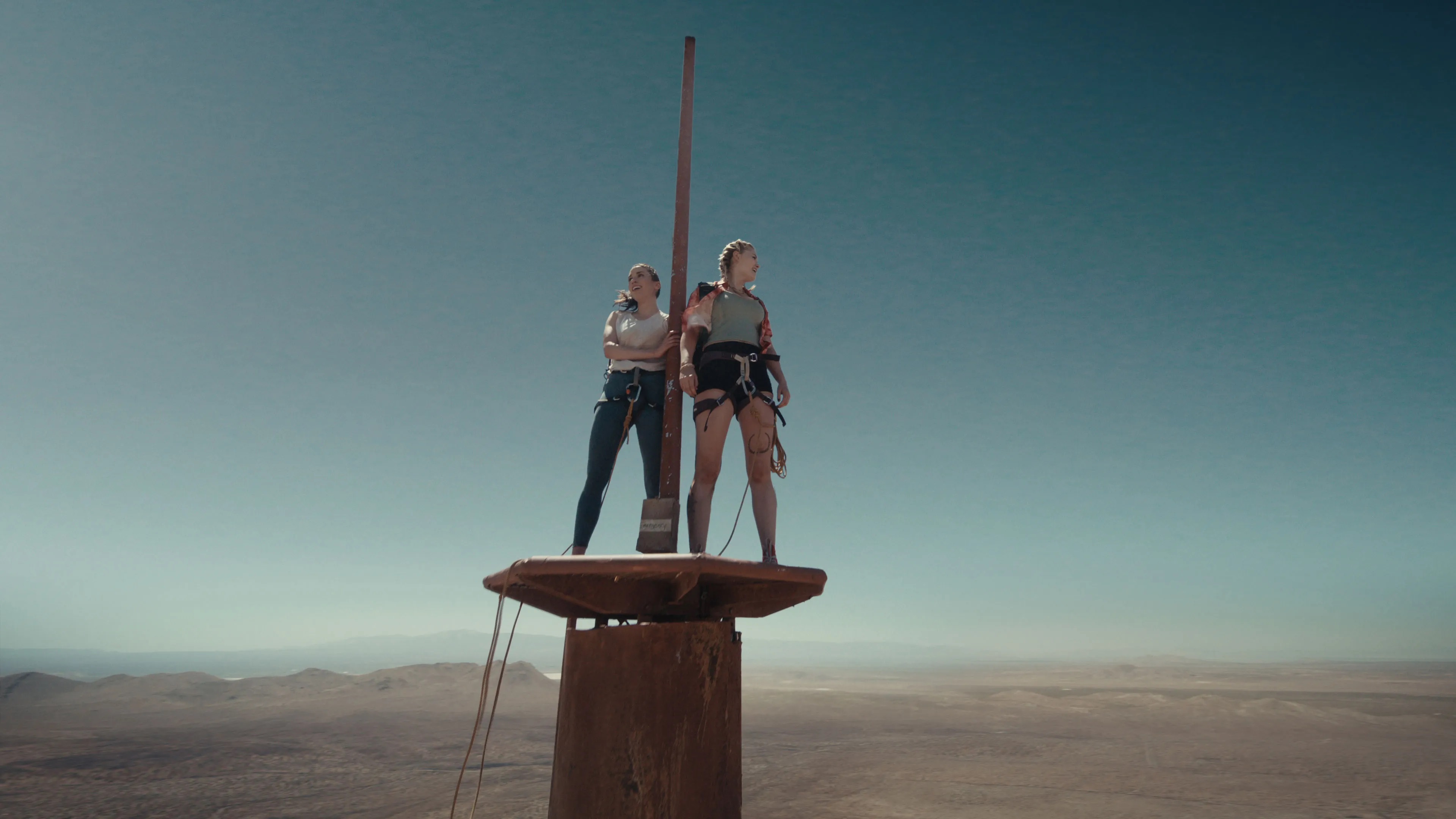
Synopsis: Two friends find themselves stranded atop a 2,000ft tall radio tower…

Review: As human beings going about our day-to-day lives, we are accustomed to having our feet on terra firma for most of the time. However, there are those daredevils out there who love to be adventurous/out of their minds (delete where appropriate), and climb exceedingly tall structures all in the name of thrill-seeking and adventure. Such individuals form the basis for this simple, but undeniably extremely tense and nerve-shredding thriller which is exhilarating and positively terrifying for those who are utterly terrified of heights.

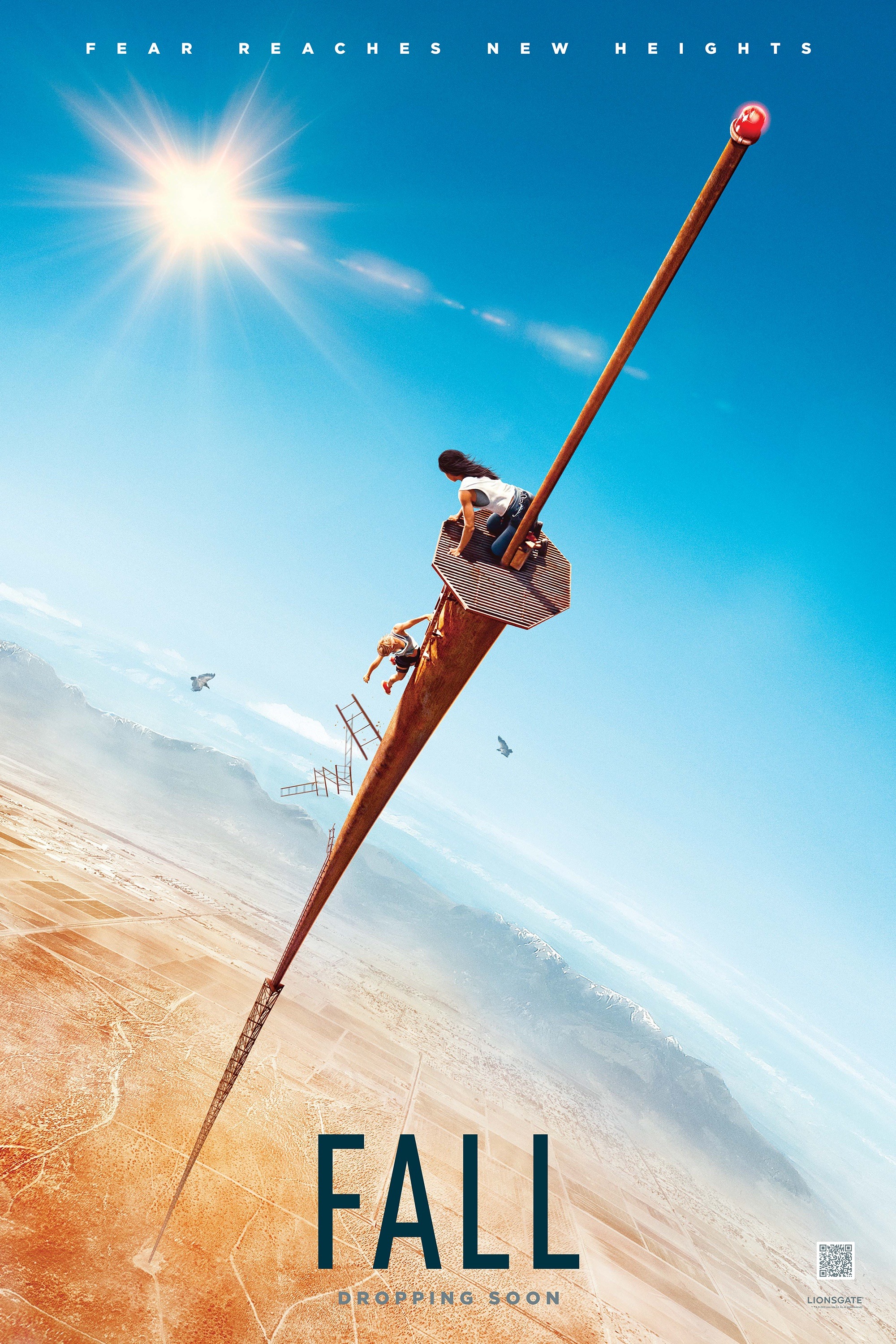
Becky (Currey) and Hunter (Gardner) are two best friends who love to go rock climbing. On one particular day, they are out climbing a mountain one day, with Becky’s husband Dan (Gooding), when tragedy strikes. Fast forward nearly a year, and Becky’s life has spiralled where she is in a deep depression and battling alcoholism. Upon encouragement from Hunter, the two of them set out to climb the 2,000 ft B67 TV tower in the middle of nowhere, so the two can rediscover their passion for adventure and enable Becky can finally move on from the tragic events one year prior. The adventure goes to plan when the two of them are, for a brief moment, on top of the world for a brief moment. However, as they begin to make their descent, disaster strikes as the ladder they used to climb up breaks apart, leaving them stranded atop the tower, with no way down and with very little in the way of supplies.

To put it into perspective, standing at 2,000ft, the B67 TV tower would be the fourth tallest building in the world behind only the Burj Khalifa in Dubai, the Merdeka 118 in Malaysia and the Shanghai Tower, which is all sorts of terrifying. While the actors were not actually at such extraordinarily unnerving heights, the decision by the filmmakers to shoot on a practical location in the California desert, and construct the upper part of the tower on top of a mountain, is extremely effective as it adds a great of authenticity to the suspense. Mann’s direction, with the vertiginous cinematography and a very effective score, all combine to sell the peril of their situation and are guaranteed to make anyone sweat profusely with anxiety as the horror of the situation unfolds as these two battle the elements, and more, in their bid to stay alive.

The script by Mann and Jonathan Frank wastes little time establishing the core events which prompt Becky and Hunter to make this perilous ascent up to the top of this abandoned TV tower. To make matters worse for them, the platform at the top of the tower is exceedingly narrow, giving Becky and Hunter little room for manoeuvre as they must find a way to ensure they avoid that terrifying 2,000 ft drop back down to earth and alert the authorities to their plight. While the script does veer a bit into the overly dramatic with some of the dialogue between the two of them, it serves to develop the relationship between them, and the performances of both Currey and Gardner remain strong as the desperation of their plight means drastic action may well have to be taken sooner or later.

The seemingly hopeless nature of these two poor souls’ plight enables Mann to keep the audience on their toes throughout the film’s 97-minute run time, while retaining the nail-biting tension. Yet by the time it reaches the culmination of the third act, the ending does feel a little bit rushed. However, it is a refreshingly original and extremely effective tale of survival in the most perilous circumstances. By the time the credits begin to roll, and your heart rate has returned to normal,  you may be eternally thankful you’ve got those two feet on the ground and will almost certainly have no plans to scale such heights now, or at any point in the future.

The premise is totally absurd, but due to extremely compelling film-making, Fall is an enthralling and simultaneously terrifying white-knuckle ride. 


Posted in 2020-2029, Film Review

Don’t Worry Darling (2022)

© Warner Bros Pictures, New Line Cinema and Vertigo Entertainment

Don’t Worry Darling – Film Review

Cast: Florence Pugh, Harry Styles, Olivia Wilde, Gemma Chan, KiKi Layne, Nick Kroll, Chris Pine

Director:  Olivia Wilde

Synopsis: A housewife living in an idyllic neighbourhood in the 1950s with her husband begins to suspect not everything is as it appears to be in their perfect community…

Review: It is always interesting to see what happens when an actor opts to move from in front of the camera to try their hands at directing. In the case of Olivia Wilde, her directorial debut Booksmart proved to be an uproarious comedy which explored what happens when two studious high school students opt to swap their books for one night of raucous partying. Unfortunately in the run-up to the release of her sophomore feature, much has been made of the reported drama that has seemingly plagued the film in the build-up to its release. From reported arguments between cast members during the production, reported arguments between cast members, and even more drama during its premiere at the Venice Film Festival which has all cast a very large shadow over the project. With this in mind, one would have hoped all the drama would fade into the background had Wilde followed up her wonderful directorial debut with another roaring success. Unfortunately, it doesn’t quite live up to that billing.

In 1950s America, in the picturesque but isolated neighbourhood of Victory, lives Alice (Pugh) and her husband Jack (Styles). In this community, while all the men go off to work on their mysterious jobs during the day, overseen by Frank (Pine), all of the women are expected to be at home doing chores enjoying all of the comforts the community of Victory has to offer. While at night, the couples mingle and throw lavish parties. However, Alice soon begins to experience strange events which lead her to question her existence in this community and suspect something may be amiss with their idyllic lives.

Without any question of a doubt, the greatest asset of the movie is another incredible performance from Florence Pugh. An actor who continues to demonstrate every time she’s on-screen why she is one of the most popular, and best, actors working today. She commits everything to her performance and we watch how this seemingly perfect lifestyle, where she has everything she could possibly want, slowly begins to crumble around her. It leads her down a dark and disturbing path where she soon starts to question everything, including what it is that Jack and all of the other men are really doing at Victory HQ, leading some of the other residents of Victory to dismiss her as paranoid and delusional. After his incredible debut performance in Dunkirk, Harry Styles had the unenviable task of acting alongside his talented co-star. While he can’t quite make up his mind about his character’s accent, he does a solid enough job and has decent chemistry with his co-star, but Pugh outshines him, and everyone else. Furthermore, aside from a rather menacing turn from Chris Pine as the leader of this community, the rest of the cast is severely underutilised, particularly Gemma Chan and KiKi Layne.

Matthew Libatique’s superb cinematography expertly juxtaposes the sun-drenched tranquillity of Victory with the dark and sinister imagery of burlesque dancers hinting at something deeply sinister at the heart of this community. Wilde steps up her game as a directing and brings a unique visual flair to this contrasting imagery, while she also delivers some pulsating chase sequences in the third act. However, what ultimately really lets the film down is its severely lacklustre script.   Reteaming with Katie Silberman, one of the co-writers of Booksmart, it starts on a strong footing as it maintains the intrigue as Alice begins to investigate what is really happening in this perceived utopia these people find themselves. Furthermore, the unnerving score from John Powell maintains the suspense as some rather disturbing truths soon come to light. Without getting into spoiler territory, the film’s exploration of pertinent themes, namely the patriarchal nature of society and the male gaze is to be commended. Unfortunately, once certain details about the world of Victory and its inhabitants have come to light in the third act, the reveals are wholly unsatisfying as they fail to fully develop and expand on them. It all amounts to sheer frustration that by the time the credits begin to roll, the audience is left with more questions than answers.

Despite these shortcomings, Wilde cannot be faulted for her bravery in following up her extremely successful directorial debut with an ambitious sophomore effort which reinforces her as a director to keep an eye on. It is ultimately a real disappointment given the scope of the project and the talent in front of and behind the camera, that potential has frittered away by the time the credits begin to roll. A real shame, darling.

Despite a premise bursting with ideas and promise, not even a stellar performance from Pugh can prevent Wilde’s follow-up to her brilliant directorial debut from failing to capitalise on its vast potential.


Posted in 2020-2029, Film Review

Bullet Train (2022)

© Columbia Pictures, North Productions and Sony Pictures

Bullet Train  – Film Review

Cast: Brad Pitt, Joey King, Aaron Taylor-Johnson, Brian Tyree Henry, Andrew Koji, Hiroyuki Sanada, Benito A Martínez Ocasio, Zazie Beetz, Sandra Bullock

Director:  David Leitch

Synopsis: A group of assassins aboard a high-speed train in Japan discover that their respective missions are interconnected…

Review:  Trian delays and cancellations, expensive fares and overcrowding in stations and on platforms, are some of the many problems that can all quickly turn the most pleasant of journeys into a nightmare. Hence, the idea of a super-fast train that could get you to your destination in an even shorter time seems like it would be the speediest and most stress-free commute ever. Yet, imagine if your train had several dangerous, highly skilled assassins, sitting in its carriages, it might well persuade someone to look for alternative routes. However, with director David Leitch the conductor of this service, this is one train ride you will definitely want to board.

Ladybug (Pitt), is a down-on-his-luck assassin, who while extremely good at his job is, determined to get out of the profession. Tasked by his handler (Bullock) to get on the world’s fastest bullet train travelling from Tokyo to Kyoto, retrieve a briefcase, and get off at the next stop seems like an easy enough assignment. However, matters get considerably complicated when Ladybug realises that he is not the only one aboard the train who has taken an interest in the briefcase. With a plethora of highly skilled assassins on board (with what at first glance appear to be unrelated missions), the realisation soon dawns on Ladybug that there is a connection between their presence and the highly dangerous criminal known only as The White Death. Turning what should have been a simple mission into a more complex one, Ladybug finds himself entangled in a brutal web of violence that thrillingly goes off the rails.

Adapted from Kôtarô Isaka’s novel of the same name, Zak Olkewicz’s screenplay wastes very little time establishing the key characters at play that all for one reason or another, have an interest in this briefcase. The screenplay also utilises non-linear storytelling to establish each character’s motivations and who is in whose respective crosshairs. The use of non-linear storytelling can initially be a bit hard to follow. However, once you have reached the light at the end of this tunnel and the tracks converge, all becomes clear.

There are a pair of contract killers who go by the aliases of Tangerine (Taylor-Johnson) and Lemon (Tyree Henry), a mysterious assassin known as The Prince (King) who puts on a youthful persona to her advantage in order to deceive her enemies, an assassin known as the Wolf (Ocasio) is out on a deeply personal revenge mission. Lastly, there’s Yuichi Kimura (Andrew Koji), who like The Wolf, is also on a deeply personal mission following a family accident. Lastly, you have Kimura’s father, known only as the Elder (Sanada) who’s doing all he can to protect his family. However, for all of the wonderful talent that the film undeniably boasts, there is an element of whitewashing that is extremely difficult to overlook. Given the film’s source material and the setting, to have only two Japanese actors among the core cast feels like a massive missed opportunity.

Despite that misstep with the casting, every actor here is having a ton of fun with the material, and for the first two acts of the film, it is a delightfully riveting watch. Like the speeding bullet train, the mystery of this case, why all these different assassins with different agendas are after begins to unravel in a gloriously bloody fashion. Brad Pitt is someone who has carved a career as one of the most recognisable A-listers working today, and once again, he brings his usual charisma. It is however Tyree Henry and Taylor-Johnson, as the hilarious double act of British assassins who steal the show. Sharing witty and often hilarious banter over topics such as Thomas the Tank Engine, these guys have built a very sincere familial-like friendship built over the missions they have shared together, making their relationship the heart and soul of the film.

David Leitch is well-versed in the world of action filmmaking, especially given his prior stuntman experience. His attention to detail provides Bullet Train with an eye-pleasing visual aesthetic, that boasts highly stylised action scenes and violent payoffs. Confining the action scenes to the narrow aisles of a speeding train is a refreshing change of pace, as it gives the characters a real headache, forcing them to scrap in an area where there is not exactly much room to hide. Despite clocking in at two hours and six minutes, this particular train journey begins to run out of steam towards the end and would have benefitted if it had concluded its journey a few stations prior. Nevertheless, the end product is such a riotous blast of fun that by the time this train has reached the end of the line, you will want to immediately book a return ticket.

It might seem like the commute from hell, but pulsating action and every single member of the cast having a blast makes this particular train journey an extremely enjoyable and exhilarating ride.