


Posted in 2020-2029, Film Review

Project Hail Mary (2026)

© Amazon MGM Studios, Sony Pictures, Lord Miller Productions and Pascal Pictures

Project Hail Mary  – Film Review

Cast: Ryan Gosling, Sandra Hüller, James Ortiz, Lionel Boyce, Ken Leung, Milana Vayntrub, Priya Kansara

Directors: Phil Lord and Christopher Miller

Synopsis: After waking up on a spaceship with no memory of how he got there, an unlikely astronaut is tasked with a desperate mission to save the Earth…

Review: What would you do if you awoke from a coma and found yourself the only person alive on a spaceship light-years away from home, with no recollection of who you are or how you got there? At first, your reaction might be one of confusion, which soon gives way to panic and sheer terror. However, as the pieces of your memory slowly but surely reassemble, you realise that you’re humanity’s last hope for a desperate mission, a Hail Mary if you will (a term defined as a last-ditch pass in American football), where failure will mean life as humanity knows it will witness a catastrophe of apocalyptic proportions as the sun slowly dies. No big whoop (!).

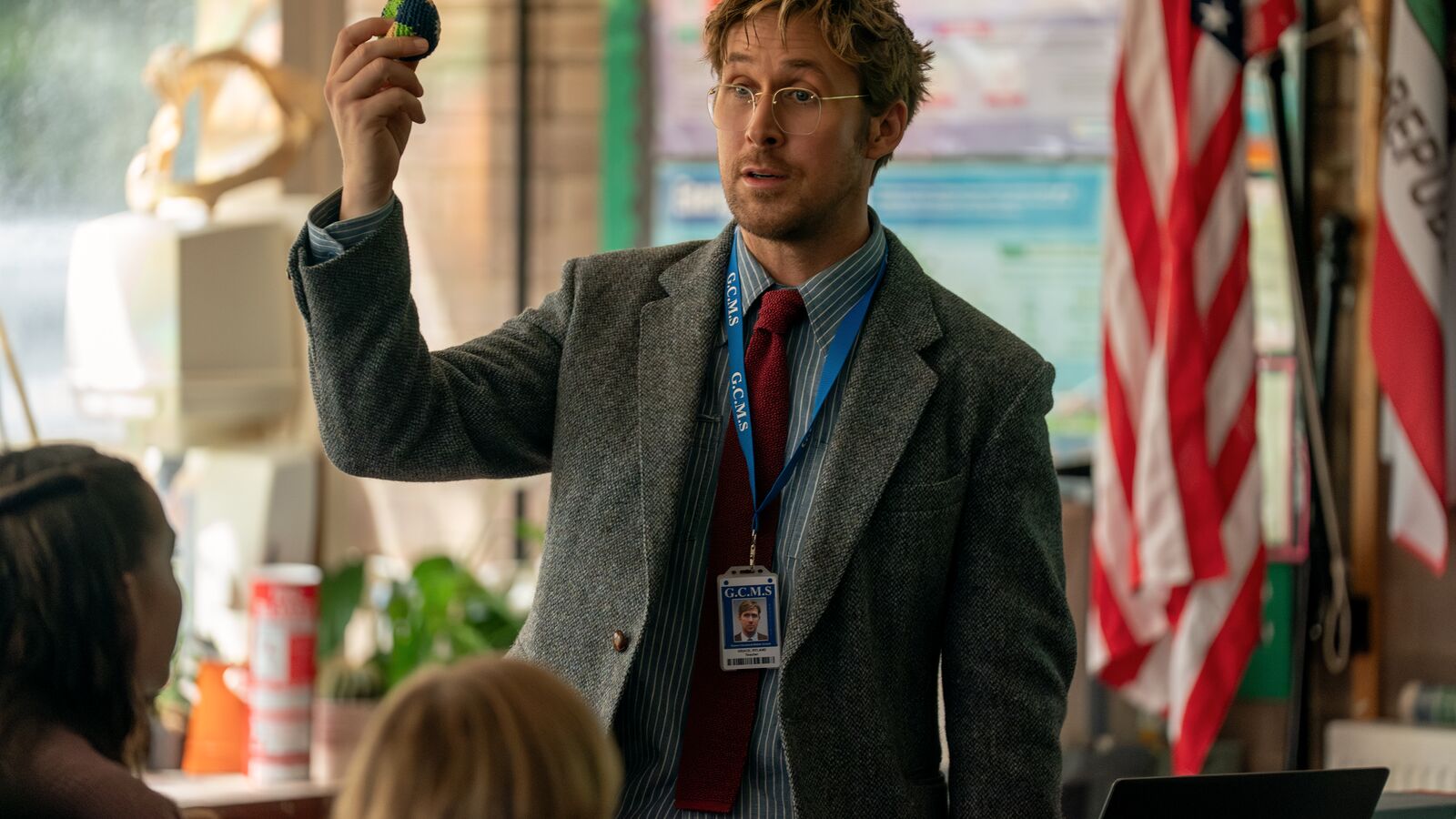
This most unlikely of heroes is Ryland Grace (Gosling), who while living on Earth, was a high school science teacher and molecular biologist. We learn through a series of flashbacks that Grace was recruited by the non-nonsense, straight-talking Eva Stratt (Hüller) to study astrophage, leading to the troubling discovery that this microorganism absorbs energy from our sun and infects other stars. Upon realising that astrophage is a fuel source, the governments of the world form a plan to send a crew of astronauts on board a ship, the Hail Mary, on a one-way trip to a distant star unaffected by the substance. Upon waking up from his coma, and looking like a long-lost member of The Beatles during their hippy era, Grace learns he is the sole survivor. Yet, despite being millions of miles away from home, Grace soon discovers he may not be alone in his mission to prevent the sun from dying.
Throughout film history, and indeed as history itself has taught us, the vast, infinite void of outer space can understandably seem like a truly terrifying entity, showing us how infinitely small we really are within the vast spectrum of our solar system. In addition, it also shows how perilous a place it can be if you make even the slightest wrong move. Yet the reverence for space, and the science by which humanity propelled itself into it, are evident in Andy Weir’s novels. That veneration was captured so magnificently by Ridley Scott and screenwriter Drew Goddard in the adaptation of The Martian. Therefore, it is no surprise that Goddard has, after making his directorial debut in 2018, returned to Weir’s to adapt his 2021 novel, again depicting another man isolated and cut adrift from any other human soul. Only, instead of the rest of the planet banding together to get one man off the Red Planet and return home, it falls to one man (and a companion) to save the Earth and humanity from their slow and inevitable doom if the Sun were to die.

In the same vein as The Martian, Goddard’s script effortlessly balances the bleak reality of humanity’s fate if the mission fails with the humour of finding the most reluctant hero of them all in space. “I put the not in astronaut,” Grace defiantly states during a crucial meeting. He might not be able to do a moonwalk, but he has the necessary scientific knowledge to pull off a miracle. It is fitting in a movie where the fate of Planet Earth rests in the hands of one man, where the film will live or die on this performance, that Gosling meets the moment and delivers a cosmically brilliant performance. Here’s an actor who has the range to deliver the stoic and serious when required, but can also effortlessly switch it up with humour when required, especially when it comes to Grace’s extraterrestrial company. The details of which shall not be spoiled here, but suffice to say, the chemistry between Grace and this mysterious being is perfectly delivered, proving that no matter who is acting opposite him, Gosling has chemistry with anyone and possesses charm that can last for days, maybe even light-years.

In a world that is more bitterly divided and fraught with each passing day, with certain sections of society going so far as to question well-established science, the film’s championing of science and its central theme of humanity and alien life working together to achieve a common goal feel particularly pertinent. If two creatures who have never met before can come together to achieve a common goal, it should serve as a lesson for all of us to do the same, given the very existential threat we face in the 21st century. The exact specifics of the science that is causing the sun to die might whizz over audiences’ heads initially, but the film’s key message about the importance of science as a means of working together to solve problems shines through and will not be lost on anyone.

Greig Fraser’s majestically dazzling cinematography adds plenty of awe and spectacle throughout, making the audience feel like they’re along for this ride with Grace. After more than a decade away from the director’s chair(s), Lord and Miller’s confident direction, with another cerebral score from Daniel Pemberton, allows the film’s humour, science, and mission to mesh perfectly like scientific samples in a test tube, arriving at the perfect conclusion. Space can undoubtedly be hazardous and perilous, but anyone who doesn’t find themselves swept up in the enthralling and heart-warming interstellar ride about the most unlikely of friendships in the most unlikely of circumstances, then you might just have a heart made out of stone.

Crafting the perfect formula of science, a life-affirming friendship between man and an extraterrestrial being gives you a visually stunning out-of-this-solar-system adaptation of an extremely timely story about working together to achieve a common goal.

Amaze amaze amaze.

Posted in 2020-2029, Film Review, London Film Festival 2023

The Zone of Interest (2023)

© A24, Film4, Access, Polish Film Institute, JW Films and Extreme Emotion

The Zone of Interest – Film Review

Cast: Christian Friedel, Sandra Hüller, Ralph Herforth, Johann Karthaus, Luis Noah Witte, Nele Ahrensmeier, Lilli Falk, Medusa Knopf

Director: Jonathan Glazer

Synopsis: A Nazi officer and his wife look to build their idyllic family life in a home right next to Auschwitz…

Review: One does not have to have picked up a history book, or to have studied World War II in extensive detail, to know between 1941 and 1945, the Nazis systematically murdered European Jews during the Holocaust. Around six million Jews, two-thirds of the Jewish population on the continent, were slaughtered. Cinema has often turned its attention to this dark and evil chapter of human history, capturing the horrendous conditions of the concentration/death camps. It seems impossible for a film to find a new way to illustrate the appalling atrocities committed by the Nazis, yet this is exactly what writer/director Jonathan Glazer does with this haunting and unnerving examination of human indifference towards unspeakable brutality.

Loosely based on the 2014 novel of the same name by Martin Amis and set in 1943, the film explores the life of Nazi SS officer and Commandment of the Auschwitz concentration camp Rudolf Höss (Friedel) and his wife Hedwig (Hüller) as they seek to build their family life in a house, right next door to the camp. The mere description of the film’s synopsis is enough to fill anyone with fury and anxiety, and anyone could reasonably think that the film’s opening shot would be an unsettling scene from inside the camp. Instead, after a lengthy black screen with only Mica Levi’s score to fill our eardrums with a terrifying sense of dread, the opening shot is one of the Höss family, having a family day out by a lake. The jarring juxtaposition of joyous family fun, in the immediate vicinity of callous acts of genocide is an immediate jolt to the senses to horrify you beyond measure.

It is such a disturbing and startling contrast that makes your stomach churn, setting the tone for the rest of the film. Throughout, we see the Höss family go about their daily lives. Banal acts such as getting ready for school, coming home, tending to your garden, having a meal, spending a family day by the pool, and sleeping safe and sound in your bed at night. The sorts of regular activities families will go through day after day. All the while, the audible sounds of gunshots, indiscernible orders, screams and cries for mercy, combined with the horrific sight of the Auschwitz chimney splurging out smoke as a result of the gas chambers being used. Yet these horrific sounds do not remotely faze the family in the slightest. They go about their lives while countless innocent souls have theirs ended in such an inhumane and callous manner. The sounds coming from the camp are deliberately kept out of sight but never out of the minds of the audience.

In what cannot have been easy roles for any of these actors to play, Christian Friedel and Sandra Hüller’s performances are both chillingly effective. Friedel portrays Hoss as a man driven by the wellness and comfort of his family while being heavily invested in his disturbing work concerning the efficiency of the camp to please his superiors. Meanwhile, Hüller as the Höss household matriarch also shows a complete lack of emotion to the situation mere yards away from her house. She is far more preoccupied with attending to the flowers and plants in her garden and trying on clothes that belonged to Jews who were housed at the camp. Both their performances are frightening due to their complete indifference to the barbaric acts of violence being inflicted upon other human beings beyond their garden wall, simply because they didn’t acknowledge the people who were housed in those conditions as people at all. Their shocking coldness in the face of the unspeakable screams with furious urgency to the audience, particularly in a world which finds itself in a seemingly never-ending continuous trend of horrific violence being inflicted on people all over the world on a day-to-day basis.

The filmmaking on display is immaculate. Glazer’s use of extensive long takes illustrates the mundanity of the everyday life of the Hoss family, while Lukasz Zal’s stripped-back cinematography is devastatingly effective. Using only practical and natural lighting, the garden scenes exude the warmth of a plot of land filled with love and care. Yet, in the very same shot, the cold, ominous, and unforgiving presence of the concentration camp’s buildings lingers in the background and serves as a glaring reminder of the horrors contained within those walls.

The art form of cinema can so often be a place for audiences to have fun and enjoy themselves, but this is emphatically not one of those instances. Glazer’s intention is absolutely to horrify the audience, to chill them to their very core as to how people can sit idly by while horrific crimes are committed in broad daylight. As the old saying goes: “Those who cannot learn from history are doomed to repeat it”. Such appalling acts of depravity should be forever confined to our history books and museums, never to be repeated. However, as recent years have shown, unspeakable atrocities are being committed due to blind hatred, while bigotry is rearing its ugly head across the world. Glazer’s message rings loud and clear. We cannot and must not be complicit in the face of evil.

An unflinching analysis of the human complicity and apathy in close proximity to the unimaginable brutality inflicted on countless innocent souls that will get under your skin and not leave your mind anytime soon. In time, this will become essential viewing for all.

a