
Posted in 2020-2029, Film Review

Joker: Folie à Deux (2024)

© Warner Bros Pictures and DC Studios

Joker: Folie à Deux – Film Review

Cast: Joaquin Phoenix, Lady Gaga, Brendan Gleeson, Catherine Keener, Zazie Beetz, Steve Coogan, Leigh Gill

Director: Todd Phillips

Synopsis: Two years after the events of the first film, as he prepares to go on trial for murder, Arthur Fleck meets fellow Arkham inmate Harleen ‘Lee’ Quinzel…

Review: In what was an incredible year for film, there were fewer films released in 2019 which caused a frenzied debate as Todd Phillips’s Joker. The winner of the Golden Lion at the Venice Film Festival, and yet, the controversy which surrounded the film in the run-up to its release was thunderous and widespread, amid fears that it would spark violence and unrest. Despite its very apparent nods to the filmography of Martin Scorsese, the film rode out those fears, taking over a billion dollars at the box office and becoming the highest-grossing R-rated film of all time (a record it held until only very recently) and bagging two Academy Awards. Amid the very divisive reactions, ultimately this version of the Clown Prince of Crime had the last laugh. At least he would have done, had the filmmakers resisted the urge to return to this dreary interpretation of Gotham and make a markedly inferior sequel.

It has been two years since failed comedian Arthur Fleck (Phoenix) violently killed several people, including three Wall Street businessmen, a co-worker, and a prominent talk show host, the latter taking place live on national television, all while adopting the mantle of the Joker. Now imprisoned at Arkham State Hospital, Arthur is awaiting to stand trial for his crimes and at the mercy of Arkham’s guards, who take great joy in taunting him. He soon meets Harleen “Lee” Quinzel (Gaga), and the two begin a bad romance, (rah-ah-ah-ah!) with Lee telling Arthur that they will build a great life for themselves once he is free. Meanwhile, in preparation for his trial, Arthur’s legal counsel Maryanne Stewart (Keener) is aiming to convince him that he has dissociative identity disorder and that it was this Joker character that committed these murders, all this is interwoven with musical numbers which attempt to explore Arthur’s mindset, because apparently a song and dance is a better outlet than talking about it?
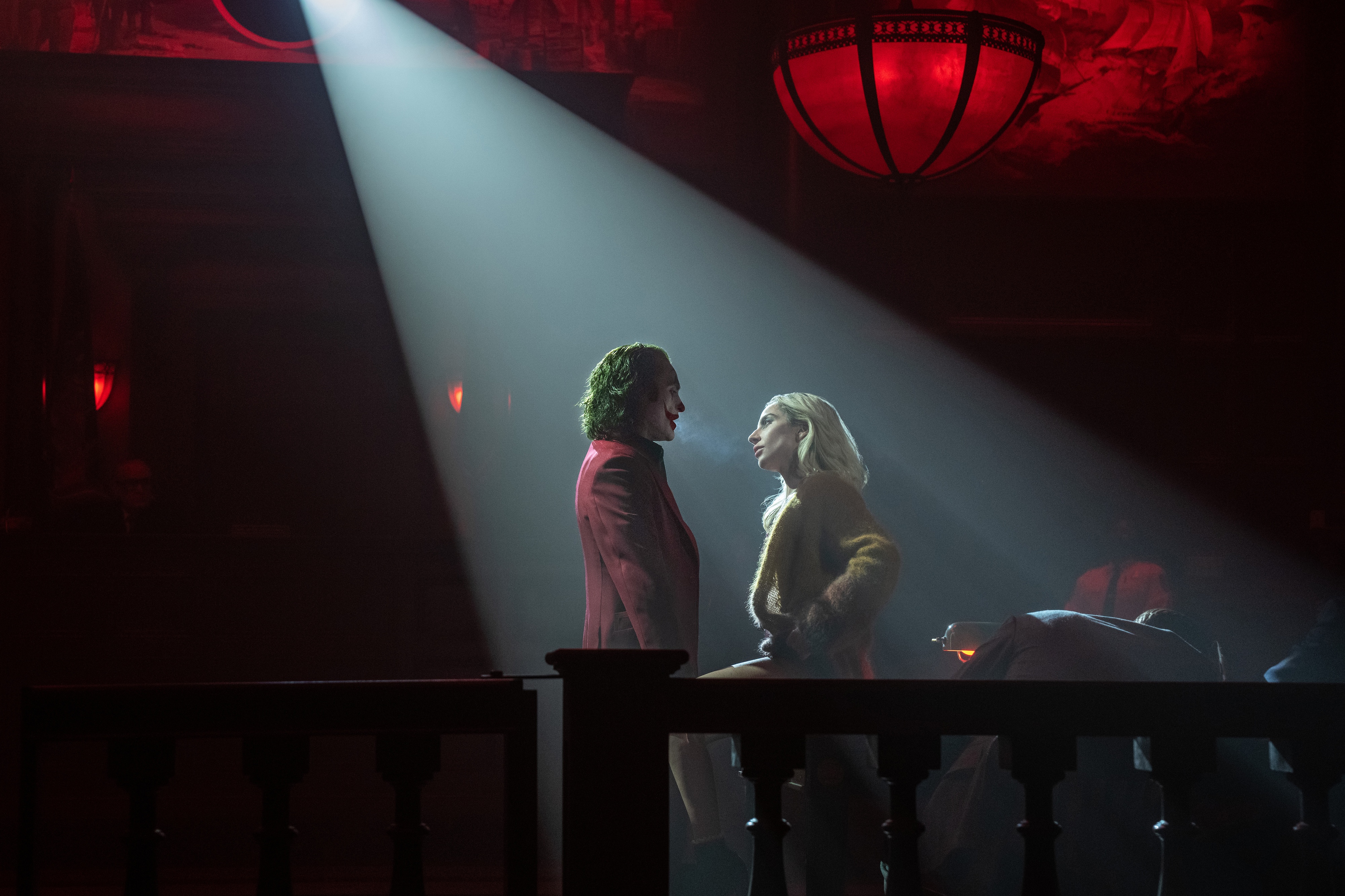
How do you solve a problem like Joker? This is presumably the question on the minds of Phillips and Scott Silver when they set about writing this follow-up. The short answer is you leave it the hell alone as not every film needs a sequel, but clearly money (especially $1bn) talks. While at least this does away with the very overt references to a superior filmmaker’s work, the decision to go down the musical route for such serious discussions about mental health and the state of Arthur’s mind is unquestionably bold. However, boldness counts for nothing if you don’t fully commit to this and go for broke and commit to batshit musical numbers. Even with a singer as talented as Gaga, the musical numbers are flat and unremarkable, and offer nothing substantive as a means of dissecting Arthur’s supposed identity crisis and both his and Lee’s mental state. Folie à Deux (or shared delusion/madness) is an apt subtitle as these are two souls whose delusion knows no bounds, but it’s a shame that the substance of the script is about as shallow as it could possibly get, and its exploration of mental health is superficial if we’re being kind, and bordering on lazy if we’re not, which we absolutely should not.

For all of the script’s many faults, with another being a courtroom drama that should be gripping and intense as Arthur is held accountable for his actions, even if that is half-baked and farcical in its execution. At least Joaquin Phoenix delivers another compelling performance, even though the material he’s been given is far beneath an actor of his immense capabilities. Gaga has proven she has the acting chops to go toe to toe with some of the biggest names in the business, and she does so again here. Her take on this iconic character is much more softly spoken and warmer than some of her immediate predecessors.  However, she doesn’t get enough screen time to truly excel and leave a lasting impression. To underutilise her musical talents, in particular, is an especially egregious sin, among the many many sins committed through a two-hour and twenty-minute run time, with severe drags in the pacing.
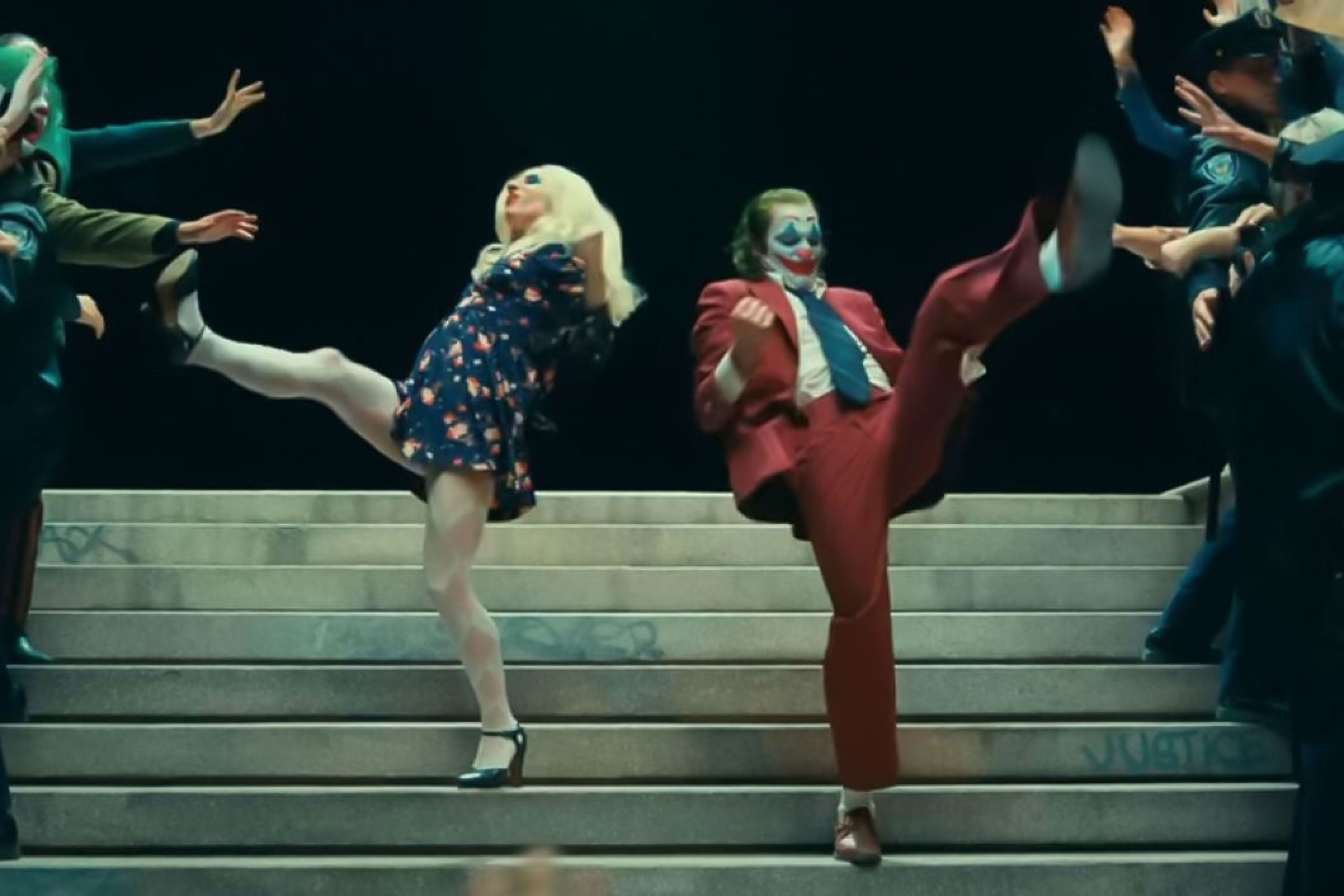
What is considerably less sinful is the sterling work of returning cinematographer and composer Lawrence Sher and Hildur Guðnadóttir, the latter of whom won an Oscar for the first film. The scenes in Arkham are aptly dim and grey, to reflect such a miserable place.  They stand as a perfect contrast to the vibrantly lit musical moments, while Guðnadóttir again deploys a haunting string-heavy to capture the gloominess of Arthur’s predicament when he’s not having a musical interlude, which ultimately feels like a waste of Guðnadóttir’s talents. Phoenix’s phenomenal performance helped to elevate the first film from its obvious influences to provide audiences with a portrayal of one of cinema’s iconic villains that for better or for worse, got people talking. However, this hollow sequel offers absolutely nothing substantial and has absolutely nothing to say. No one is laughing anymore, and it is time for this clown to exit the stage once and for all.
Even with the incredible talents of the production design and technical team, their efforts and excellent performances from Phoenix and Gaga, are all in service of dull musical numbers and a script devoid of anything meaningful to say.

Posted in 2020-2029, Film Review, London Film Festival 2023

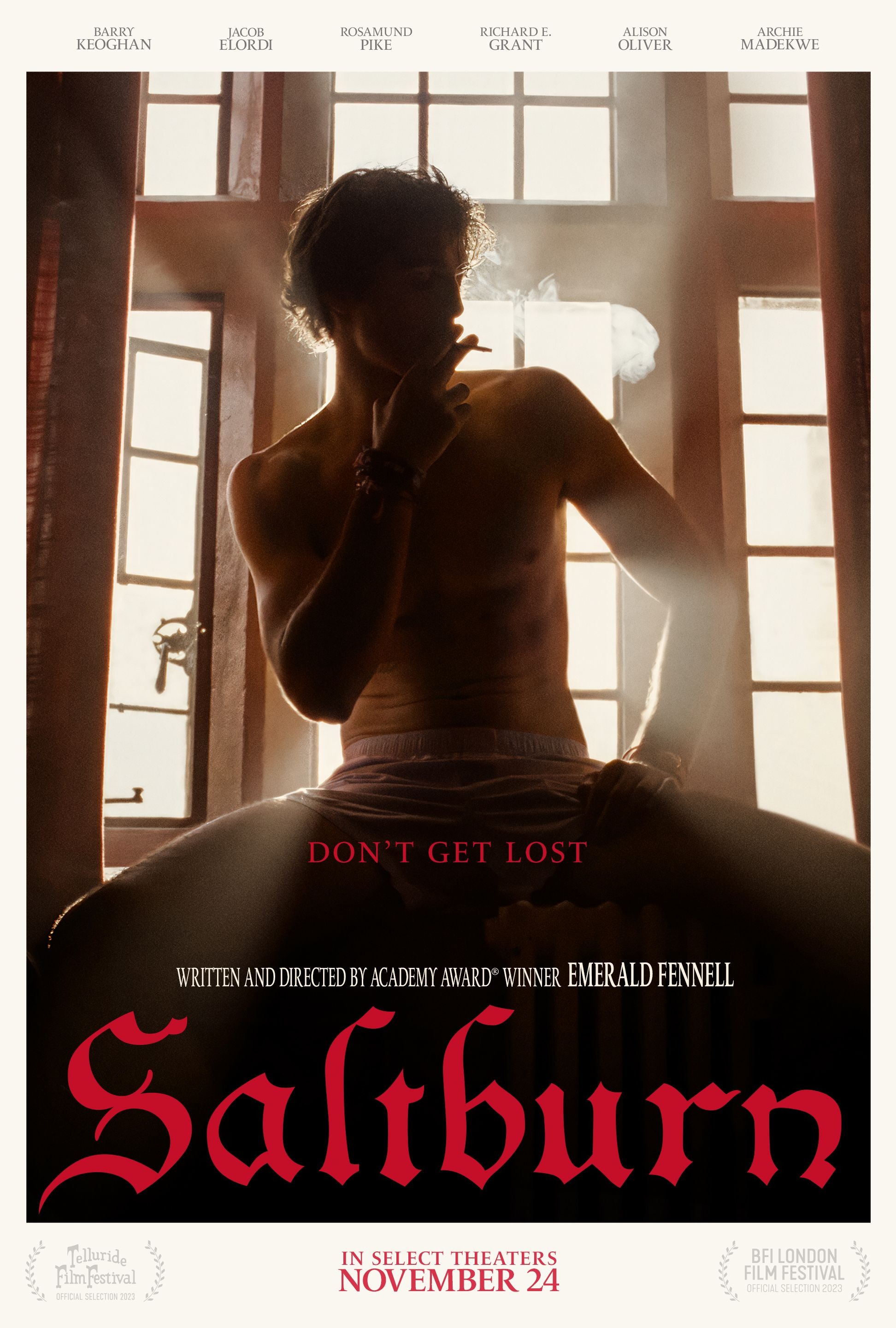
Saltburn (2023)

© Metro-Goldwyn-Mayer Pictures. MRC and LuckyChap Entertainment

Saltburn – Film Review

Cast: Barry Keoghan, Jacob Elordi, Rosamund Pike, Richard E. Grant, Alison Oliver, Archie Madekwe, Carey Mulligan

Director: Emerald Fennell

Synopsis: An introverted Oxford University student is invited by a wealthy classmate to spend the summer at his family’s estate…

Review: There can be surely no finer way for a director to announce themselves as an exciting new voice in cinema when their debut is a powerful piece of storytelling which holds a mirror up to society and ignites a conversation. This is precisely what Emerald Fennell accomplished when her incredible directorial debut, Promising Young Woman, was unleashed onto the world in 2020/21. By putting sexual harassment and the extremely predatory behaviour of men towards women under a microscope, it earned her a well-deserved Academy Award for Original Screenplay, as well as landing nominations for Directing and Best Picture. After such richly deserved success, much anticipation followed as to what she would bring to the table with her follow-up. It is safe to say, here’s a director who is not afraid to really push boundaries.

Oliver (Keoghan) is a bright but socially introverted student who arrives at Oxford University in the mid-2000s. He initially struggles to settle in and make friends, but an act of kindness towards his wealthy aristocrat and extremely popular classmate Felix Catton (Elordi), helps Oliver to integrate himself into Felix’s circle of friends, much to the dismay of Farleigh (Madekwe), Felix’s cousin. Over the next few months, the two of them begin to form a close friendship which culminates in Felix inviting Oliver to spend the summer at his family’s extravagant estate, Saltburn, for a summer filled with extravagant parties, romance and a summer unlike anything Oliver has experienced before.

Over the years, and particularly since the Covid pandemic, films which put the class system under a microscope have been in plentify supply. Yet, while all of these films had a common thread of “eating the rich”, each delivered this message in an original and witty manner. They were full of sharp observations and satire towards the lifestyles of the rich and powerful. Fennell’s screenplay follows a similar theme with the opulence and the extravagance of those lifestyles on full display. Yet, as far as Oliver is concerned, it is not a case of casting a scowl and an angry stare at the affluence of his hosts. Instead, it is in fact a desire (bordering on lust) to integrate himself into that lifestyle, where would be willing to do anything he can obtain it.

After slowly but steadily building his name as an actor to watch in recent years, which culminated in landing his first Oscar nomination in last year’s The Banshees of Inisherin, Barry Keoghan delivers yet another memorable performance to add to an already impressive career. He starts off as a very timid student who seems petrified to come out of his shell. Yet as the film slowly progresses, he morphs and transforms into a very different character once he has a taste of the lifestyle enjoyed by Felix and his family. Speaking of the family, everyone is brilliant to watch, but the standouts are easily Felix’s parents Elsbeth (Pike) and Sir James (Grant). Both of them revel in their status as part of the elite while being snobby and condescending towards those they see as beneath them, and will fire off snide remarks at will towards people such as Oliver and Pamela, a far too brief but wonderful turn from Mulligan to reunite with her Promising Young Woman director.

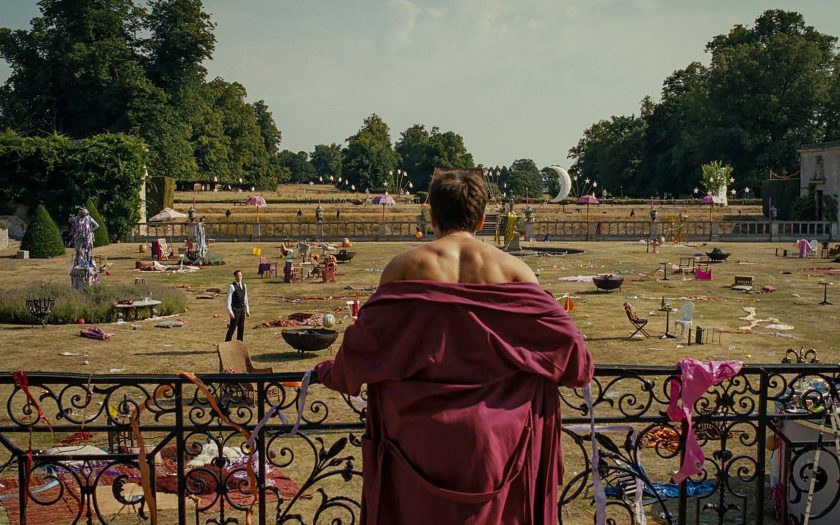
With no shortage of striking and haunting religious imagery in her debut film, while effortlessly flipping between rom-com and revenge thriller, Fennell repeats this trick once again and demonstrates what a fearless filmmaker she is. This time around, she blends romantic drama, black comedy and psychological thriller into one big melting pot baked in the British summer sunshine. Furthermore, through the immaculate cinematography from Linus Sandgren the beauty of the titular estate while drenched in the warm summer sunshine is juxtaposed with an atmospheric and ominous presence, particularly at nighttime capturing a gothic horror vibe to the place. The clever use of the 4:3 ratio creates the illusion that despite its vast grounds, the Saltburn estate has much less privacy than one might expect.

The film is undeniably visually stunning, and Fennell deserves credit for once again being so daring in her storytelling. However, without getting into spoilers, the direction the story goes in is extremely provocative and twisted. It goes for shock value for the sake of it, rather than having anything of real substance to say the affluence of the 1% and fails to replicate her debut feature’s emotional gut punch that left audiences reeling. That being said, like its predecessor, it does close out on one hell of a needle drop which will likely leave said song stuck in your head for days on end.

Despite some interesting ideas and a scintillating lead performance from Keoghan, Fennell’s follow-up to her Oscar-winning debut is a frustrating case of style over substance.

Posted in 2020-2029, Film Review

Don’t Worry Darling (2022)

© Warner Bros Pictures, New Line Cinema and Vertigo Entertainment

Don’t Worry Darling – Film Review

Cast: Florence Pugh, Harry Styles, Olivia Wilde, Gemma Chan, KiKi Layne, Nick Kroll, Chris Pine

Director:  Olivia Wilde

Synopsis: A housewife living in an idyllic neighbourhood in the 1950s with her husband begins to suspect not everything is as it appears to be in their perfect community…

Review: It is always interesting to see what happens when an actor opts to move from in front of the camera to try their hands at directing. In the case of Olivia Wilde, her directorial debut Booksmart proved to be an uproarious comedy which explored what happens when two studious high school students opt to swap their books for one night of raucous partying. Unfortunately in the run-up to the release of her sophomore feature, much has been made of the reported drama that has seemingly plagued the film in the build-up to its release. From reported arguments between cast members during the production, reported arguments between cast members, and even more drama during its premiere at the Venice Film Festival which has all cast a very large shadow over the project. With this in mind, one would have hoped all the drama would fade into the background had Wilde followed up her wonderful directorial debut with another roaring success. Unfortunately, it doesn’t quite live up to that billing.

In 1950s America, in the picturesque but isolated neighbourhood of Victory, lives Alice (Pugh) and her husband Jack (Styles). In this community, while all the men go off to work on their mysterious jobs during the day, overseen by Frank (Pine), all of the women are expected to be at home doing chores enjoying all of the comforts the community of Victory has to offer. While at night, the couples mingle and throw lavish parties. However, Alice soon begins to experience strange events which lead her to question her existence in this community and suspect something may be amiss with their idyllic lives.

Without any question of a doubt, the greatest asset of the movie is another incredible performance from Florence Pugh. An actor who continues to demonstrate every time she’s on-screen why she is one of the most popular, and best, actors working today. She commits everything to her performance and we watch how this seemingly perfect lifestyle, where she has everything she could possibly want, slowly begins to crumble around her. It leads her down a dark and disturbing path where she soon starts to question everything, including what it is that Jack and all of the other men are really doing at Victory HQ, leading some of the other residents of Victory to dismiss her as paranoid and delusional. After his incredible debut performance in Dunkirk, Harry Styles had the unenviable task of acting alongside his talented co-star. While he can’t quite make up his mind about his character’s accent, he does a solid enough job and has decent chemistry with his co-star, but Pugh outshines him, and everyone else. Furthermore, aside from a rather menacing turn from Chris Pine as the leader of this community, the rest of the cast is severely underutilised, particularly Gemma Chan and KiKi Layne.

Matthew Libatique’s superb cinematography expertly juxtaposes the sun-drenched tranquillity of Victory with the dark and sinister imagery of burlesque dancers hinting at something deeply sinister at the heart of this community. Wilde steps up her game as a directing and brings a unique visual flair to this contrasting imagery, while she also delivers some pulsating chase sequences in the third act. However, what ultimately really lets the film down is its severely lacklustre script.   Reteaming with Katie Silberman, one of the co-writers of Booksmart, it starts on a strong footing as it maintains the intrigue as Alice begins to investigate what is really happening in this perceived utopia these people find themselves. Furthermore, the unnerving score from John Powell maintains the suspense as some rather disturbing truths soon come to light. Without getting into spoiler territory, the film’s exploration of pertinent themes, namely the patriarchal nature of society and the male gaze is to be commended. Unfortunately, once certain details about the world of Victory and its inhabitants have come to light in the third act, the reveals are wholly unsatisfying as they fail to fully develop and expand on them. It all amounts to sheer frustration that by the time the credits begin to roll, the audience is left with more questions than answers.

Despite these shortcomings, Wilde cannot be faulted for her bravery in following up her extremely successful directorial debut with an ambitious sophomore effort which reinforces her as a director to keep an eye on. It is ultimately a real disappointment given the scope of the project and the talent in front of and behind the camera, that potential has frittered away by the time the credits begin to roll. A real shame, darling.

Despite a premise bursting with ideas and promise, not even a stellar performance from Pugh can prevent Wilde’s follow-up to her brilliant directorial debut from failing to capitalise on its vast potential.