Posted in 2020-2029, Film Review

The Brutalist (2025)

© A24. Universal Pictures and Focus Features

The Brutalist – Film Review

Cast: Adrien Brody, Felicity Jones, Guy Pearce, Joe Alwyn, Raffey Cassidy, Stacy Martin, Emma Laird, Isaach de Bankolé, Alessandro Nivola

Director: Brady Corbet

Synopsis:  A talented architect escapes post-World War II Europe and emigrates to the US to start a new life in pursuit of the American dream…

Review: An arduous boat journey, followed by a walk down a gangway, to mark the start of a new life in a country that offers so much potential and opportunities for success. This is the core principle of the American Dream, a concept popularized by US writer James Truslow Adams during the Great Depression. It has been ingrained in the ideals of the nation for decades. No matter who you are or where you come from, you can achieve your dreams in the United States of America. This promise has inspired millions of immigrants to move to the country and lies at the heart of this ambitious and powerful film by Brady Corbet.

In post-World War II Europe, Hungarian-Jewish architect László Toth (Brody) emigrates to the United States after surviving the Holocaust. Unfortunately, he has been separated from his wife, Erzsébet (Jones), who remains in Europe with their niece, Zsófia (Cassidy). After disembarking from the boat and catching an upside-down glimpse of Lady Liberty in all her glory, László makes his way to Pennsylvania to stay with his cousin, Attila (Nivola), and Attila’s wife, Audrey (Laird). Attila offers László the chance to work in his furniture business. One fateful day, they receive an offer from Harry Lee Van Buren (Alwyn), who wants to hire them for a job to renovate the library at his father Harrison’s (Pearce) home. Initially, Harrison, a wealthy industrialist, strongly disapproves of the renovations and dismisses László from his home without paying him for the work. However, after László’s designs for the library receive glowing praise from the architectural community, Harrison returns to offer László the opportunity to design his magnum opus: a community centre that will house a gymnasium, chapel, and reading room in honour of Harrison’s late mother.

In such times when the subject of immigration is at the centre of hateful and bigoted rhetoric emanating from certain world leaders, the arrival of such an expansive and grand film in terms of its scope and themes couldn’t be more timely. Like a vast and tall structure built to last for generations to come, Corbet and Mona Fastvold’s weighty screenplay tackles a plethora of meaningful and potent subjects including the Jewish identity, the unremitting horrors the Holocaust inflicted on the Jewish people, the joys and hardships that go along with looking to fulfil the promise of the American dream as an immigrant, and the desire to make or construct something which will ensure you leave a lasting legacy on the world. Yet that ambition comes with a cost, because as Laszlo finds out, to what extent will you drive yourself into the ground in pursuit of perfection when the path to get there is littered with seemingly mountainous obstacles too heavy to move?

To leave everything you have known behind to pursue a brand new life on an entirely new continent is a journey that millions have embarked upon across generations. For Adrien Brody, whose mother and grandparents fled their native Hungary to emigrate to the US, it is evident how much of a personal role it is for him. He channels this into his incredible performance as we can see Laszlo is a man driven by his passion for his craft, and his determination to make a better life for himself so that one day Erzsébet and Zsofia will finally be able to join him in the US. Such is the lengthy process, it takes a while for Erzsébet and Zsofia to finally be reunited, but when she does finally arrive in the US, Jones more than makes her presence known with a powerful performance. As the wealthy benefactor who plays a central role in giving Laszlo a chance to realise his vision, Pearce is utterly compelling as Van Buren Sr. There is a warmth to him, a generosity where he recognises Laszlo’s talents. However, beneath that warm and embracing exterior, there is a hint of a darker side, a jealousy and bitterness that threatens to come to the surface as the film, and this hugely ambitious project progresses.


Whenever a film clocks in at a runtime exceeding three hours, discussions inevitably arise as to whether it justifies such a lengthy runtime. With a built-in intermission, the film’s structure keeps eyes firmly transfixed on the screen, be it the awe-inspiring production design, Lol Crawley’s breathtaking cinematography and the majestic score by Daniel Blumberg. Given the exorbitant budgets with which many films are made these days, how the film only cost $10m is astonishing and should serve as a lesson for filmmakers that exorbitant budgets aren’t always needed. However, even with the lengthy runtime, during which the audience has been taken on an immersive journey across several decades, the conclusion comes off as very abrupt and rushed. Like spending years on an exciting construction project, only to haphazardly complete the final stages in a comparatively short period. Even with such a lengthy runtime, the film would have benefitted from an extra 15 to 20 minutes to provide audiences with some necessary closure.

Despite some question marks about the film’s use of AI to enhance the Hungarian dialogue of László and Erzsébet, as well as for some of the former’s drawings, what Corbet has brought to the screen with only his third feature film is mightily impressive. With its pertinent exploration of the struggles of immigrants to fulfil the promise that the American dream sold to them, combined with its weighty themes of striving to establish yourself as a master in your craft, only to be held back due to a plethora of societal factors, including but not limited to the brutal (pun absolutely intended) nature of capitalist society. The wondrous filmmaking will only carry increased significance as time goes by.

Across such an epic runtime, The Brutalist could have easily been bogged down by the sheer ambition of its timely story. However, with an engrossing performance from Adrien Brody at its core, Corbet has built a towering and pertinent examination of the immigrant experience which will stand tall for generations to come. 

Posted in 2020-2029, Film Review

Gladiator II (2024)

© Paramount Pictures, Scott Free Productions and Lucy Fisher/Douglas Wick Productions

Gladiator II – Film Review

Cast: Paul Mescal, Pedro Pascal, Joseph Quinn, Fred Hechinger, Lior Raz, Derek Jacobi, Connie Nielsen, Denzel Washington, Yuval Gonen, Matt Lucas, Tim McInnerny

Director: Ridley Scott

Synopsis: After his home is invaded and conquered by the Roman army, Lucius Verus is forced to follow in the footsteps of the legendary Maximus and become a gladiator…

Review: “What is your Roman Empire?” is a question you may have noticed has popped up a lot in interviews recently, thanks to a trend on social media in which men are asked how often they think about the Roman Empire. If one were to put this question to Sir Ridley Scott, the answer would probably be a fair bit due to the fact among the legendary director’s distinguished filmography, many could point to 2000’s Gladiator as his magnum opus, and for good reason. The story of a Roman General who is betrayed and sees his family murdered on the orders of a corrupt emperor, then becomes a gladiator to seek vengeance, in this life or the next, has stood the test of time for its epic scope, an incredible array of characters, enthralling action sequences, and one of maestro Hans Zimmer’s greatest scores of all time. After nearly a quarter of a century, the Roman Empire evidently wasn’t far from Scott’s mind because, like a triumphant gladiator, he returns to the Colosseum, in thrilling style.

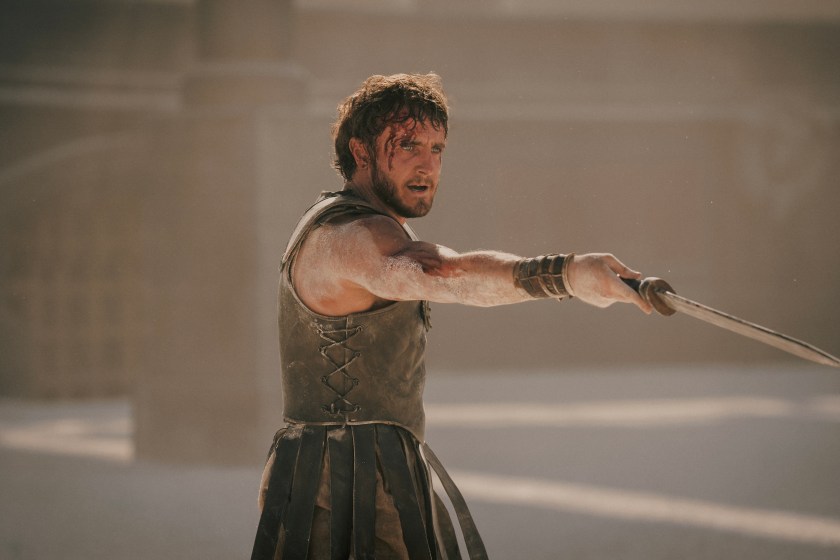
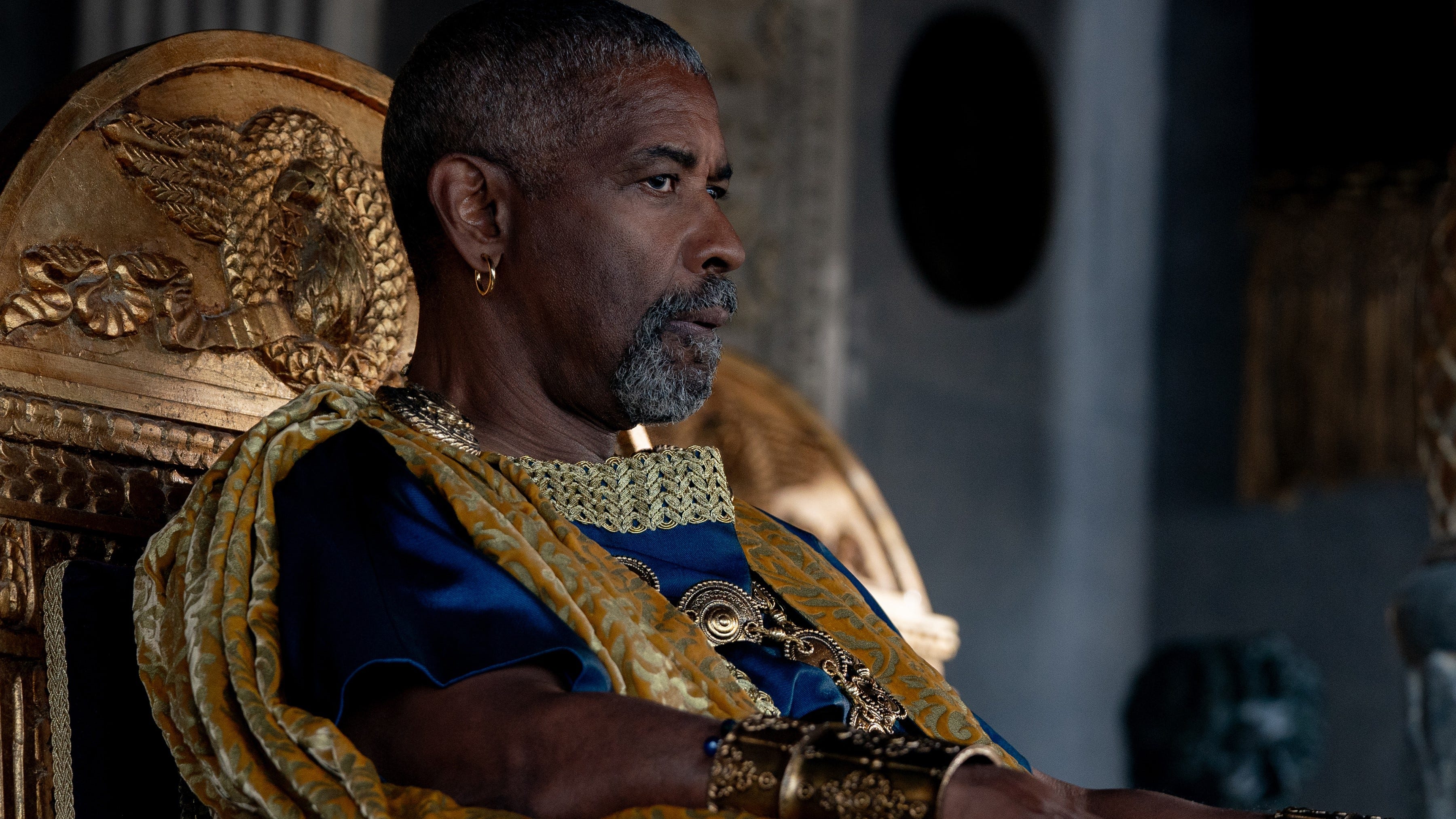
Sixteen years after the death of Maximus in the arena following a personal bout with his uncle Commodus, Lucius Verus, going by the alias “Hanno”, lives in the Roman province Numida with his wife Arishat, a far cry from his early life by his mother Lucilla’s side in preparation for a very regal future. In the years since, Lucius’s grandfather Marcus Aurelius’s dream that was Rome is a distant memory, with the twin Emperors Geta (Quinn) and Carcella (Hechinger) presiding over corruption and political turmoil.  This has left some in the Roman army, such as General Acacius (Pascal) increasingly disillusioned with their rule. When his home is conquered by the Roman army, Lucius follows in the footsteps of Maxiums and becomes a gladiator after being sold into slavery. He soon comes to the attention of former slave Macrinus (Washington) who senses Lucius’s rage and looks to offer him a path to satisfy the rage he has against those who invaded his homeland and murdered his family.

It’s remarkable that even at 86 years old, Ridley Scott shows no signs of slowing down and continues delivering spectacular films, particularly in the swords-and-sandals and historical epic genres, in a way few directors can match. However, creating a sequel to such a beloved and iconic masterpiece is undoubtedly a daunting and risky endeavour for this legendary director. Reteaming with his Napoleon screenwriter, David Scarpa’s screenplay wisely chooses to follow the narrative beats of the original. In this continuation, the protagonist experiences a significant loss, which drives him to channel his grief and intense rage against those responsible for inflicting great pain, for the loss of those he held dear and for those who cost He takes his vengeance to the Great Colosseum of Rome, where he must fight in several bloody battles to the death, while trying to convince anyone who will listen of his grandfather’s dream. However, as Lucius will soon find out, the depravity that went on while his uncle held the throne is nothing compared to what has been allowed to unfold in the nearly two decades since under the reign of the two men who sit on the throne that by all rights, should have been his.

Like a fatal blow in the Colosseum, the film’s powerful central message – that will strike deep and echo in eternity – lies in its damning indictment of modern-day politics. In recent years, the world has seen numerous figures rise to power on the back of populist rhetoric. When these charlatans rise to power, with their unchecked egos demanding loyalty from anyone and everyone while never giving anything in return, they leave considerable damage in their wake and show little to no thought or consideration for the harm they have inflicted with their arrogance and pomposity. It serves as a damning reminder of what can happen when such dangerous and unqualified demagogues are allowed to assume positions of power.

Such political chaos and turmoil allow for some savvy and cunning figures to exploit the corruption to get ahead, and this is where Macrinus thrives. Washington, the legend that he is, is clearly having a ball with this role and he captivates every time he’s on screen, so much so it matters not that he is speaking with his natural accent. Filling Maximum’s armour is a tough ask, but Lucius’s arc makes for a compelling one, and Mescal gives a suitably wounded and gritty performance, his anger and fury with those in power never too far from the surface. Meanwhile, Quinn and Hechinger are suitably deranged and loathsome as the maniacal emperors, channelling Commodus’s wickedness and being accompanied by a pet monkey, as you do.

Some of the action scenes in the original could very easily lay claim to some of the best action of Scott’s long and glittering career as a director. So how does the octogenarian director top what he accomplished 24 years ago, by putting the history book to the sword and refusing to give a damn whether or not the events depicted in the Colosseum have any foundation in historical fact. Battles with manic baboons, and rhinos, and filling the Colosseum with water to recreating a great naval battle. It’s all utterly bonkers and wild, how can you not be entertained and give a thumbs up and watch the carnage and bloody battles unfold on screen in all their bloody glory. Yet, given the film’s exorbitant $250m budget, some of the VFX looks lacklustre and merits a thumbs down. Matching the lofty standards set by the first film was always going to be a tall order, but with Scott committed to delivering swords to the wall action and the political machinations that are all too relevant today, gives this sequel the strength and honour it needs for the audience to say: We who love Gladiator salute you, Sir Ridley.

It could have been an almighty risk to return to the Colosseum 24 years after Gladiator conquered everything before it, but with a scathing critique of modern-day politics and a memorable Denzel Washington performance, this sequel will leave you more than entertained. 

Posted in 2020-2029, Film Review

The Woman King (2022)

© Sony Pictures Releasing, TriStar Pictures, eOne and TSG Entertainment

The Woman King – Film Review

Cast: Viola Davis, Thuso Mbedu, Lashana Lynch, Sheila Atim, John Boyega

Director:  Gina Prince-Bythewood

Synopsis: A group of all-female warriors in a West African kingdom seek to protect and defend their lands from enemy outsiders…

Review:  The subject of history is an endlessly fascinating one as it enables us to revisit specific periods of the past and learn about a plethora of different cultures and civilisations that have existed throughout the centuries human life has existed on this planet. Indeed, one of the many wondrous aspects of films is they can shine a spotlight on these civilisations and bring them to life in such a rich, beautiful and meaningful manner. While some societies have been covered more than others, there are others who have not been talked about as much as they should be. This is precisely what this enthralling historical epic from Gina Prince-Bythewood does, by shining a light on an incredibly fierce troop of all-female warriors, the Agojie.

Set in the Kingdom of Dahomey, West Africa, General Nanisca (Davis) is the commander of the Agojie, an all-female elite troop of warriors who are sworn to protect the Kingdom from enemy forces that wish to conquer them, most notably the Oyo Empire. Nanisca is seeking capable warriors from the next generation to join this prestigious arm and to prepare their people for the defence of their homeland. Seeking to prove herself worthy to be a part of this elite group of warriors is Nawi (Mbedu) who is determined to prove herself after being shunned by her family for refusing to be married off to suitors chosen by her father. Her ambition and relentless determination capture Nanisca’s and, and Igozie’s (Lynch) attention, the latter of whom resolves to provide Nawi with the tutelage she will need to succeed in her aim to become part of the Agojie and successfully defend their land.

Having a historical epic like this being led by a predominantly black, female cast is a hugely significant moment for these types of big-budget blockbusters, the importance of representation and giving a platform for filmmakers to tell stories from the perspective of these civilisations cannot be overstated. The screenplay from Dana Stevens tackles first and foremost, female empowerment and the sheer intensity and skill of the Agojie on the battlefield. However, it also drives the significance of home, a family and a vibrant community which would enable a new recruit to rise through the ranks and take her place as part of the Agojie, who served as the inspiration for the Dora Milaje from Black Panther. In addition, the film crucially does not shy away from the part the Dahomey Kingdom had in the slave trade.

To be the leader of the kingdom’s all-powerful group of female warriors, you need an actor who brings a commanding screen presence every time she steps in front of a camera. Someone who has the aura of someone you would dare not cross or talk back to, and Viola Davis brings both those qualities in abundance. Nanisca is the exact sort of leader you want to have on the front line of the battlefield. However, there is far more to Nanisca’s character than being the commander of the Kingsguard, there’s a very personal element to her story which comes to the fore when she meets Nawi. To be tasked to act alongside a legend of the industry like Davis is far from an easy feat. However, Mbedu rises to the challenge in spectacular fashion, a feat all the more impressive considering this is her feature film debut. Lashana Lynch’s career is going from strength to strength and she gives perhaps the performance of her career thus far, being the warrior to take Nawi under her wing and offer invaluable advice, while John Boyega is the perfect combination of gravitas and a surprising amount of humour with his role as King Ghezo.

Through all of the moving exploration of the community of the Agojie and the powerful bond between all of these amazing and brave warriors, under Prince-Bythewood’s soaring direction, the battle scenes are immaculately helmed and enthralling to watch. There is one minor side plot with a romance between Nawi and a man who is travelling with a group of slave traders which is not properly developed and could have easily been cut out from the final cut, but it is not enough to drag the film down. Historical epics have rarely been told from the perspectives of black women, and showcasing these extraordinary warriors deserves to be celebrated and championed.

Through its extraordinary ensemble cast, led by Viola Davis, The Woman King delivers emotionally resonant themes of female empowerment combined with enthralling action scenes that will have you bowing down in awe.


Posted in 2000-2009, Film Review

Gladiator (2000)

gladiator-movie-poster
© Universal Pictures, Scott Free Productions and Red Wagon Entertainment

Gladiator – Film Review

Cast: Russell Crowe, Joaquin Phoenix, Connie Nielsen, Oliver Reed, Djimon Hounsou, Richard Harris, Derek Jacobi, Spencer Treat Clark, Ralf Möller

Director: Ridley Scott

Synopsis: Popular Roman GeneralMaximus Decimus Meridius is betrayed by the elderly Emperor’s corrupt son, who seizes power for himself. Having lost everything, Maximus becomes a gladiator, determined to get revenge…

Review: Whenever you learnt about history, be it at school or university, odds are good that you would have learnt about the Romans and their considerable Empire. Their presence in history is certainly vast and they have left their mark on the world today in no uncertain terms. As such, many filmmakers have taken the task of representing the Roman Empire in film. 1959’s Ben-Hur or 1960’s Spartacus certainly come to mind, but no movie has arguably come quite as close to capturing Ancient Rome in all its glory as well as Ridley Scott

It is 180 AD and Maximus (Russell Crowe) is leading the Roman Army in a battle against the “barbarians” of Germania. All goes swimmingly and the general has the affection of the elderly emperor Marcus Aurelius. Unfortunately, he does not share this love for his legitimate son Commodus, which does not end well for all parties. In committing his treason, the usurper must dispense with Maximus and his family. This plan goes somewhat awry but not before Maximus can save his family from a brutal fate. Furious with grief and anger over the murder of his Emperor and family, the fallen General sets out on a path of vengeance, against the corrupt Commodus, determined to bring justice to all those who wronged him.

Gladiator

Scott is a director known for his work in science fiction, but he skillfully captures the grandeur of Ancient Rome. Every detail is meticulously portrayed, from the costumes to the production design and sets, all appearing exceptional. With numerous extras, one can only imagine the immense effort that went into achieving such detail. Although CGI is utilized for the Colosseum scenes, it does not detract from the overall impact of the film. The movie won the Oscar for Best Costume Design, along with several other awards, including Best Picture, and received nominations for art and set decoration.

Such attention to detail would have been nothing without a compelling story, which we most certainly have courtesy of the screenplay by David Franzoni, John Logan and William Nicholson. The screenplay fuses perfectly the intense battle scenes with the behind-the-scenes political manoeuvring. From the very first battle onwards, the story is gripping, from a very climactic opening battle to some scenes with some very personal, emotional moments between these characters. Russell Crowe completely shone as the lead Maximus, he’s a loyal man, to his emperor and to his family, and a brilliant soldier. Strength and Honour are two words that absolutely define him. So when he becomes a gladiator, that compassion is gone, replaced by a ferocious hatred against those who committed horrific acts against those closest to him, but his honour remains absolute. Joaquin Phoenix is also on great form as the slimy, cold Commodus who has an alarming desire to sleep with his sister Lucilla (Connie Nielsen). The late Richard Harris as Marcus Aurelius and Oliver Reed as Proximo also both deliver excellent performances in what is an outstanding cast.

There are more than a few superb action scenes packed into the movie’s run time. Scott helms these scenes excellently, and you have battles of all sorts, including a battle with chariots and in one instance, tigers. The action is edited superbly well and the scenes are completely gripping to watch from the scenes in a Roman Province right to the superbly recreated Gladitorial battles which took place in the Colosseum. Russell Crowe certainly showed his action chops in these scenes, and he delivered a career-defining performance in this role, that won him an Oscar. In addition, with an immortal line of dialogue when faced against the treacherous Commodus will go down as one of the best lines of dialogue in any movie, ever, Maximus can certainly lay claim to being one of the best movie characters of the 2000s.

A brilliant historical spectacle fused with fictitious elements, superb action, and a career-defining performance from Crowe, Gladiator can certainly claim to be one of Scott’s best movies.

Rating: A+