

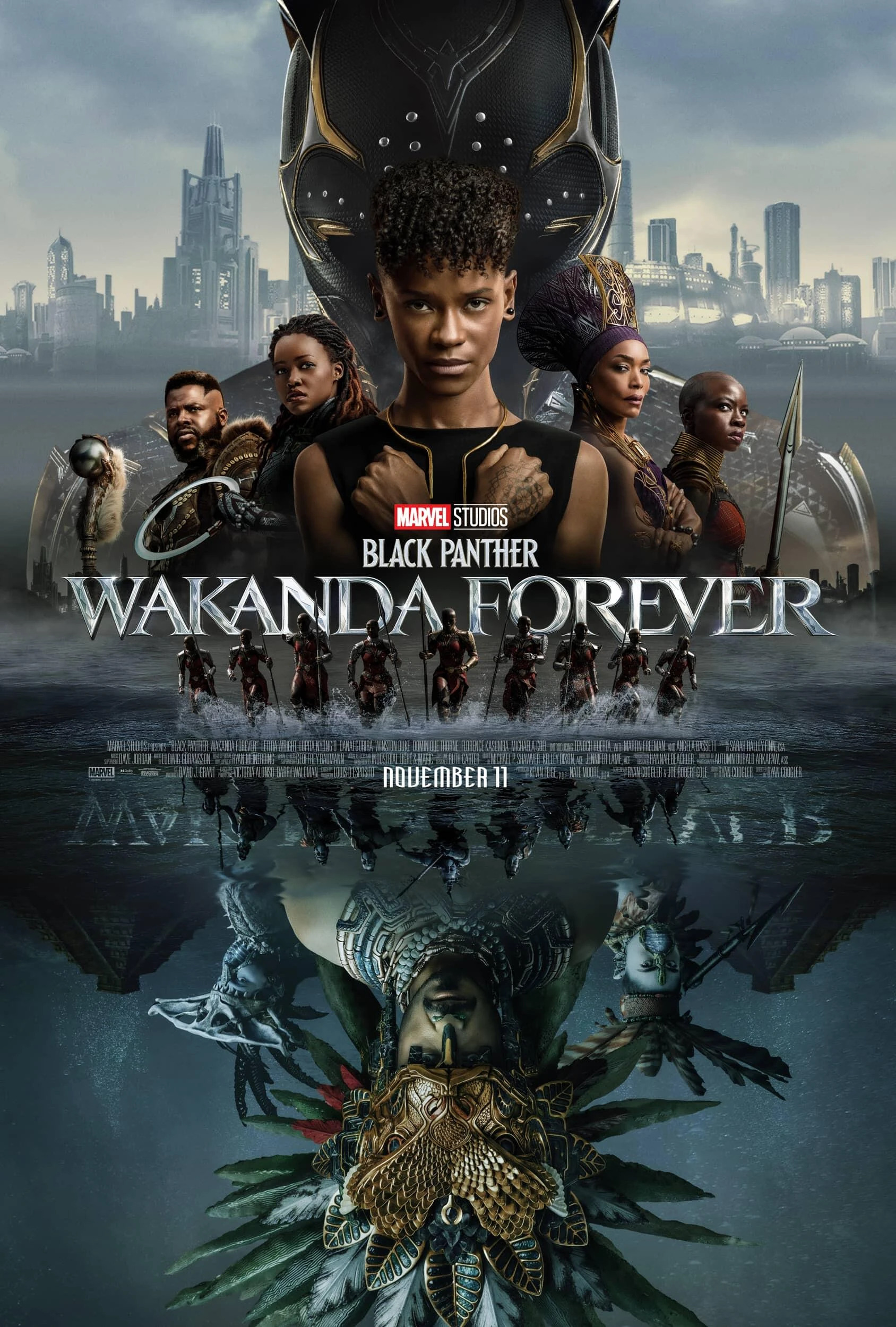
Black Panther: Wakanda Forever – Film Review
Cast: Letitia Wright, Angela Bassett, Lupita Nyong’o, Danai Gurira, Winston Duke, Dominique Thorne, Florence Kasumba, Michaela Coel, Tenoch Huerta, Martin Freeman
Director: Ryan Coogler
Synopsis: Following the passing of King T’Challa, the nation of Wakanda finds itself increasingly isolated and weakened as it faces a new threat in the form of Namor, the leader of an all-powerful underwater nation…
Review: It would be something of an understatement to say making a film is a massive undertaking which requires a herculean amount of effort from a troop of people both in front of and behind the camera, especially for a tentpole blockbuster. However, for the sequel to 2018’s phenomenally successful Black Panther, the typical challenges facing the cast and crew were compounded by the tragic death of Chadwick Boseman in 2020. The passing of the man who brought so much to a role which meant so much to millions of fans across the world, it begged the question as to how on earth could director Ryan Coogler and his crew overcome such a heartbreaking loss? It is therefore to their immense credit that they have overcome the most devastating of obstacles to produce a film which not only beautifully honours Boseman’s legacy but delivers a worthy sequel to one of the best films in the MCU.
The nation of Wakanda finds itself in mourning after their beloved King T’Challa dies from a mysterious illness. One year later, after a funeral and a beautiful celebration of his life, his sister Shuri (Wright) is struggling to come to terms with her loss and chooses to keep herself occupied with the Wakandan technology she pioneered. However, Wakanda finds itself under increasing scrutiny from the rest of the world, which wants to see the country share its resources, most notably vibranium, putting pressure on Ramonda (Bassett), who has become Queen following T’Challa’s passing. However, the Wakandans face a further challenge when they encounter the ruthless Namor (Huerta), the leader of the underwater nation of Talokan, who is determined to wage war on all of the countries on the surface.

The task facing Coogler and his fellow screenwriter Joe Robert Cole to honour the legacy of Boseman in this sequel was an unenviable one, to say the least. Death is something we as human beings will all have to grapple with at some point in our lives. The grief and personal pain we experience when someone we love departs this world varies from person to person, and the screenplay offers a profoundly moving story which analyses how the grief and pain we endure manifests itself in individuals, whilst simultaneously illustrating the power of communities coming together to pay their respects to those who have passed on. It enables the performances of the characters, especially those of Letitia Wright and Angela Bassett, to flourish as their grief over the loss of their brother and son is raw, powerful and extremely emotional. We, as the audience, are grieving for them, and with them. As a result, their stories understandably take centre stage, but it does mean returning characters such as Nakia (Nyong’o), Okoye (Guiria), and M’Baku (Duke) feel somewhat underutilised.
Aside from the deeply personal tragedies facing its characters, in the same vein as its predecessor, Wakanda Forever also brilliantly factors geopolitical issues into its story. The first film grappled with Wakanda’s decision to hide itself and its resources away from the rest of the world. However, without their ruler and protector, the Wakandans are much more vulnerable, and this is something the rest of the world is keen to exploit. Consequently, this only causes Wakanda to find itself increasingly more isolated, which is where Namor, the leader of the underwater nation of Talokan comes in. In the same vein as Killmonger, Namor is a compelling villain with a fascinating backstory. He too leads a nation which is isolated from the rest of the world, but one which is also steeped with resources and considerable military strength, which makes for a fascinating dynamic between Namor and the Wakandans, and Huerta’s performance is extremely captivating.
Returning costume designer Ruth Carter and production designer Hannah Beachler once again do a magnificent job of bringing Wakanda and Talokan to life, and while the first film’s cinematographer Rachel Morrison does not return for the sequel, Loki cinematographer Autumn Durald Arkapaw steps up to the plate magnificently. The film can feel a little long in places and certain aspects of the film could arguably have been left on the cutting room floor. However, after the last few MCU films have been grappling with the concept of the multiverse and lots of big CGI battles, it is a refreshing change of pace to see Wakanda Forever dial this back to allow the characters and their journeys to take centre stage. This isn’t to say that there is no CGI battle, because it would not be an MCU film without one, and Coogler’s direction remains marvellous and the visual effects have considerably improved this time around.
It is next to impossible to imagine how tough it must have been for the cast and crew every day during production. However, in the face of such devastating tragedy, they have ensured Phase 4 of the MCU closes with one of its best films and serves as a fitting dedication to the legacy of Chadwick Boseman, who through his immense body of work, will live on in the hearts and minds of millions of fans forever.
Through unimaginably difficult circumstances, Wakanda Forever is a moving sequel, delivering a poignant reflection on grief and tragedy while serving as a beautiful and emotional tribute to the wonderful legacy of Chadwick Boseman.




 Through the Silver Screen