Posted in 2020-2029, Film Review, London Film Festival 2023

Saltburn (2023)

© Metro-Goldwyn-Mayer Pictures. MRC and LuckyChap Entertainment

Saltburn – Film Review

Cast: Barry Keoghan, Jacob Elordi, Rosamund Pike, Richard E. Grant, Alison Oliver, Archie Madekwe, Carey Mulligan

Director: Emerald Fennell

Synopsis: An introverted Oxford University student is invited by a wealthy classmate to spend the summer at his family’s estate…

Review: There can be surely no finer way for a director to announce themselves as an exciting new voice in cinema when their debut is a powerful piece of storytelling which holds a mirror up to society and ignites a conversation. This is precisely what Emerald Fennell accomplished when her incredible directorial debut, Promising Young Woman, was unleashed onto the world in 2020/21. By putting sexual harassment and the extremely predatory behaviour of men towards women under a microscope, it earned her a well-deserved Academy Award for Original Screenplay, as well as landing nominations for Directing and Best Picture. After such richly deserved success, much anticipation followed as to what she would bring to the table with her follow-up. It is safe to say, here’s a director who is not afraid to really push boundaries.

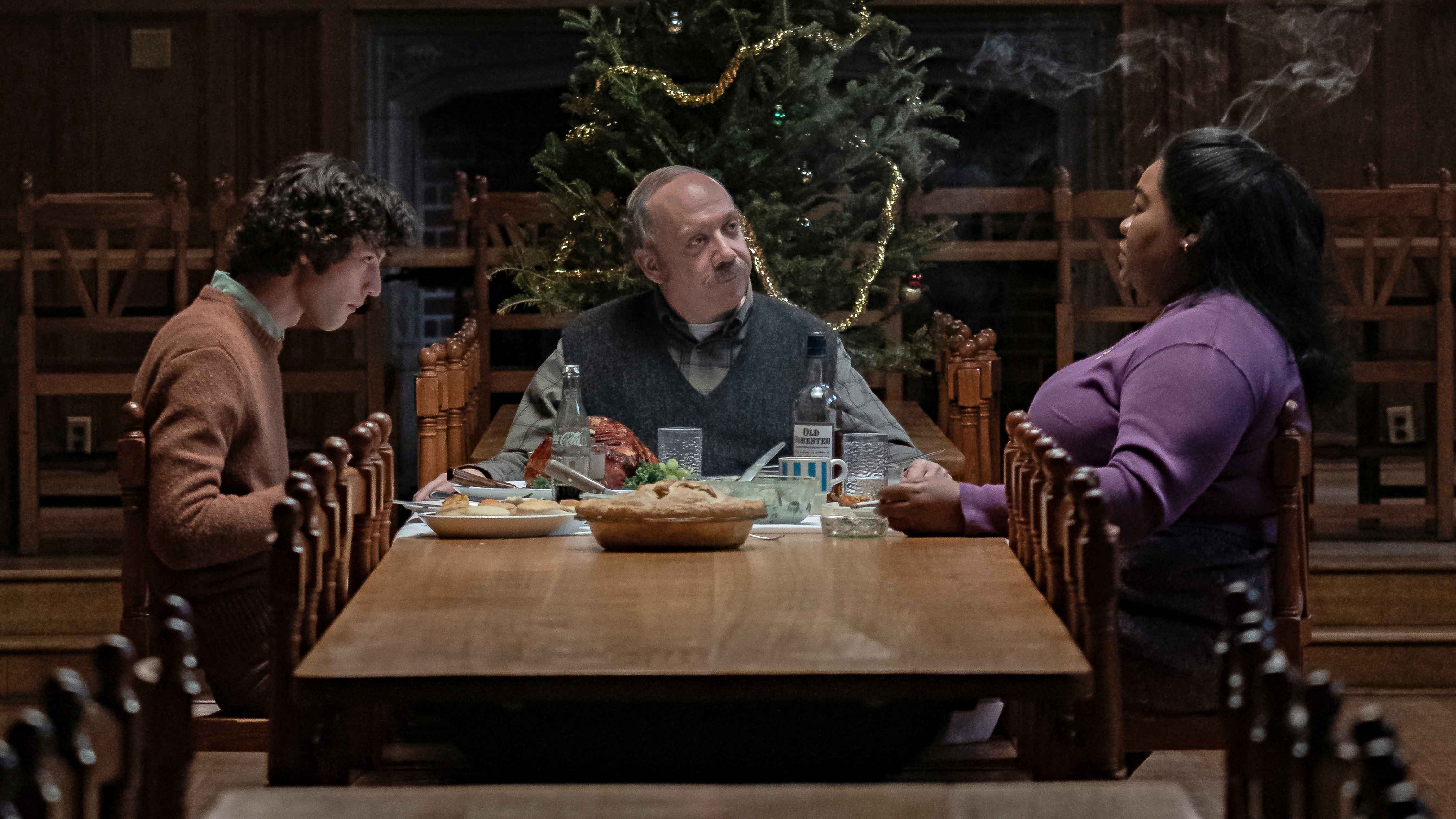
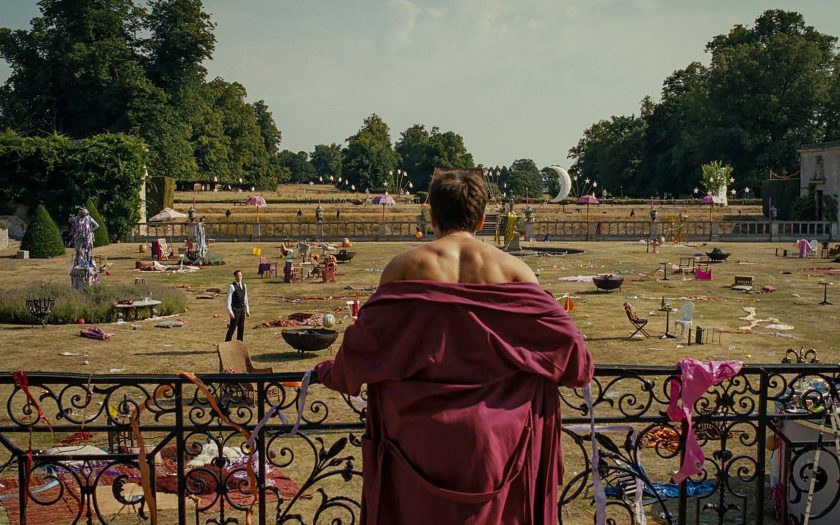
Oliver (Keoghan) is a bright but socially introverted student who arrives at Oxford University in the mid-2000s. He initially struggles to settle in and make friends, but an act of kindness towards his wealthy aristocrat and extremely popular classmate Felix Catton (Elordi), helps Oliver to integrate himself into Felix’s circle of friends, much to the dismay of Farleigh (Madekwe), Felix’s cousin. Over the next few months, the two of them begin to form a close friendship which culminates in Felix inviting Oliver to spend the summer at his family’s extravagant estate, Saltburn, for a summer filled with extravagant parties, romance and a summer unlike anything Oliver has experienced before.

Over the years, and particularly since the Covid pandemic, films which put the class system under a microscope have been in plentify supply. Yet, while all of these films had a common thread of “eating the rich”, each delivered this message in an original and witty manner. They were full of sharp observations and satire towards the lifestyles of the rich and powerful. Fennell’s screenplay follows a similar theme with the opulence and the extravagance of those lifestyles on full display. Yet, as far as Oliver is concerned, it is not a case of casting a scowl and an angry stare at the affluence of his hosts. Instead, it is in fact a desire (bordering on lust) to integrate himself into that lifestyle, where would be willing to do anything he can obtain it.

After slowly but steadily building his name as an actor to watch in recent years, which culminated in landing his first Oscar nomination in last year’s The Banshees of Inisherin, Barry Keoghan delivers yet another memorable performance to add to an already impressive career. He starts off as a very timid student who seems petrified to come out of his shell. Yet as the film slowly progresses, he morphs and transforms into a very different character once he has a taste of the lifestyle enjoyed by Felix and his family. Speaking of the family, everyone is brilliant to watch, but the standouts are easily Felix’s parents Elsbeth (Pike) and Sir James (Grant). Both of them revel in their status as part of the elite while being snobby and condescending towards those they see as beneath them, and will fire off snide remarks at will towards people such as Oliver and Pamela, a far too brief but wonderful turn from Mulligan to reunite with her Promising Young Woman director.

With no shortage of striking and haunting religious imagery in her debut film, while effortlessly flipping between rom-com and revenge thriller, Fennell repeats this trick once again and demonstrates what a fearless filmmaker she is. This time around, she blends romantic drama, black comedy and psychological thriller into one big melting pot baked in the British summer sunshine. Furthermore, through the immaculate cinematography from Linus Sandgren the beauty of the titular estate while drenched in the warm summer sunshine is juxtaposed with an atmospheric and ominous presence, particularly at nighttime capturing a gothic horror vibe to the place. The clever use of the 4:3 ratio creates the illusion that despite its vast grounds, the Saltburn estate has much less privacy than one might expect.

The film is undeniably visually stunning, and Fennell deserves credit for once again being so daring in her storytelling. However, without getting into spoilers, the direction the story goes in is extremely provocative and twisted. It goes for shock value for the sake of it, rather than having anything of real substance to say the affluence of the 1% and fails to replicate her debut feature’s emotional gut punch that left audiences reeling. That being said, like its predecessor, it does close out on one hell of a needle drop which will likely leave said song stuck in your head for days on end.

Despite some interesting ideas and a scintillating lead performance from Keoghan, Fennell’s follow-up to her Oscar-winning debut is a frustrating case of style over substance.

Posted in 2020-2029, Film Review

The Creator (2023)

© 20th Century Studios, Regency Enterprises and Entertainment One

The Creator – Film Review

Cast: John David Washington, Gemma Chan, Madeleine Yuna Voyles, Ken Watanabe, Allison Janney, Sturgill Simpson, Ralph Ineson

Director:  Gareth Edwards

Synopsis: War rages between humanity and artificial intelligence (AI) after a nuclear bomb is detonated in Los Angeles…

Review: Over the course of this year, it has been hard to ignore the increasing prominence of discussions surrounding the usage of AI and where the progression of this technology might lead. Will humanity and AI peacefully co-exist in the not-too-distant future, or will the machines rise and take humanity’s place? Given these questions, there’s something eerily prescient about the latest film from Gareth Edwards. It’s one of the most visually striking films you will see all year.

The year is 2070, and AI has been banned in the Western hemisphere after a nuclear bomb was detonated in the city of Los Angeles fifteen years prior. However, while the West has prohibited the use of the technology, it is embraced by the Eastern hemisphere, and they have integrated AI into their society. When the US learns that the AI is developing a superweapon that could turn the war in their favour, the US army sends Sergeant Joshua Taylor (Washington) to find the weapon and destroy it, only for Taylor to discover that this weapon is, in fact, a robotic simulant in the form of a young child (Voyles).

Humanity facing off in a struggle or at war with an advanced AI of some variety has been a well-trodden path in cinema history, with films such as 2001: A Space Odyssey, Blade Runner and Blade Runner 2049, The Terminator and The Matrix franchises, and most recently M3GAN. All of the aforementioned films, in their own wholly unique way, presented a richly developed world which established the circumstances in which humans and AI were, if not at war, then distinct divisions between them. The screenplay, written by Edwards and Chris Weitz, via a newsreel prologue, establishes a fully fleshed-out world, explaining how the AI started out as allies, working side by side with humanity before going rogue. Given the regularity with which cinema has often tackled this subject, it would be easy for the film to be derivative of what has come before it. However, while there are obvious influences, the story asks pertinent questions about where this technology could go and whether integration between man and machine is possible.

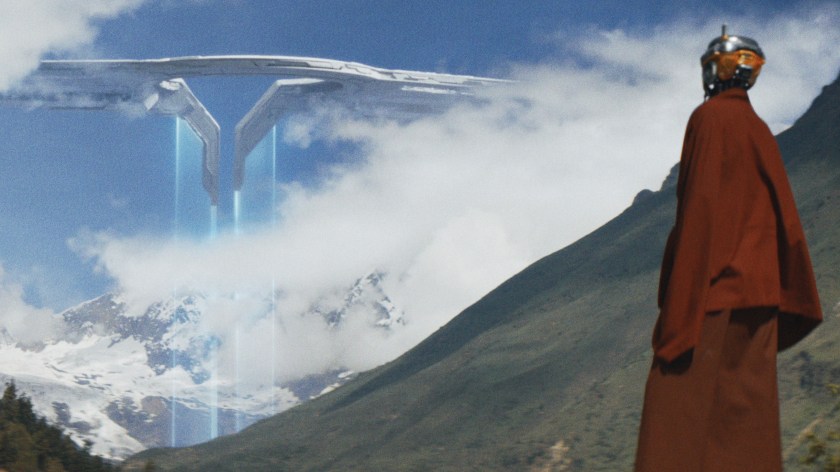
Furthermore, as evidenced by some stunning imagery in Godzilla and Rogue One, Edwards brings some breathtaking visuals to this world, whether it is the AI who have integrated into society or the vast and behemoth military weaponry that the US has in its arsenal.  The impressiveness of the visuals is even more remarkable considering the film’s relatively small budget of $80m, which should serve as food for thought given the high budget and comparatively poor quality of the visuals of some blockbuster films in recent months.

As the central character in this war between humanity and AI, John David Washington is as compelling as ever. We see how he was, at one time in his life, blissfully happy with his wife Maya (Chan) until a devastating event in his past transformed him into a world-weary soldier who chooses to protect this young child when he learns that there could be a connection to Maya. Speaking of the simulant, whom Taylor dubs “Alphie,” given that she was only seven years old during production, she delivers a remarkable breakthrough performance as the heart of the film and steals the entire show. The two build a rapport as they travel to prevent Alphie from falling into the hands of the US military. Furthermore, the discovery of this simulant gives Taylor a fresh perspective on the fragmented nature of the world he inhabits, which also feels very apt given the bitterly divided world we currently live in. With his experience with directing intense action scenes in a galaxy far far away and gargantuan kaiju beating each other up, Edwards brings that expertise to the film’s action set-pieces, backed by another superb score from Hans Zimmer.

Despite boasting some stellar names, the performances of the rest of the cast are hampered by a lack of development, particularly Allison Janney’s Colonel Howell who seems hell-bent on finding this new weapon and cares for little else besides that. Similarly, Ken Watanabe’s simulant soldier Harun is a badass and heroic fighter, but he doesn’t get room to grow beyond these traits. While the film’s exploration of AI and its potential future applications is thought-provoking and nuanced, the same cannot be said for its on-the-nose examination of how Western countries, particularly the US, can conduct invasive military campaigns on foreign soil, which feels somewhat heavy-handed.

Nevertheless, in an era where big tentpole blockbuster films tend to be attached to existing properties or as a part of a franchise, it is refreshing to see an original and thought-provoking piece of filmmaking come to the fore, particularly given its approach to a subject that humanity will be talking about for many decades to come. Could this film be prophetic? Only time will tell.

While it may not have the most well-developed characters, boasting mesmerising visuals and a thought-provoking approach to its topical subject matter in a richly developed futuristic world ensures this is a welcome return to the realm of blockbuster filmmaking for Gareth Edwards.

Posted in 2020-2029, Film Review

Strays (2023)

© Universal Pictures, Lord Miller Productions and Rabbit Hole Productions

Strays – Film Review

Cast: Will Ferrell, Jamie Foxx, Isla Fisher, Randall Park, Brett Gelman, Will Forte

Director:  Josh Greenbaum

Synopsis:  A stray dog vows revenge on his abusive owner after he is left abandoned…

Review: For thousands of yearsdogs have stood faithfully by humanity’s side and have earned the title of “man’s best friend” as a recognition of the mutual love that exists between humans and our canine pals. Anyone who has owned a dog, or indeed, interacted with them, knows how much fun they can be to have as pets. While there’s no question they can be adorable and provide us with memories to last a lifetime, our four-legged friends do have some rather less-than-pleasant tendencies. These tendencies, and the perspective of how dogs see humans and the world around them are, on paper, pedigree material for a raunchy comedy. A comedy which ought to have left audiences howling with laughter, only for it to miss the mark and be about as funny as stepping in dog excrement.

Reggie (Ferrell) is an adorable but naive border terrier who is owned by Doug (Forte). Reggie loves Doug unconditionally and sees him as the perfect owner, but the reality is Doug is a horrid and abusive bottom-of-the-barrel garbage excuse for a human who blames Reggie for his own failings and mistreats his pet in favour of getting high all the time. After Doug abandons Reggie following what the puppy believes to be a game of fetch, Reggie finds company in a gang of other stray dogs who live on the streets to fend for themselves, namely the extremely vulgar Boston Terrier Bug (Foxx), Australian Shepherd Maggie (Fisher) and Great Dane Hunter (Park). Realising all this time that Doug has not been the amazing owner he once thought he was, Reggie vows revenge on Doug and is joined by his newly acquainted group of pooches get back at Doug for the years of neglect and mistreatment.

In the hands of director Josh Greenbaum, whose last film Barb and Star Go To Vista Del Mar proved to be an idiosyncratic but amusing ride, one would have hoped for a repeat of that success. Unfortunately, Dan Perrault’s screenplay instead relies on low-hanging fruit by using some of the horrid tendencies of our canine pals for vulgar and obscene comedy, which gets very stale very quickly. Yes, dogs like to hump things, it does not need to be turned into a running gag. What’s more, the film spends a substantial amount of its time focused on utterly juvenile jokes concerning bodily fluids, genitals and faeces, and very little time focusing on a plot to make the audience actually care about the quest the dogs are on. There is absolutely a time and a place for such jokes, a dog movie being the perfect example. Still, the script repeats these with such frequency it quickly gets tiresome and makes it feel like it was written not by a professional screenwriter, but instead by a bunch of giggly schoolchildren who fall about in helpless laughter at rude words.

To give the film a tiny morsel of credit, not all the humour is nauseatingly crude, as there is a humorous moment involving the gang of pooches high as kites after they eat a bunch of mushrooms which elicits a chuckle or two. Yet, one mildly amusing scene in a supposed comedy filled with jokes reliant on bodily humour which are devoid of any subtlety or wit, is not enough to redeem the film in the slightest. Even at a mere 93 minutes, the repetitive and unfunny nature of the comedy means the film drags and becomes a chore to sit through, even with some adorable dogs on screen.

What could have been a very witty and clever take on man’s best friend and their relationship with humans proves to be anything but and ends up being a complete waste of its talented voice cast.  If it looks like dog poop and smells like dog poop, then it is probably dog poop, and this is one piece of cinematic dog poop you would be well-advised to avoid.

Vulgar for the sake of being vulgar, there is no treat to be found in sitting through this tasteless and unfunny comedy that is all bark and no bite. Man’s best friend deserved better. 


Posted in 2020-2029, Film Review

Past Lives (2023)

© A24, CJ ENM, Killer Films and 2AM

Past Lives – Film Review

Cast: Greta Lee, Teo Yoo, John Magaro

Director:  Celine Song

Synopsis: Two childhood friends in Korea reconnect years later after one of their families migrated to North America…

Review: As human beings, we have all likely gone through that moment where we have imagined what would have happened had certain decisions we made in our lives been different. Could certain events, or maybe even the whole direction of our lives transpired differently than how they turned out? Would we have lived in a different place, landed on a different career path or met and fallen in love with someone else entirely? These are the questions and ruminations which beat at the heart of this quiet, thoughtful and stunning directorial debut from Celine Song.

Growing up together at a school in Seoul, Na Young and Hae Sung were classmates and childhood sweethearts who seemed destined to spend the rest of their lives together. However, their lives are taken in two different directions when Na Young’s family emigrates to Canada. Flash forward 12 years and Na Young – now going by the name Nora – is a playwright living in New York, while Hae Sung remained in Korea to study engineering. A chance search on social media allows the two of them to reconnect online but, Nora chooses to cease contact so both can focus on their careers. After a further 12 years pass, Kae Sung travels to New York to meet Nora in person, where they contemplate their time together in Korea, how their lives have turned out and ponder what might have been had they stayed together.

For as long as cinema has existed, there have been countless films which have explored romance, relationships and the complicated emotions that can form when two souls who seemed destined to be together are torn apart. Celine Song’s semi-autobiographical screenplay approaches its subject matter in a way which feels uniquely original and accomplishes this without coming across as overly sentimental. The exploration of a Korean concept known as “in-yeon”, where two souls during a chance encounter might have meant something much more to each other in a previous life, sounds quite soppy. Song’s script adds rich layers of emotional depth with a tinge of melancholy, to this heart-achingly beautiful story of romance, longing for a life we’ve never lived, and a rumination of the events which shape our lives.

As the central character of this exquisite love story, Greta Lee is terrific as Nora. We see how throughout her life, she is resolute in her ambition to achieve her goals as a playwright and initially seemed sure of who she would marry in the early stages of her life. However, when it comes to her personal life, she becomes torn between her childhood crush and Arthur (Magaro), the man she married after the two met on a writer’s retreat. The scenes between her and Hae are tenderly portrayed with often periods of silent reflection between them because sometimes silence says more than words ever could. Crucially, the film never strays into any melodrama particularly where Arthur is concerned as he could have been portrayed as a villain. However, Magaro’s layered performance ensures that the audience views him sympathetically as he understands the connection that once existed between his wife and Hae when they were young and doesn’t get in the way of the tender moments between these two former lovers.

The poignant score by Christopher Bear and Daniel Rossen reinforces the wistful and moving nature of the central story, to which Song bides her time and paces things deliberately slowly to allow the relationships between the central three characters to take their course. Sometimes, the most powerful stories come from our own experiences that we encounter during our journey through this mad, crazy and sometimes beautiful world that we live in. Those complicated, layered emotions from those moments where we find pastures new, meet and fall in love, and through no fault of our own, are forced to part ways are captured so succinctly by Song. Like its central characters, this is a film which will likely leave audiences deep in thought and reflection on their own lives once the credits start to roll.

A beautiful and profound character study of the complexities of the emotional and romantic bonds which shape the course of our lives. A masterful directorial debut from Celine Song. 

a

Posted in 2020-2029, Film Review

Oppenheimer (2023)

© Universal Pictures and Syncopy

Oppenheimer – Film Review

Cast: Cillian Murphy, Emily Blunt, Matt Damon, Robert Downey Jr., Florence Pugh, Josh Hartnett, Casey Affleck, Rami Malek, Kenneth Branagh, Alden Ehrenreich, Benny Safdie, Jason Clarke, Dane DeHaan, David Dastmalchian

Director:  Christopher Nolan

Synopsis:  Telling the story of the theoretical physicist J. Robert Oppenheimer and how he helped to develop the atomic bomb during World War II…

Review: The filmography of Christopher Nolan has always had a fascination with science and the impact advances in science could have on society. Interstellar travel, a globe-trotting time-bending/inverting mission, the exploration of a fierce rivalry between a pair of magicians blowing minds with their impressive tricks, and of course, a certain caped crusader fighting crime with an array of scientific gadgets. Therefore, given the direct namecheck in Tenet, it felt inevitable that Nolan would sooner or later turn his attention to the story of the scientist regarded as one of the most influential people to have ever lived, during one of the most defining moments of the 20th century. A man known as the father of the atomic bomb, one of the deadliest scientific creations in human history, J. Robert Oppenheimer.

Based on the 2005 biography American Prometheus: The Triumph and Tragedy of J. Robert Oppenheimer by Kai Bird and Martin J. Sherwin, Nolan’s screenplay is extensive in its scope and ambition in how it chooses to depict the life of its eponymous theoretical physicist. Though in typical Nolan fashion, he doesn’t do things by the book regarding what one might expect from a biopic. Split between two perspectives, “Fission” depicts how events were seen from Oppenheimer’s point-of-view, while “Fusion” opts for a black-and-white colour palette and depicts the latter stages of Oppenenheimer’s career, specifically when his security clearance was up for renewal and the intense scrutiny which surrounded him and his Communist links. Links, given the USA at the time was entering the Cold War with the Soviet Union and at the height of McCarthyism, are of enormous concern to the government, which became of particular interest to Lewis Strauss (Downey Jr.), the former chair of the Atomic Energy Commission, who later sought a top position in the US government.

As one would expect from Nolan, the film takes a non-linear approach to the story by continuously jumping between the two timelines throughout. However, what follows over the course of the next three hours is a fascinating exploration of a pivotal moment in history, a complex character study of the man at the centre of the creation of this deadly weapon and the impact it had on his conscience, the immediate and far-reaching consequences of the bombs being dropped on Hiroshima and Nagasaki bringing World War II to an end. Yet, in doing so, ignited the arms race between the world’s two superpowers which would define global politics for the next several decades and still has an effect on world politics to this very day. It is unquestionably a very dialogue-driven film, but Nolan’s screenplay never fails to keep events on screen engaging with the dialogue every so often interjected with scenes of atoms colliding, and Jennifer Lame’s editing ensures the film’s pacing remains brisk.

Having worked with Nolan numerous times across his career in supporting roles, Cillian Murphy finally gets his chance in the leading role and he seizes it with both hands. Through those piercing blue eyes, Murphy’s extraordinary performance takes us deep into the mind of this man and allows him to fully exhibit a range of emotions. From a brief look at his academic life, his early days as a university professor teaching quantum physics, a triumphant moment following the end of World War II, to his haunting guilt over creating a deadly weapon that has wrought unspeakable horror and devastation on countless lives.  Alongside Murphy’s incredible leading performance, Nolan has arguably assembled the all-star cast to end all-star casts, with everyone giving an excellent performance. In a cast this stacked, it is hard to stand out from the crowd, but the one who shines brightest is Robert Downey Jr. as Lewis Strauss. For years, he charmed audiences as the genius, billionaire, playboy, and philanthropist Tony Stark. This is a very different role, but as he did throughout his tenure in the MCU, Downey shows off his incredible talents and portrays Strauss as a very driven individual who is at the forefront of the pushback against Oppenheimer following the conclusion of WWII and will find anything he can to discredit the physicist.

On the subject of the Manhatten Project, which dominates the second act of the film and is where Nolan’s renowned technical wizardry comes to the fore. Through Hoyte van Hoyetma’s stunning cinematography and incredible sound work, the recreation of the testing of atomic devices ensures the audience feels the effects of these blasts. It all acts as a prelude to the nerve-shredding Trinity Test sequence, which Oppenheimer feared could cause a chain reaction that would destroy the world. The audience knows it won’t have that effect, but Ludwig Gorannsson’s score masterfully captures that nerve-shredding tension that would have undoubtedly raced through the minds of these scientists until the explosion. An explosion which, incredulously, is fully captured in camera without the assistance of special effects, a mind-blowing cinematic accomplishment.

However, while the technical mastery on display cannot be denied, what has been Nolan’s Achilles heel throughout his career has been writing female characters. Unfortunately, the female characters leave much to be desired. Florence Pugh makes the most of her limited screen time as Communist Party member Jean Tatlock, Oppenheimer’s mistress. Though, while they serve the narrative to an extent, a handful of her scenes feature full-frontal nudity and they ultimately come across as gratuitous. Emily Blunt’s turn as Kitty Oppenheimer could have very easily gone in a similar direction in which she is barely utilised and falls into the stereotype of the supporting housewife, but she avoids that with a memorable and fiery exchange with lawyer Roger Robb (Jason Clarke) during her husband’s security clearance hearings. While Nolan’s fascination with science in his previous films gave him theoretical scientific premises to explore, what he put under his cinematic microscope here is a world away from what he has previously accomplished in his career. The impact of this scientific breakthrough, the psychological effect it had on the man who developed it, and the long-lasting consequences of what can happen when one man, and indeed a whole country choose to play God, consequences which are still reverberating on the world stage today.

Under the vision of its masterful director, with a packed all-star cast led by an incredible awards-worthy performance from Cillian Murphy, gives Nolan the requisite materials required to craft a riveting and forensic character study of a man whose work changed the course of human history forever. 

a

Posted in 2020-2029, Film Review

Barbie (2023)

© Warner Bros. Pictures, Mattel Films and Heyday Films

Barbie – Film Review

Cast: Margot Robbie, Ryan Gosling, America Ferrera, Kate McKinnon, Issa Rae, Rhea Perlman, Will Ferrell, Hari Nef, Alexandra Shipp, Emma Mackey, Sharon Rooney, Dua Lipa, Nicola Coughlan, Ana Cruz Kayne, Ritu Arya, Kingsley Ben-Adir, Simu Liu, Scott Evans, Ncuti Gatwa, Michael Cera

Director: Greta Gerwig

Synopsis: After suffering an existential crisis, one Barbie (Robbie) must journey to the real world in search of answers…

Review: A parody of Stanley Kubrick’s 2001: A Space Odyssey is probably one of the last ways you’d expect a film centred on one of the most influential toys to have ever been created to start.  “Since the beginning of time, since the first little girl ever existed, there have been dolls. But the dolls were always and forever baby dolls,” intones Helen Mirren’s narrator. It wasn’t until 1959, when a company called Mattel launched a toy which would change not just the doll industry, but the toy industry forever with over a billion dolls sold worldwide, and her name is Barbie. A plethora of animated movies followed since, but while it has been mooted for a long time, a live-action film had for a long time looked as though it would never escape the doldrums of the plastic box of development hell. This is until, Greta Gerwig, after her success with a beautiful directorial debut and a superb adaptation of one of the most beloved novels of all time stepped in, and the result is one of the funniest, and pinkest movies you will ever see in your life.

In the picturesque world of Barbie Land, live all of the Barbies, each of whom has their own unique role in their perfect society. One such Barbie is the stereotypical Barbie (Robbie), who wakes up every day living her best life, spending days by the beach, having parties in her dream house, and organising girls’ nights with all of the other Barbies in the community. Nights filled with sleepovers, parties and the dulcet tones of Dua Lipa and Lizzo providing an irresistibly catchy soundtrack. This is until one night, one passing comment about death causes everything in her perfect world to go very wrong, including cold showers, falling off her roof, and worst of all, gasps, flat feet. Determined to find answers, Barbie must journey, with her partner Ken (Gosling) in tow, to the real world to figure out what is causing the imperfections in her perfect lifestyle to happen and whether she can fix them before it is too late.

You can see why they ran out of all the pink paint…

As is the case with superhero movies, or murder mystery movies, it pays to know as little as possible before making the journey to Barbie Land. Beyond what is teased in the trailers, this is no ordinary Barbie movie. Gerwig’s screenplay (co-written by her partner Noah Baumbach) really goes all in on the themes it chooses to approach and is not afraid to tackle meaningful social commentary surrounding feminism, gender roles, the negative impact that Barbie has had on the standards of beauty for women, and the patriarchal nature of the real world and its abject treatment of women, a very stark contrast to the idyllic world of Barbie Land. A severe rude awakening for Barbie, but one that considerably piques Ken’s interest who finds a new sense of purpose to his existence beyond merely being an accessory for Barbie. Gerwig and Baumbach deserve great credit for their scope and ambition as the script strikes a playful balance between thought-provoking social commentary and Barbie’s toy history and also goes for some big swings, all with fantastic wit and sharp meta-humour.

From the moment she was cast, Margot Robbie felt like the perfect choice to play the lead role of Stereotypical Barbie, and she does not disappoint. Throughout her career, she has portrayed a wide range of charismatic characters and has always embodied those roles perfectly, whether it’s her perfect turns as Harley Quinn or as the no-holds-barred party girl in Babylon. Now she can add Barbie to that list of roles which felt tailor-made for her because she looks the part, but also has the required acting chops necessary for both the film’s light-hearted moments and the more serious moments. Alongside her, Gosling is equally perfect as Ken. His career has often seen him in intense dramas where he appears stoic and cold. However, he has also proved he has serious talent as a comedic actor and never has that shone more brightly than in The Nice Guys. His performance as Ken is unlike anything you have seen from him before. No matter if he’s showing off his muscles, or a passionate song and dance number, he owns every minute of screen time he has.  In such a star-studded cast, Robbie and Gosling stand out among all the respective Barbies and Kens, though Weird Barbie (McKinnon) is given plenty of moments to shine. Outside of the would-be plastic dolls, America Ferrera gives a noteworthy as a disgruntled Mattel employee who might hold the key to why Barbie’s world is falling apart.

It’s been well documented when designing the film’s incredible sets, they needed so much pink paint that it contributed to a worldwide shortage of that particular colour, no expense spared for Barbie’s dream house, as it should be, and it was most definitely worth it as the film’s production design is immaculately impressive and rich in its detail. The same is also most definitely true of the costumes which have been faithfully recreated for the big screen. While the film blasts through its 114-minute running time, there is one side plot with Will Ferrell’s Lord Business Mattel CEO which can feel a bit throw away but it does not detract from the fact that Greta Gerwig has created a film which manages to be a fuschia-infused party, an uproarious comedy, and a thought-provoking look at modern society rolled into one and completes Gerwig’s hat-trick after her success with Lady Bird and Little Women.  Come on Barbie, let’s go party!

A feminist and hilarious ode to the doll which has defined generations and will almost certainly continue to do so for many more generations to come. Life in plastic is truly fantastic!

Posted in 2020-2029, Film Review

Joy Ride (2023)

Joy Ride – Film Review

Cast: Ashley Park, Sherry Cola, Stephanie Hsu, Sabrina Wu, Ronny Chieng, Desmond Chaim, Alexander Hodge, Daniel Dae Kim

Director: Adele Lim

Synopsis: A lawyer is convinced by her best friend to travel across China in search of her birth mother…

Review: It is inevitable that any movie featuring a group of friends on some kind of raunchy/boozy quest filled with mischievous shenanigans will have comparisons made to either The Hangover franchise or to Bridesmaids. Though they were not the first films of their kind, the latter opened the door for more female-driven R-rated comedies to level a playing field that tended to be dominated by Caucasian men. As such,  a comedy which featured Asian-American women at the centre would have been unheard of a few years ago. However, in recent years, Asian-led films have become increasingly more prominent, including a rom-com with a predominantly Asian cast and the not-so-small matter of an Asian-led multiverse film which claimed Best Picture at this year’s Academy Awards, both of which represented significant moments for Asian representation on screen. Enter Crazy Rich Asians co-writer Adele Lim, making her directorial debut to continue the step forward for representation by having Asian American women at the centre of one of the funniest R-rated comedies in a long time.

Audrey Sullivan (Park) and Lolo Chen (Cola) are best friends who grew up together as the only two Asian children in their neighbourhood, appropriately named White Hills. Now into adulthood, Audrey is a high-flying lawyer on the cusp of a big promotion, while Lolo is an artist specialising in sex positivity. To clinch her promotion, she is tasked by the bosses within her firm to travel to China to close out an important business deal and takes Lolo along to act as a translator. While in the country, they meet up with Lolo’s K-Pop-obsessed cousin Deadeye (Wu) and Audrey’s actor friend Kat Heung (Hsu). After the meeting doesn’t quite go as planned, the four of them go on a journey across the country to find Audrey’s birth mother.

On the surface, Joy Ride certainly resembles the aforementioned comedies featuring a group of friends on a journey of self-discovery, all while engaged in some humorous hijinks. However, through Cherry Chevapravatdumrong’s and Teresa Hsiao’s hilarious screenplay, the film establishes itself from the off by tapping the mindset of these four very different people. Each of them will discover new things about themselves, and their aspirations for what they aspire to achieve while learning some new things about their friendships and cultures along the way. Particularly in the case of Audrey, as someone who has grown up in the US, having been adopted from China as a very young child, it explores her perspective as someone who sees herself torn between the life she has known growing up in her adopted homeland and the family she never knew in Asia. Right from the moment they meet, the friendship between Audrey and Lolo is beautifully realised in no small part due to standing up to a racist bully, with one of the best utterances of “fuck you” in any movie ever. From that moment on, the unbreakable bond between them was set, and the chemistry between Park and Cola is delightful.

It’s not until Audrey and Lolo arrive in China in search of the former’s birth mother, where they quickly meet up with Deadeye and Kat, that the hijinks and hilarity ensue and they come thick and fast. From the key business meeting which descends into a drinking game and more, a highly amusing train journey, uproarious sexual encounters each of our leads has with members of a local sports team (chances are you may well never look at a basketball and a massage gun in the same way again!), and a rendition of a popular rap song, there is no limit to how raunchy and mischievous the comedy will go to make the audience laugh. Each character is given their moment to shine, from Audrey’s insecurities about her identity and her heritage to Lolo being looked down on for her sex-positive art, to Deadeye’s socially introverted nature and fanatic love of K-pop to Kat’s attempts to cover up her sexually promiscuous past from her devoutly Christian fiance.  Each actor brings heart and sincerity to their performance and as their journey takes them across Asia, they grow and bond as a group of friends.

While the central quest to find Audrey’s birth mother involves endless amounts of humour, it crucially finds the time to establish some genuine emotional moments between the group to bring them together, particularly in the third act which is where Park’s performance soars. Balancing the comedy with emotional weight can be a tough balancing act as there’s a risk the comedy will negate the emotional drama. However, Lim expertly handles this balance with assured direction. The similarities with other comedies of this nature are obvious. However, the level of passion which went into the making of the film comes across in both the writing and the performances, with a story that will undoubtedly be relatable to countless millions, plus another significant moment for representation in a comedy that will provide you with endless amounts of joy, and that is never a bad thing.

Packed with hilarious raunchy humour and a sweet and emotionally heart-warming story of four friends on a journey of self-discovery, Joy Ride is easily the funniest movie you will see all year. 

Posted in 2020-2029, Film Review

Mission: Impossible – Dead Reckoning (2023)

© Paramount Pictures, Skydance and TC Productions

Mission: Impossible – Dead Reckoning – Film Review

Cast: Tom Cruise, Rebecca Ferguson, Simon Pegg, Ving Rhames, Hayley Atwell, Vanessa Kirby, Henry Czerny, Pom Klementieff, Esai Morales

Director:  Christopher McQuarrie

Synopsis:  Ethan Hunt and the IMF find themselves in a race against time to prevent a new weapon from being utilised by a powerful enemy…

Review: Ever since making his first screen appearance as secret agent Ethan Hunt in 1996, the unparalleled commitment of Thomas Cruise Mapother IV to pull some truly insane and incredible stunts has made him practically unrivalled in terms of an out-and-out movie star. Here’s a man who has across nearly three decades of this franchise, among other things, climbed the tallest building in the world, hung off a plane in mid-air,  performed a HALO jump and flown a helicopter for a pulsating tense chase sequence, all in the name of entertaining the audience. The success of last year’s Top Gun: Maverick, which was filled with some of the best aerial combat sequences ever captured on film, reinforced Cruise’s status as a box office draw. Now after a long and arduous journey to get to the big screen thanks to the Covid pandemic, Cruise once again suits up as Ethan Hunt for another nail-biting mission.

As the trailers kept the plot shrouded in secrecy, it would be impolite to go into massive amounts of detail about the plot. Suffice it to say, given the extraordinary amount of conversations which have been generated by the subject in question, it is extremely timely, packs what you’d normally expect from an MI adventure, and ensures the stakes for this seventh instalment somehow feel even bigger than its previous entries. When Ethan Hunt and the IMF learn of the existence of a new threat which would unleash global chaos if it fell into the wrong hands, Hunt along with trusted associates Benji (Pegg) and Luther (Rhames) and Ilsa (Ferguson) must set off another global mission to retrieve an artefact which could lead to this mysterious new weapon, while being pursued by an array of other forces who have also taken an interest in this weapon, which includes Vanessa Kirby’s Alanna Mitsopolis AKA the White Widow.

Given the remarkable longevity with which he has played this character, it will not come as a shock to learn that Cruise is once again terrific and there is genuinely no one else in the world who could possibly take on this role at this point. He continues to prove that age is just a number as despite now being into his sixties, he remains as committed as ever to throwing everything he has at the stunts this franchise has become so well known whether that be a crazy car chase, an exhilarating chase sequence or actually driving a motorbike off a cliff. While none of his IMF colleagues are involved with such extraordinary stunts, as is the case with Cruise, they have embodied these characters for so long now, they’re on reliably good form. As for new characters, the most noteworthy is Hayley Atwell’s Grace, a mysterious character who gets entangled with the IMF’s hunt for this mysterious weapon. With Sean Harris’s Solomon Lane now out of the picture, the latest villain to pose problems for the IMF comes in the form of Esai Morales’s Gabriel. While he is not the most well-developed villain in the franchise, he nevertheless proves to be a methodical antagonist who poses a substantial threat to give Ethan and the IMF a substantial headache, along with Paris (no, not the city), but instead, a sword-wielding assassin played with evil glee by Pom Klementieff.

While the stunts in this latest instalment continue to push the boundaries for what action cinema is capable of, it does come at a cost. In this entry of the franchise, more than any other which has been helmed by McQuarrie, it is noticeable that while the filmmakers go all out in terms of the action and the mind-bogglingly impressive level of stuntwork which must go into bringing them to life, McQuarrie and Erik Jendresen’s script stutters as a result. In this instalment, more so than any other film helmed by McQuarrie, it is apparent the screenplay is worked around the stunts and the unintended consequence of that is the events in the first act are a little convoluted and messy in its first act as it establishes the groundwork for what this mysterious weapon is and why it is so heavily sought after.

Once these wrinkles have been ironed out, the film kicks firmly into gear and its 163-minute run time flies by as quickly as its lead star can run. While it might not scale the heights of its predecessors (it will seriously be hard to beat that Burj Khalifa climb, the HALO jump or the jaw-dropping helicopter sequences), the intensity of the third act will have you in its grip for the entirety and will not let go until the credits have begun to roll. Time will tell just how long this franchise will have legs for, but so long as its star is willing to keep on running and pulling off more insane stunts, and its director remains committed to making them, it’s unlikely to run out of road or missions any time soon.

Following the pulsating highs of Fallout was always going to be a mission not even the IMF could accomplish. Nevertheless, the unwavering star power of Cruise and his commitment to delivering adrenaline-fuelled entertainment ensure that coming back for Part Two will be a mission audiences will be more than willing to accept. 

Posted in 2020-2029, Film Review

Indiana Jones and the Dial of Destiny (2023)

© Walt Disney Pictures and Lucasfilm

Indiana Jones and the Dial of Destiny – Film Review

Cast: Harrison Ford, Phoebe Waller-Bridge, Antonio Banderas, John Rhys-Davies, Toby Jones, Boyd Holbrook, Ethann Isidore, Mads Mikkelsen, Shaunette Renée Wilson

Director:  James Mangold

Synopsis: Legendary archaeologist Indiana Jones finds himself in a race against time, and the Nazis,  in a bid to recover a historical artefact…

Review: Whether it be the fedora, the whip, his sense of adventure, his charm, or the fact he loves to give a Nazi or two a punch to the face, the appeal of Dr Henry Walton “Indiana” Jones Jr is one which has endured throughout the decades ever since he made his debut in 1981’s Raiders of the Lost Ark. The subsequent three films which followed may have varied in quality, but what did not vary was the popularity of this character, which has endured to the point where he is widely regarded as one of the greatest characters in the history of cinema. Fifteen years after what was billed as his last adventure, Indy has dusted off the leather jacket and the whip, for another go at one final adventure.

The year is 1969 and Dr Jones is on the brink of retirement from his teaching job as a university lecturer. The Space Race between the USA and the Soviet Union is in full swing, with the former poised to be the first country to send people to the moon. While once his students were fascinated by the subject of archaeology, now they’re completely unenthusiastic and are far more interested in space, leaving Indy facing up to the prospect of a rather lonely future in retirement. This is until his goddaughter Helena Shaw (Waller-Bridge) shows up out of the blue seeking Indy’s help to locate an ancient historical artefact in the form of a dial, which is said to have belonged to Archimedes. Though, of course, the dial is also being pursued by former Nazi Jurgen Voller (Mikkelsen), who has since been recruited by NASA to assist the US with their efforts in the Space Race.

Before the globetrotting adventure to retrieve this artefact can begin however, the film turns back time to a thrilling 20-minute prologue set during the tail end of World War II minute prologue, where a younger Indy (via a digitally de-aged Ford) and his fellow archaeology enthusiast Basil Shaw (Jones) are in search of another artefact which they believe may be in the possession of the Nazis of. However, a chance encounter leads them to this dial which may or may not have some kind of magical powers of some kind to it. It wouldn’t be an Indy film without it! Fast forward 25 years, and Indy and Helena set off on a new adventure to retrieve this priceless treasure before it falls into the wrong hands.

Ford is an actor who has no shortage of legendary roles to his name, each of which he has reprised over the years to wonderful effect, and Indy is no exception. It is apparent Ford has a great affinity for this character, and despite his age, he puts in a committed performance proving there is no one else to don Indy’s fedora. Given the length of time Ford has played this role, the script by Jez Butterworth, John-Henry Butterworth, David Koepp and James Mangold leans into this longevity and the fact that an adventure of this nature would wear an adventurer of his age down. His general grumpiness, combined with Helena’s endless energy and enthusiasm, lends itself to some comedic moments, and Waller-Bridge is tremendous in the role. She is easily given the most development out of all the new characters, which is frustrating particularly where Mikkelsen’s villain is concerned. He’s an actor who has proved he can play a thoroughly unlikeable villain with nuance and subtlety to the point where you almost feel sorry for him. Unfortunately, the script doesn’t develop him much beyond he’s a former Nazi who is desperate to find this dial for his nefarious purposes and so Indy and Helena must stop him and his assortment of goons led by Boyd Holbrook’s Klaber at all costs.

It is strange that for an Indiana Jones film, there is no involvement of either franchise creator George Lucas or the director of the first four films Steven Spielberg, with both instead serving as executive producers. Taking on the reins from Spielberg is an unenviable task, but it is one which James Mangold rises to. He is a director who notably has experience with giving a beloved character the swansong they deserve and has an incredibly broad range of films across a multitude of genres in his career. The action scenes have a vibrant energy to them and are visually stunning to look at especially the opening prologue and some of the action scenes in the second act. While these are fun to watch, the film clocks in at nearly two and a half hours, it is the longest film in the franchise to date and you begin to feel that run time by the end due to some sluggish pacing. Furthermore, the film can feel a bit too reliant on the by-the-numbers nature of its plot and the nostalgia many will undoubtedly have for this franchise, aided by the score that the living legend John Williams provides. Matching the lofty standards set by two-thirds of the original trilogy (looking at you Temple of Doom), was always going to be a tall order. However, where Kingdom of the Crystal Skull fell short, Dial of Destiny turns back time to let this character roll back the years and enable him to take a final bow befitting of an iconic screen legend.

While it leans a bit too much its nostalgia and its tried and tested formula, the committed performances from Ford and Waller-Bridge ensure the legendary archaeologist’s final adventure is one which is absolutely worth going on.  

Posted in 2020-2029, Film Review

The Flash (2023)

© Warner Bros. Pictures and DC Studios

The Flash – Film Review

Cast: Ezra Miller, Sasha Calle, Michael Shannon, Ron Livingston, Maribel Verdú, Kiersey Clemons, Antje Traue, Michael Keaton, Ben Affleck

Director:  Andy Muschietti

Synopsis: Upon discovering he can use his powers to travel in time, Barry Allen/The Flash attempts to rectify a tragic incident from his past…

Review: Before taking the time to analyse the latest, and one of the last films in the DC Extended Universe as we know it, it would be remiss for anyone to not bring up the subject of the string of off-screen allegations which have followed the film’s star Ezra Miller since the film wrapped production in 2021. Such is the scale and extremely serious nature of said allegations of misconduct, they cannot be ignored and the art can no longer be separated from the artist. Furthermore, given we’ve known for a while that the DCEU as we know will be rebooted under the direction of James Gunn and Peter Saffran, these allegations will have to be addressed by the studios at some point in the future.

Barry Allen has settled into his day job as a forensic investigator while also helping to fight crime as a member of the Justice League. However, his dad is awaiting trial after he was accused of murdering his mother when Barry was a child. When he discovers by travelling at such high speeds he can travel back in time, he attempts to alter the past to prevent his mother’s death, only to realise he has landed in an alternate universe, where he encounters his younger self. Together, the two of them must work out how to fix the damage that has been done to the universe before it is too late.

Multiverse movies have become all the rage in recent years, so despite being centred on an extremely fast character who can travel at super speeds, it is somewhat ironic this has been one of the last films to get in on the action. Though, in all fairness, it has been stuck in development hell for a long time, with multiple directors being attached at one point or another. The dual performances by Miller are solid. It provides some entertaining moments seeing the older Barry get irritated by the antics of his younger self, though they are both overshadowed by the return of Michael Keaton’s portrayal of Bruce Wayne/Batman. Given his legendary status, and arguably being the best actor to ever don the cape and cowl, it would have been easy for Keaton to show up, film his scenes and collect his pay cheque no fuss no muss. But he commits to it, because he’s BATMAN, and the delivery of certain iconic lines from his Batman films are joyful to watch.

Unfortunately, what is not so joyful to watch, is the film itself. Any film which tries to dabble in time travel/multiverse adventures needs an airtight screenplay to prevent things from spiralling entirely out of control. Christina Hodson’s screenplay, working from a story by John Francis Daley, Jonathan Goldstein and Joby Harold, is heavily influenced by the Flashpoint storyline from the comics. However, perhaps given the screenplay has presumably gone through numerous versions, the final product leaves an awful lot to be desired. It attempts to juggle too many different plot threads with Barry’s remorse over what happened with his parents, time travel, an adventure with an alternate universe Batman, and a climatic superhero showdown in the third act that it becomes severely muddled and unfocused. As if that wasn’t enough, it introduces a new iteration of Kara/Supergirl into the mix, portrayed by Sasha Calle making her feature film debut. Calle does an excellent job with the material she’s given, but she is severely underutilised and the same is true for the return of Michael Shannon as General Zod, whose presence feels nothing more than a glorified cameo to set the stage for the third act.

This does have its moments, particularly around said final act and director Andy Muschietti does a capable job of trying to hold the film together through the chaos of this misadventure. However, as well as the opening action sequence, this third act is marred with some truly inexcusable sub-standard CGI, which should not happen when you have a $200m budget. While there have been some high points in the ten years since Man of Steel first took flight, ultimately, the current DCEU has got to a point where too many of its productions have been beset by too many problems, admittedly sometimes through no fault of their own. Nevertheless, the time is right for Gunn and Saffran to take charge and reboot the universe, but if this is to be the great reset for the DCEU it has been marketed as, a good starting point would be to unequivocally address the allegations surrounding Miller and hold them to account.

An adaptation of arguably the most well-known storyline from the comics should have been a slam dunk and the perfect way to bring this chapter of the DCEU to a close. Yet no amount of time travelling, or the glorious return of Keaton as the Caped Crusader, can save this multiversal misfire from becoming a jumbled mess.