
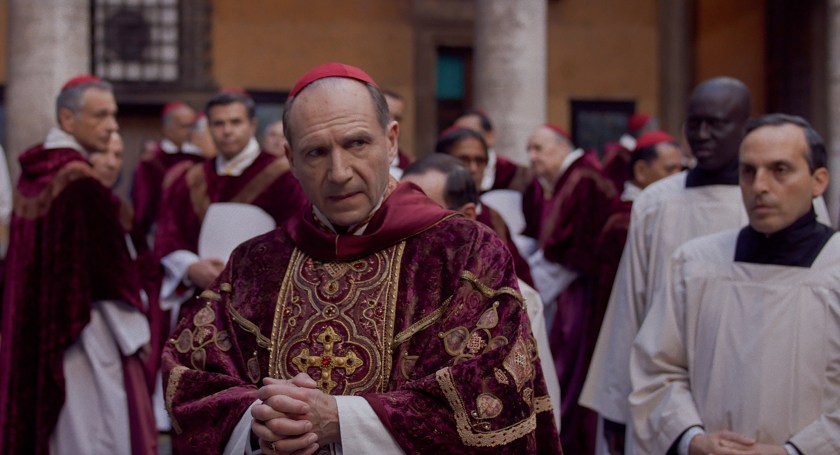

Conclave – Film Review
Cast: Ralph Fiennes, Stanley Tucci, John Lithgow, Sergio Castellitto, Isabella Rossellini, Lucian Msamati, Carlos Diehz
Director: Edward Berger
Synopsis: After the death of the Pope, a cardinal is tasked with organising the vote to elect a new leader of the Catholic Church…
Review: In a year when many people worldwide have gone to the polls to cast their ballot in elections, Edward Berger’s follow-up to his Oscar-winning All Quiet on the Western Front, couldn’t be timelier. Like the outcomes of these general elections, the election of a leader for an institution like the Catholic Church – an important pillar of faith for millions – is highly consequential. While the process is conducted away from the eyes of the watching world, Berger swaps the trenches of World War I for the halls of the Vatican and peers through the black or white smoke, at one of the most secretive and oldest elections in human history.
The film opens with Cardinal Lawrence (Fiennes) pacing through the streets of Rome late at night, arriving at the Pope’s private chambers in the Vatican. There, he receives the solemn news that the Holy Father has passed away from a heart attack. As the Dean of the College of Cardinals, Lawrence is tasked with organising the papal conclave, the election process to select the new pope. As the election begins, four leading contenders emerge: the liberal Cardinal Bellini (Tucci), the socially conservative Cardinal Adeyemi (Msamati), the moderate Cardinal Tremblay (Lithgow), and the hardline traditionalist Cardinal Tedesco (Castellitto), who threatens to reverse decades of reform. As the election unfolds to determine the most powerful figure in the Catholic Church, startling revelations emerge, threatening to overshadow the process and could cause catastrophic damage to the Church’s reputation, if they became public knowledge.

In the same vein as the elections the public participates in, with politicians desperately looking to either attain power or hang onto it by any means necessary by appealing to their respective electorates, Conclave is a fascinating exploration of humanity’s innate and almost selfish desire for ambition and to obtain power whenever they can. These are traits you wouldn’t expect of religious men in the service of a higher being and the institution to which they have devoted their lives. Peter Straughan’s script, adapted from the book of the same name by Robert Harris, lays this for all to see as these four men desperately look to play their hands and outmanoeuvre their competitors. It is all the more difficult for Lawrence, who shares the same political mindset as Bellini but must position himself as neutral given his position as the one who is overseeing the election. Yet, he knows of the damage that would be dealt to the Church and the Papacy if someone like Tedesco ascended to the papal throne. All the while, as the election takes shape, the revelations that come to light cause Lawrence to doubt his faith in the institution to which he has devoted his entire life.
The hallways of the Vatican, featuring men in fancy garments writing some words on a bit of a paper to choose their next leader, might seem the most unlikely ground for a pulsating, edge-of-your-seat thriller. Yet, for a gripping 120 minutes, as agendas begin to shuffle, the scheming commences as support for the various candidates fluctuates as some uncomfortable truths are revealed. It never fails to be utterly captivating, in no small part due to the phenomenal performances across the board. As the cardinal at the centre of this, Fiennes has consistently had a consistently captivating screen presence across his 40-year career, and he is utterly masterful once again. He must balance the difficult task of remaining objective in the running of the conclave, while desperately trying to prevent the election of a pontiff that would in his mind, cause considerable damage to an institution that has already had plenty of issues to contend with that have damaged its standing with the public. While Bellini ideologically aligns with Lawrence, he emphatically rejects any desire to become Pope. However, he may find himself reluctantly drawn into it to prevent Tedesco, or the devious Tremblay from winning the election, the latter of whom may also have some secrets he desperately tries to keep hidden.

While these cardinals scheme, bicker and devise plots throughout the process, the nuns in the Vatican remain mostly anonymous and silent observers. This is until Sister Agnes (Rossellini) is called upon when a decades-old secret comes to Lawrence’s attention. Fleeting though her screentime may be, with every word or gesture, she makes the most of her screentime in no uncertain terms. Reteaming with Berger after their combined Oscar success, Volker Bertelman’s string-heavy score is enough to get your heart racing with its intensity as if there wasn’t fraught enough with the events of the election playing out before our very eyes. The brisk editing by Nick Emerson ensures the film’s pacing never lags while Stéphane Fontaine’s cinematography is with several scenes boasting such visual splendour, that they wouldn’t look out of place in the Sistine Chapel. 2024 has been a significant year for vying for power at the highest positions of government, perhaps more than some would have liked it to be, given the outcomes of certain elections. Yet, it serves as a stark reminder, that absolute power corrupts absolutely, and no man, religious or not, can hide from that inescapable truth.
Through the divine work of an impeccably acted ensemble, featuring some of the best performances of Fiennes’ illustrious career, who would have thought a film about the election of a leader of the Catholic Church could be so thrilling?

 Through the Silver Screen