

The Wild Robot– Film Review
Cast: Lupita Nyong’o, Pedro Pascal, Kit Connor, Bill Nighy, Stephanie Hsu, Mark Hamill, Catherine O’Hara, Matt Berry, Ving Rhames
Director: Chris Sanders
Synopsis: After being shipwrecked on a deserted island, a robot must learn to adapt to its new surroundings and is put to the test when it has to care for an orphaned baby chick…
Review: Our world is home to a diverse range of fascinating wildlife and plant life. This may sound like something you’d hear in a nature documentary narrated by Sir David Attenborough (try reading that first sentence in his voice), but as those series demonstrate, the wonders of nature can be discovered anywhere on this magnificent planet. Since the dawn of humanity, we have explored and uncovered the marvels that the natural world has to offer. Now, imagine yourself as an outsider who has never encountered these wondrous sights or experienced nature’s beauty for the first time. You are a robot programmed to assist humanity, only to find yourself surrounded by an assortment of wildlife. The challenge of assimilation and finding your place in the world is beautifully captured in one of the year’s most compelling films.
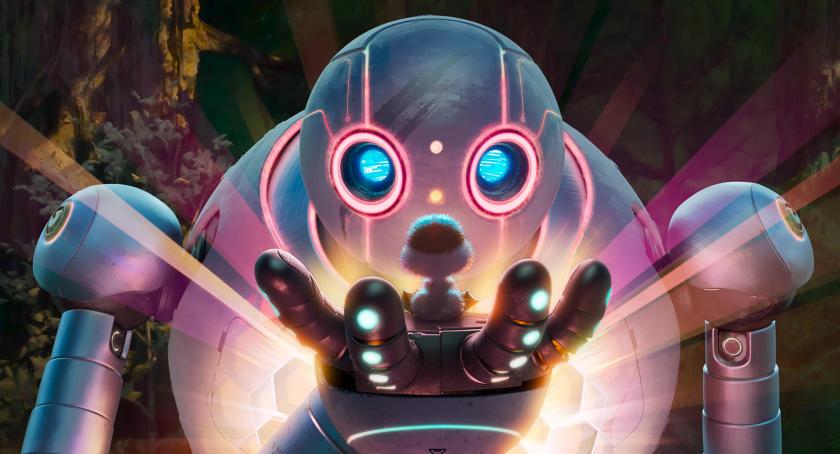
Set on an unnamed island, the Universal Dynamics ROZZUM Unit 7134 (Nyong’o) washes up on the beach after a storm. Upon booting up, Roz, as she quickly becomes known, attempts to adapt to her new surroundings and offers to assist the island’s inhabitants. Unfortunately, the locals are immediately hostile towards her arrival and reject her help. After Roz comes under attack from a frightening predator, she inadvertently destroys a goose’s nest, resulting in the death of the mother goose and leaving only a single egg remaining. Overcome with guilt, Roz decides to raise the surviving gosling, whom she names Brightbill until he is ready to join the rest of his kind for migration. Although she admits that this task is “not in her programming,” Roz becomes determined to work tirelessly until Brightbill can swim, eat, and fly, and gain the strength to take his place among his own kind.

As the relationship between humanity and machines, specifically artificial intelligence (AI), is increasingly scrutinized, The Wild Robot offers a fascinating perspective on how a robot might interact in a natural environment devoid of human presence. Adapted from the book series by Peter Brown, having beautifully brought to life the journey of one boy who learns how to train his dragon, Chris Sanders’ script delves deeper than just the exploration of nature’s struggle against AI. In this touching and heartfelt story, Roz often finds herself at odds with her programming as she works to protect Brightbill, a gosling vulnerable to other animals in their habitat. This conflict only strengthens Roz’s determination to help Brightbill gain acceptance in his community. Throughout their journey, Roz and Brightbill encounter various unique creatures, including Fink (Pascal), a sly and cunning fox with a peckish who sees Brightbill as his prey. However, Roz’s persistence and determination to raise Brightbill as her own leaves a lasting impression on Fink, and Pinktail (O’Hara) and her legion of adorable little babies.
Even if someone has never had children, anyone and everyone will be acutely aware of the difficulties and challenges that come with parenthood and raising children, because let’s be honest, we’ve all done things when we were young with the sole intention to annoy our parents. Therefore Roz’s battle to become a mother, something she has no prior experience of, will undoubtedly strike a chord with those undertaking the most difficult task any living creature could put themselves through. Though parenthood is an immensely difficult challenge, it has its own rewards and the film chooses to celebrate those as well as a pertinent reminder of the healing power that community and togetherness can bring, because as Roz herself puts it: “Sometimes, to survive, you must become more than you were programmed to be.”

Speaking of Roz, a robot is not usually the most expressive and emotional being, on account of it being a robot. It therefore takes an extremely talented actor to bring such warmth and emotion to a life form designed with one specific purpose in mind. In Academy Award winner Lupita Nyong’o, you have the perfect actor to bring those qualities and more. Nyong’o radiates warmth and compassion, even though it goes completely against what the nameless corporate bigwigs at Universal Dynamics clearly intended Roz to be. Nyong’o is the unquestioned star of the show, but she is given excellent support in a glittering voice cast from the likes of one the internet’s favourite personalities, Pedro Pascal who is equally charming and delightful as Fink. The bond between a parent and their child can be a loving one, but it is usually not without its fraught moments, and Kit Connor’s voice performance as Brightbill captures this balance of that very complex and loving relationship that develops between himself and his surrogate mother.
With the likes of Sony’s Spider-Verse films, and last year’s Puss In Boots: The Last Wish, the bar for high-quality animation has been considerably raised in recent years by breaking new ground in what audiences thought possible, as well as combining 2D and 3D styles. Sanders and the animation wizards at DreamWorks have outdone themselves here, with utterly breathtaking visuals that feel so lifelike and realistic, if you didn’t know any better, also feel like they could easily have been pulled straight from one of those nature documentaries. In an increasingly hostile and chaotic world, if an outsider like Roz can against all odds, go against her programming and find her place in the world and work with the community around her, a lesson for all of us to take heed to.
Beautifully animated, with a powerfully resonant and emotional message at its core, Roz and her array of furry friends will charm their way into your hearts and never let go.




 Through the Silver Screen